TheJakartaPost
Please Update your browser
Your browser is out of date, and may not be compatible with our website. A list of the most popular web browsers can be found below.
Just click on the icons to get to the download page.


Popular Reads
Top Results
No results found. Please check your search term and try again
Can't find what you're looking for?
View all search results
Popular Reads
Top Results
No results found. Please check your search term and try again
Can't find what you're looking for?
View all search resultsBI tightens capital control over payment system firms
The bigger the company, the more heavily regulated it will be, said financial systems surveillance head Budiatmaka.
Change text size
Gift Premium Articles
to Anyone
Share the best of The Jakarta Post with friends, family, or colleagues. As a subscriber, you can gift 3 to 5 articles each month that anyone can read—no subscription needed!
B
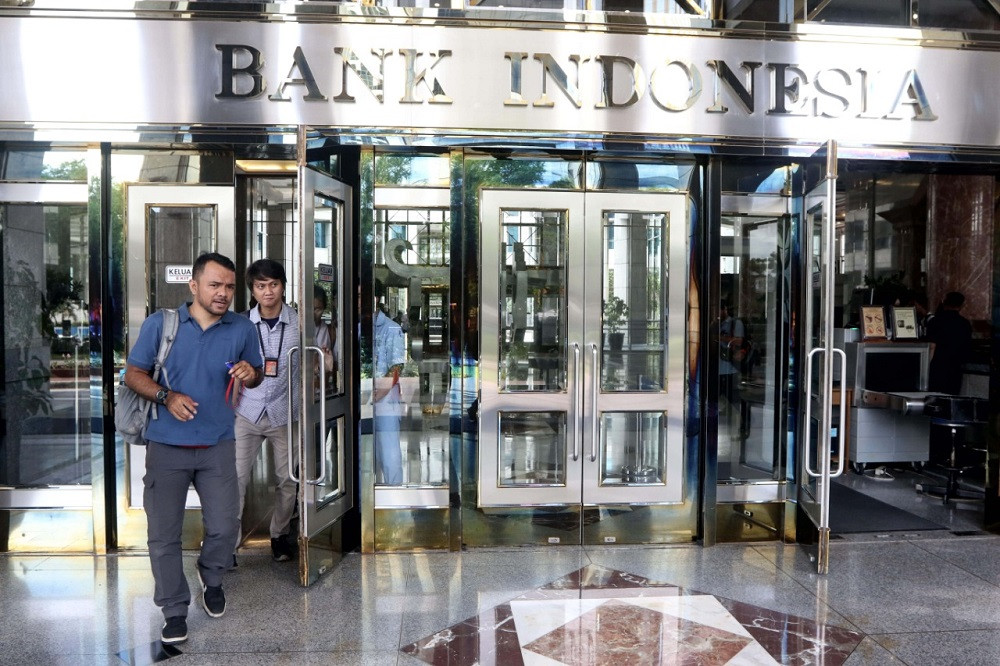
ank Indonesia (BI) has put into effect minimum initial capital requirements for payment system providers in order to tighten control over the country's burgeoning financial technology (fintech) companies.
The central bank announced on Wednesday the issuance of two derivative regulations of BI Regulation No. 23/2021 that officially impose such requirements on payment service providers (PJP) and payment system infrastructure providers (PIP). The regulations came into effect on July 1.
The PJP category includes e-wallets, such as ShopeePay, GoPay and OVO, payment gateway providers such as Midtrans and Cashlez, and other non-bank financial institutions. Meanwhile, the PIP includes switching companies such as ATM Bersama and ALTO.
Read also: Regulators, fintech companies work to balance innovation, regulation
The regulations require local switching companies to have at least Rp100 billion (US$6.92 million) in initial capital. Meanwhile, a PIP must have minimum initial capital ranging from Rp 500 million to Rp 15 billion depending on the variety of services offered.
“The more [service] permits they have, the bigger the capital requirement,” said BI financial systems surveillance head Budiatmaka at a press briefing about the new regulation on Wednesday.
“The bigger, more complex and more systematic their business activity, the more they will be treated like banks,” he reiterated.
Filianingsih Hendarta, head of BI’s macroprudential policy department, said the two derivative regulations kicked off the implementation of the central bank’s 2020-2025 Indonesia Payment Systems Blueprint.
“The blueprint balances between innovation and consumer protection, integrity and stability, as well as healthy competition,” she said, also on Wednesday.
Read also: Indonesian economy 2021: Maintaining stability towards recovery
BI has registered 190 PIP consisting of nine infrastructure providers and 181 PJP.
Indonesia Payment System Association (ASPI) chairman Santoso Liem stated that the new regulations applied to both banks and non-bank institutions but that the former already had minimal core capital requirements set by the Financial Services Authority (OJK).
“This means that the obligation to fulfill the minimum capital has more impact on non-bank institutions, which have relatively smaller capital,” Santoso said, as reported by Kontan.co.id on Friday.