TheJakartaPost
Please Update your browser
Your browser is out of date, and may not be compatible with our website. A list of the most popular web browsers can be found below.
Just click on the icons to get to the download page.


Popular Reads
Top Results
No results found. Please check your search term and try again
Can't find what you're looking for?
View all search results
Popular Reads
Top Results
No results found. Please check your search term and try again
Can't find what you're looking for?
View all search resultsState banks offer solar panel loans to boost adoption
The loans are intended to offset the upfront costs of installing rooftop solar panels and to help meet government renewable energy targets.
Change text size
Gift Premium Articles
to Anyone
Share the best of The Jakarta Post with friends, family, or colleagues. As a subscriber, you can gift 3 to 5 articles each month that anyone can read—no subscription needed!
S
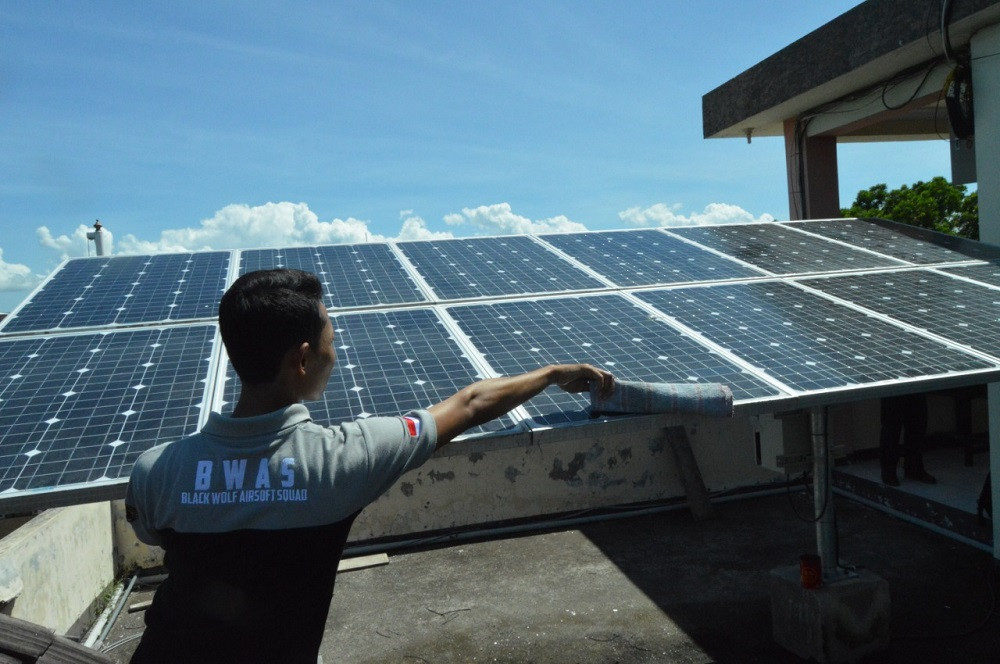
tate-owned banks have launched several special financing schemes for rooftop photovoltaic (PV) panels this year to help the government achieve its renewable energy targets.
Bank Mandiri, Bank Rakyat Indonesia (BRI) and Bank Negara Indonesia (BNI), which are among the country’s five biggest banks, launched their respective financing schemes between January and June. The loans are intended to reduce the upfront costs of installing solar panels.
Indonesia Solar Energy Association (AESI) chairman Fabby Tumiwa told The Jakarta Post on July 13 that residential rooftop solar panel use had increased from about 200 to 3,000 households over the past three years.
“More affordable financial schemes will help spur this growth,” said Fabby, who is also the executive director of the Institute for Essential Services Reform (IESR), an energy think tank.
He added that such financing schemes would be best suited to middle-class households whose power capacities were over 2,200 volt-amperes (VA) and whose monthly power bills were over Rp 700,000 (US$48.22).
Rooftop solar power could serve roughly 7 million households, he added, and was a potentially lucrative market.
The government expects solar power, one of the world’s fastest growing renewable energy technologies, to lead the way to achieving at least 23 percent renewable energy in the country by 2025 and at least 31 percent by 2050, as dictated by the National General Energy Planning (RUEN) road map.
Read also: Ministry mulls retiring giant Suralaya coal plant, replacing it with solar farm
In 2017, the AESI, the Energy and Mineral Resources Ministry, the Industry Ministry, the Indonesian Renewable Energy Society (METI) and several other organizations launched a separate initiative to have 1 million Indonesian households with rooftop solar panels by 2025.
Bank Mandiri, the country’s largest bank by asset value, launched a program in May that offers Greater Jakarta residents solar panel loan packages that range from a Rp 20 million loan for a 1 kilowatt peak (kWp) PV unit to a Rp 70 million loan for a 5 kWp unit.
The loans are being offered in collaboration with the National Energy Council (DEN) and state-owned electronics manufacturer PT LEN Industri.
“Indonesia’s solar panel market has quite a lot of potential. Moreover, the use of solar cells is a form of long-term investment for households, as it allows customers to obtain energy sources that are more prudent and efficient,” said Bank Mandiri Corporate Secretary Rudi As Aturridha on Wednesday.
Read also: Indonesia’s huge solar power potential still going to waste
BRI, the country’s second-largest bank by asset value, launched a similar program in January in collaboration with DEN and LEN Industri. The lender offers a solar panel loan with a duration of up to 15 years and an interest rate of around 0.92 percent.
BRI corporate secretary Aestika Oryza Gunarto said on July 14 that the scheme would be implemented through the Briguna credit program, wherein the bank deducts loan installments from borrowers’ payrolls.
“BRI projects an increase in interest income from Briguna loans in the rooftop solar power plants market, in line with the development of similar collaborations with other companies that are using BRI payroll,” he said.
BNI launched its own solar panel loan program in June in partnership with publicly listed solar panel producer PT Sky Energi Indonesia.
The state-owned lenders’ programs were only preceded by Singapore-based private lender UOB Indonesia, which launched its U-Solar financing scheme in November 2019 in partnership with PT Selaras Daya Utama and TML Energy. The U-Solar program is offered throughout Southeast Asia.
Energy Ministry renewables director general Dadan Kusdiana said on April 15 that the government aimed to have 2.14 GW of solar power capacity installed by 2030, 648.7 MW of which would be installed at households, 742 MW at state-owned enterprises and 624.2 MW in industries and business.
“We are optimistic that the addition of new PV cells can reduce greenhouse gas emissions by 3.2 million tons of carbon dioxide equivalent,” he said.