TheJakartaPost
Please Update your browser
Your browser is out of date, and may not be compatible with our website. A list of the most popular web browsers can be found below.
Just click on the icons to get to the download page.


Popular Reads
Top Results
No results found. Please check your search term and try again
Can't find what you're looking for?
View all search results
Popular Reads
Top Results
No results found. Please check your search term and try again
Can't find what you're looking for?
View all search resultsLack of competition lets food delivery giants take large cuts
While a latecomer has entered the market with a slightly lower commission, high fees charged by the biggest names in the business are deemed overly burdensome for merchants.
Change text size
Gift Premium Articles
to Anyone
Share the best of The Jakarta Post with friends, family, or colleagues. As a subscriber, you can gift 3 to 5 articles each month that anyone can read—no subscription needed!
A
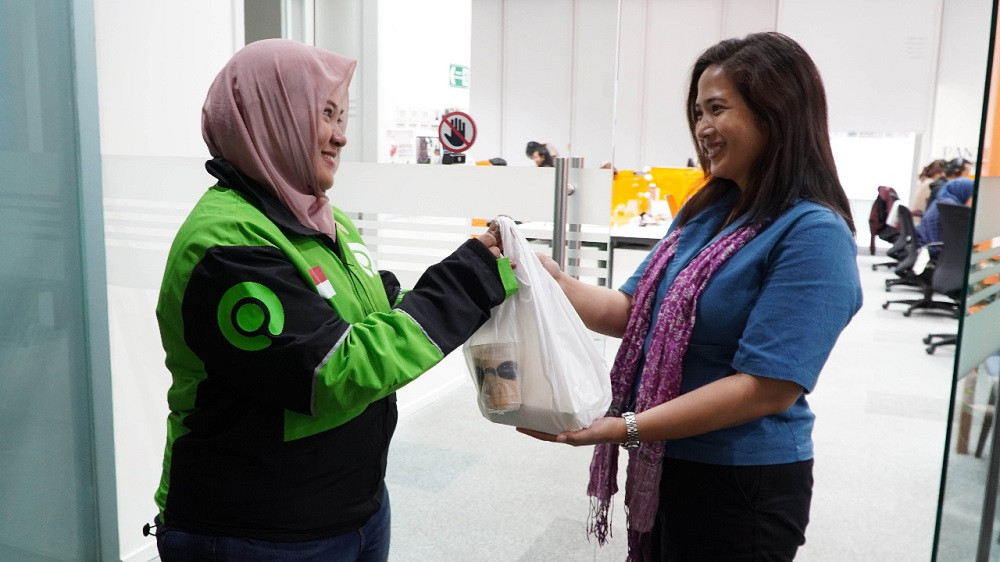
lack of competition has been blamed for helping food delivery companies charge high fees, hurting micro, small and medium enterprises (MSME) that rely on such platforms.
Ride-hailing and financial services company Gojek, a subsidiary of tech giant GoTo, charges 20 percent with an additional Rp 1,000 (7 US cents) for every transaction on GoFood, its food delivery platform.
GrabFood, the food delivery service of ride-hailing company Grab, takes 30 percent in commission for every transaction.
“When fees are relatively high, there should be new players offering lower fees. That is the case in a market with healthy competition, but because the competition tends to lead to an oligopoly, it is very hard to bring down the fees,” Bhima Yudistira, an economist at the Institute of Development for Economics and Finance (Indef), told The Jakarta Post in a phone interview on Tuesday.
Indonesia’s food delivery service market was estimated at US$3.7 billion in 2020, larger than those of neighboring Thailand, Singapore, Malaysia, the Philippines and Vietnam, according to Momentum Works. Grab accounted for 53 percent of that and Gojek for 47 percent.
Read also: Indonesia’s $3.7b food delivery market largest in region
The market previously had another major player, Berlin-based Foodpanda, but tight competition with then-newcomers like GoFood forced it to close its business in Indonesia in late 2016, after operating since 2012 and partnering with thousands of restaurants.
E-commerce company Shopee recently joined the food delivery market by launching ShopeeFood. It charges 20 percent in commission, according to news agency Kontan.
Traveloka, the largest online travel start-up in Southeast Asia, also joined the market with Traveloka Eats. The travel company takes a more modest 15 percent cut from every transaction on its platform, according to news website Tech in Asia.
Bhima said charging high fees from merchants was in line with the increasing pressure on start-ups to generate profits, but he suggested that food delivery companies charge around 15 percent to alleviate the burden on merchants, especially small businesses. He also suggested different fees for large and small merchants.
The market entry of ShopeeFood and Traveloka Eats has brought the average fee down to around 21.25 percent from 25 percent when there were only GoFood and GrabFood.
Yet many still consider the fees too high. In Central Java, Surakarta Mayor Gibran Rakabuming Raka, the eldest son of President Joko “Jokowi” Widodo, asked Gojek to lower the fees imposed on GoFood merchants.
“In the long run, this will kill our MSMEs,” Gibran, who was a business owner himself, said at an event on Oct. 1. “This adds to the burden on our MSMEs.”
Around eight in 10 MSMEs use digital platforms, according to an online survey of 100 MSMEs conducted in May and June by research firm DS/innovate. Most of the businesses that were not on digital platforms cited a lack of understanding as the reason, but 12 percent said high costs kept them from using such services.
Read also: High e-commerce fees squeeze small F&B firms’ margins
Some 15 million MSMEs have joined online platforms following a marked increase as merchants sought to survive the coronavirus pandemic, according to the Cooperatives and SME Ministry. That figure is up from around 8 million in mid-2020 and accounts for 23 percent of all MSMEs.
A study from the Demography Institute of the University of Indonesia (UI) on GoTo Financial, which comprises GoPay and GoBiz, found that some three of five merchants were first-time users that had joined the platforms when the pandemic began.
The survey was conducted online in August and involved 7,355 consumers and merchants.
Around 70 percent of the surveyed MSMEs said they had chosen GoPay because many consumers used it, and 59 percent noted that many other businesses used it as well.
Given improvements in scale and efficiency, the Demography Institute estimated that the revenue of MSMEs using GoTo Financial’s services would grow by Rp 53.2 trillion or 37 percent this year.
MSME Association (Akumindo) chairman Ikhsan Ingratubun said small businesses had to raise their prices by 20 percent to cover the fees when joining food delivery platforms, although some businesses had begun to join new platforms that charged less.
Ikhsan added that selling through social media platforms like Instagram could help MSMEs avoid high fees and thus, maintain their prices.
“Whether we like it or not, we have to raise prices if we enter marketplaces,” Ikhsan told the Post in a phone interview on Tuesday.