TheJakartaPost
Please Update your browser
Your browser is out of date, and may not be compatible with our website. A list of the most popular web browsers can be found below.
Just click on the icons to get to the download page.


Popular Reads
Top Results
No results found. Please check your search term and try again
Can't find what you're looking for?
View all search results
Popular Reads
Top Results
No results found. Please check your search term and try again
Can't find what you're looking for?
View all search resultsJokowi names four new national heroes
President Joko “Jokowi” Widodo posthumously bestowed the title of national hero on four historical figures – the father of Indonesian cinema, a sultan, a king and an ancestor of the current vice president – in commemoration of Heroes Day.
Change text size
Gift Premium Articles
to Anyone
Share the best of The Jakarta Post with friends, family, or colleagues. As a subscriber, you can gift 3 to 5 articles each month that anyone can read—no subscription needed!
P
resident Joko “Jokowi” Widodo posthumously bestowed the title of national hero on four Indonesian historical figures on Wednesday in commemoration of Heroes Day.
As part of annual celebrations held every Nov. 10, the government has made it an ongoing tradition to reach into the nation’s rich tapestry of history and prehistory to recognize figures who were influential in the building of the nation and its political and sociocultural makeup.
This year, Jokowi reached across centuries to honor West Sumatra’s Usmar Ismail, the father of Indonesian cinema, as well as one of three founders of Tangerang, a king and a sultan, with the latter two coming from regions whose leaders have yet to be recognized as national heroes.
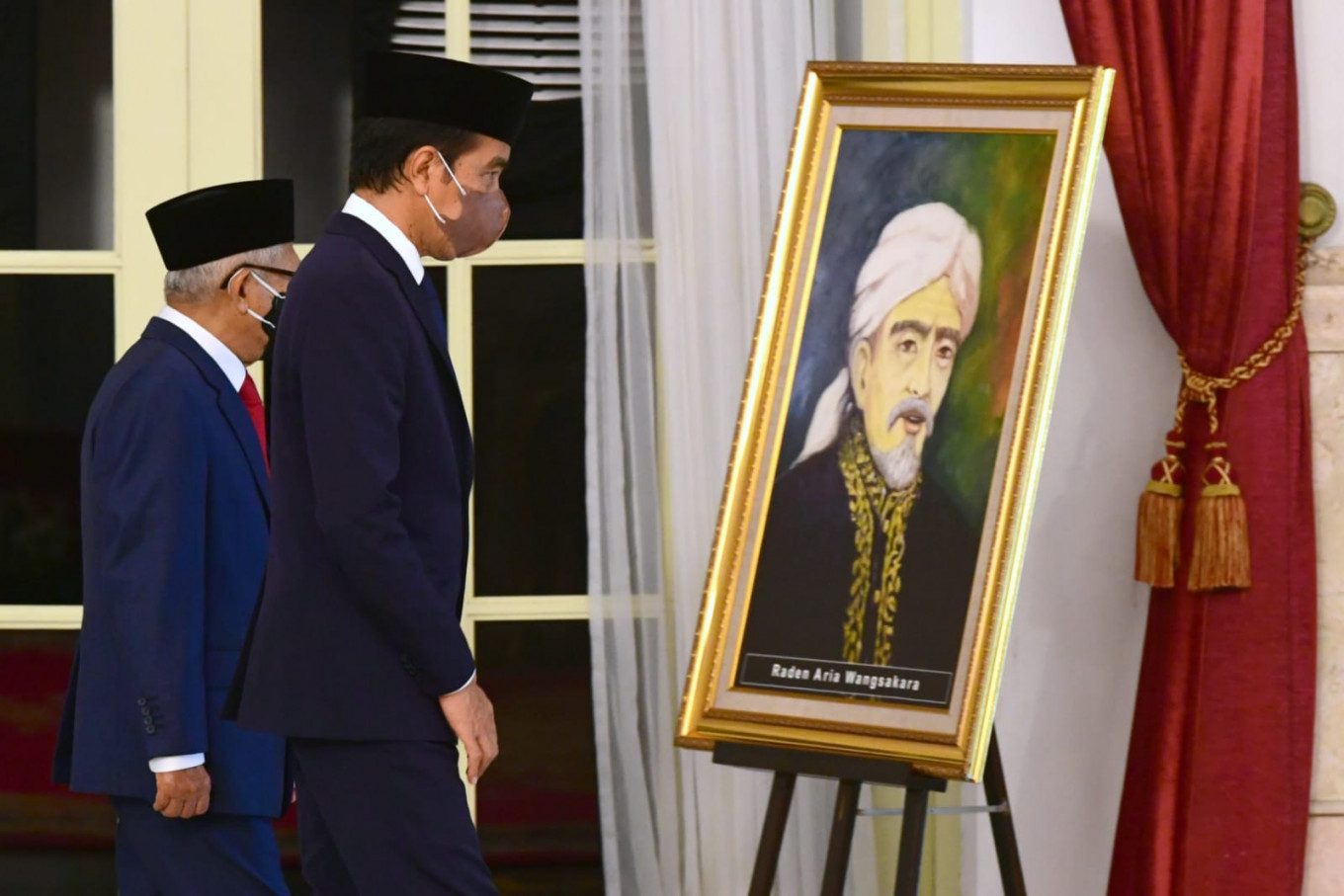
Besides Usmar, the President also recognized Banten revolutionary Raden Aria Wangsakara, King Tombolotutu from Central Sulawesi and Sultan Aji Muhammad Idris from Kutai Kartanegara, the oldest kingdom in Indonesia that is based on the site of modern day East Kalimantan.
Their inclusion among the ranks of national heroes, based on a decree issued on Oct. 25, was formalized at the State Palace on Wednesday in a ceremony led by presidential military secretary Air Vice Marshal Tony Harjono.
“While they have all passed, their service in the struggle, defense and exercise of independence, as well as their efforts to keep the nation united and intact, will forever be remembered,” Jokowi said on an official Instagram post.
Read also: On Heroes Day, Jokowi calls for spirit of heroism in COVID-19 battle
Across the ages
Born in Bukittinggi, West Sumatra, Usmar forged a career as a prolific director, making more than 30 films over the course of his life. His 1950 production, Darah dan Doa (The Long March of Siliwangi), was the first film made by a local director after the country became independent.
The first day of shooting of the film, which was March 30, is now officially celebrated as National Film Day. He also established the Indonesian National Theater Academy (ATNI) in 1955, the first arts institution in Jakarta.
Usmar passed away on Jan. 2, 1971 at the age of 49.
According to ancient scriptures chronicling the history of Tangerang and the Banten sultanate, Aria Wangsakara was one of three Islamic scholars sent by Banten in the 1600s to mount a defense against the Dutch East India Company (VOC) from a stronghold on the banks of the Cisadane River, Kompas daily reports. He played a big part in spreading Islam in the area and would go on to become the first regent of prehistoric Tangerang. Vice President Ma’ruf Amin is a descendant of Wangsakara.
Tombolotutu, a 19th century king of Parigi Moutong, was known for his role in the fight against Dutch colonial rule in the fortress town of Parigi. He died in 1901, exactly 44 years prior to Indonesia's declaration of independence. The current regent of Parigi Moutong, retired infantry colonel Samsurizal Tombolotutu, is a known descendant.
Aji Muhammad Idris, who ruled Kutai Kartanegara ing Martadipura from 1735 until his death in 1739, was the first ruler in the history of the sultanate to use an Islam-inflected name. In league with a relative in Wajo, South Sulawesi, he fought alongside the Buginese people to thwart VOC rule, according to records of the regency administration.
Read also: Jokowi honors fallen medical workers ahead of Independence Day
Modern-day heroes
As he did last year, the President also awarded medals of honor to frontline health workers who died in the fight against COVID-19.
The honors were awarded to a total of 300 recipients but represented by three fallen figures. I Ketut Surya Negara, a doctor at Sanglah General Hospital in Denpasar, Bali, received the Bintang Jasa Pratama, the second rank of the Bintang Jasa honor; Sicilia Indah, a nurse at Dr. Sitanala General Hospital in Tangerang, Banten, also received the Bintang Jasa Pratama on behalf of 221 other recipients; while Emialoina Lasia Carolin, a midwife at the Pesanggrahan community health center in Jakarta; received the Bintang Jasa Nararya, the third class of the honors, on behalf of 76 other recipients.
All the honors were awarded to the heirs and family members of the newly named national heroes as well as representatives of the Bintang Jasa recipients, in a ceremony held under strict health protocols, according to the Presidential Secretariat’s Press Bureau.
The award ceremony capped Jokowi’s Heroes Day activities, which began early in the morning with a customary visit to the Kalibata Heroes Cemetery, accompanied by Vice President Ma’ruf, Religious Affairs Minister Yaqut Cholil Qoumas, Social Affairs Minister Tri Rismaharini and House of Representatives Speaker Puan Maharani.
During the visit to Kalibata, the President paid respects to various national figures entombed there, including the late president BJ Habibie and his wife Ainun, the late husband of former president Megawati Soekarnoputri, Taufik Kiemas, and Ani Yudhoyono, the late wife of former president Susilo Bambang Yudhoyono.
The presidential entourage also visited the graves of other former senior government officials, such as Umar Wirahadikusumah, Soedharmono and Adam Malik.