TheJakartaPost
Please Update your browser
Your browser is out of date, and may not be compatible with our website. A list of the most popular web browsers can be found below.
Just click on the icons to get to the download page.


Popular Reads
Top Results
No results found. Please check your search term and try again
Can't find what you're looking for?
View all search results
Popular Reads
Top Results
No results found. Please check your search term and try again
Can't find what you're looking for?
View all search resultsNew documentary shows heartbreaking impact of deforestation
The Flame shows the environmental, human and sociopolitical impact of Indonesia’s constant deforestation
Change text size
Gift Premium Articles
to Anyone
Share the best of The Jakarta Post with friends, family, or colleagues. As a subscriber, you can gift 3 to 5 articles each month that anyone can read—no subscription needed!
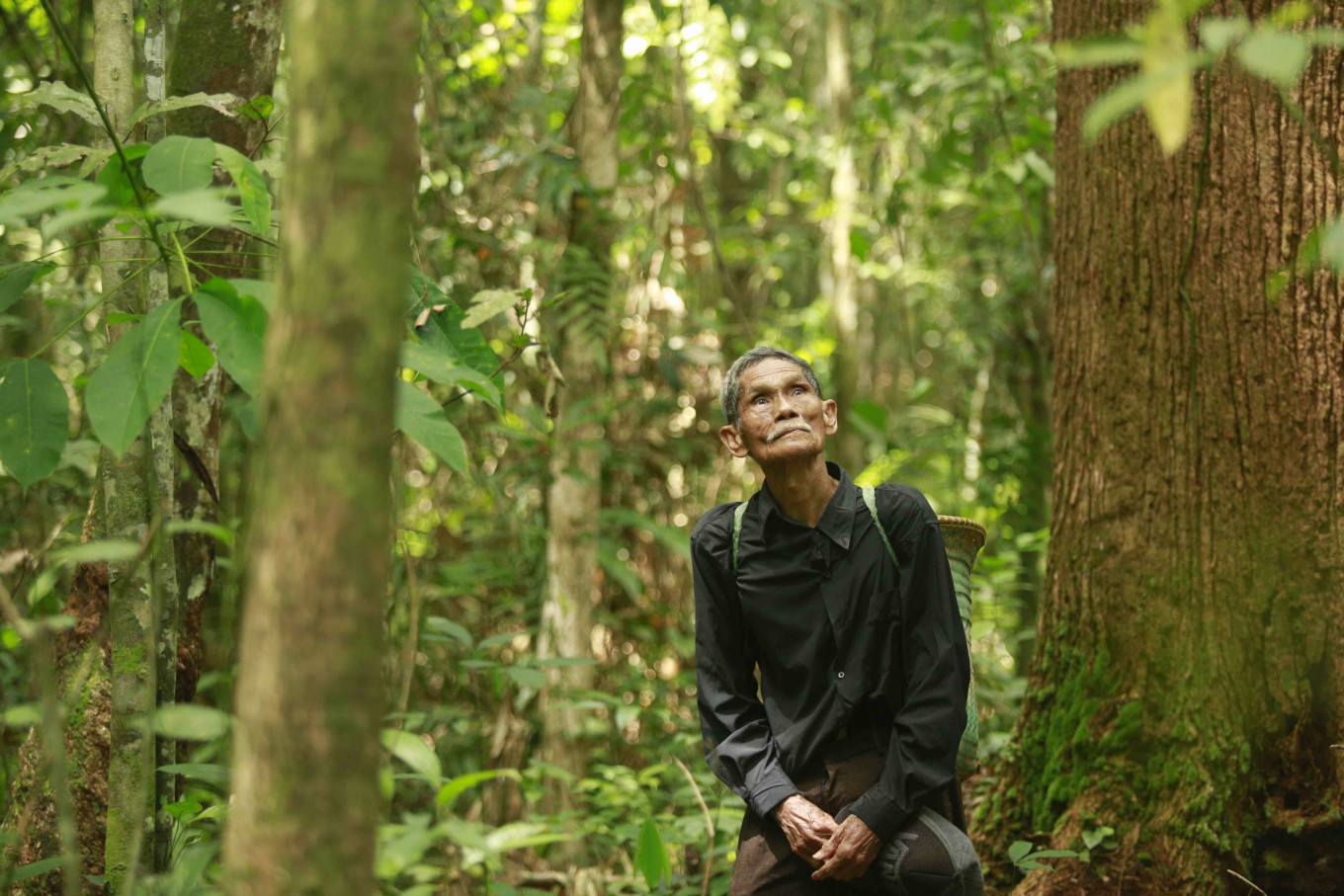
The Flame focuses on the environmental, human and sociopolitical impact of Indonesia’s constant deforestation
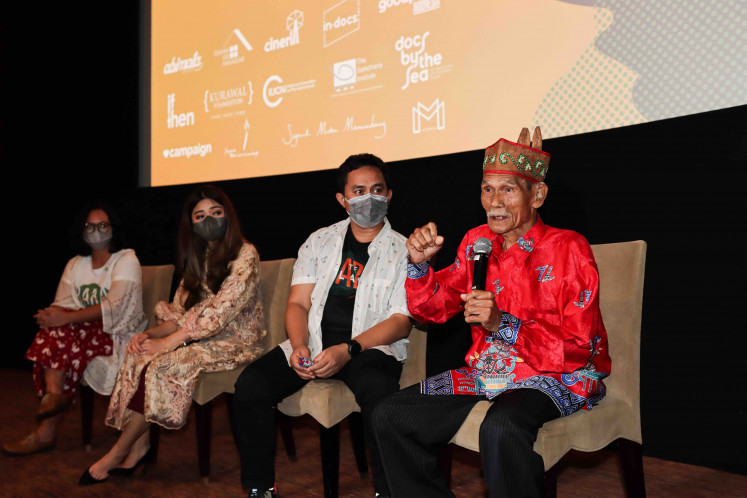
A documentary by director Arfan Sabran and producer Gita Fara, Bara (The Flame), which premiered in April this year in Switzerland, has finally made its way to local screens. At a special screening on Monday at Plaza Indonesia, Central Jakarta, Arfan said the film’s production was a long and arduous process.
“We shot in between huge forest fires and smog. It was very hard to manage the production,” he said.
The Flame follows a 77-year-old native Dayak man, Iber Djamal, during his legal battle against corporations and authorities in obtaining the rights to preserve the remaining customary forests surrounding his village on Barasak Island, Kalimantan.
Customary forests are jungles that are considered to belong to their surrounding indigenous communities.
The one-hour documentary shows how the wilderness of tropical Kalimantan forest is far less deadly than the thorny bureaucratic jungle Iber had to go through in order to preserve his people’s land and culture. The film shows scenes of Iber running through the piles of paperwork, sometimes deterred but always passionate. It also showcases footage of him walking through the lush forest – at least what’s left of it.
Iber, who met Arfan for the first time in 2014, said he was proud and happy to have his struggles documented and shown to the world.
“I am very proud. My experience is very [limited], but [my story] can be screened to such a large audience. I wish this little story of mine can bring benefit to the world,” Iber, who wore a striking red traditional Dayak costume, said.
The Flame was created in collaboration between Abimata Group, Cineria Film, RM Cine Makassar and Al Jazeera Documentary Channel. The film shows the importance of customary forests, which do not only provide financial benefits, but are also crucial for the sustenance of indigenous people. Throughout the film, Iber shows that customary forests hold the symbols of life, balance and wisdom for his family and community.
Aside from its premier at Visions du Réel Film Festival in Switzerland in April, it was screened at DMZ Documentary Film Festival in Korea in September, Bozcaada International Festival of Ecological Documentary (Bifed) in Turkey in October, Singapore International Film Festival in November and at the Jogja NETPAC Asian Film Festival (JAFF) also in November.
“We hope the documentary film can open people’s eyes on social issues, especially around customary forests, and can encourage them to initiate actions to protect and preserve Indonesian customary forests,” Arfan said.
Lingering effect
Iber Djamal and his community have witnessed two decades of ecological disasters caused by deforestation. One million hectares of Kalimantan rainforest, including areas familiar to him, were destroyed for the Mega Rice Project, a food estate program initiated by President Soeharto’s administration in the mid 90s before being abandoned due to the havoc it wreaked on the environment.
Barasak Island is the last forest area in Pilang village, Central Kalimantan. This is where Iber resides.
In order to preserve the forest’s biodiversity and its people’s culture, Iber has to obtain government recognition of the status of Barasak Island as a customary forest. His tireless efforts include going through the complicated bureaucracy and collecting the seemingly endless documents required by the government to file his complaints. All of these were done in between witnessing forest fires and smog disasters that literally cloud the villages, causing disruption and economic loss for many neighboring countries and extensive diplomatic tensions.
On The Flame’s official website, Arfan writes of Iber’s plight: “Iber is one among the thousands of victims of Indonesia’s Mega Rice Project [...] He always cries when I ask about the Mega Rice Project, but is also thinking about what will happen to the forest in the future, especially if we do not take action. I respect him because he has never given up, even with his declining health.”
The Mega Rice Project saw the deforestation of 1 million hectares of Kalimantan forest in 1996, with the goal to turn peat swamp forest into rice paddies. Although the government invested heavily in constructing irrigation canals and removing trees, the project was eventually abandoned after it failed to deliver the expected harvest as the peatland later proved not to be suitable for cultivating rice.
The project has caused a large amount of destruction to the environment, dropping forest cover from 64.8 percent in 1991 to only 45.7 percent in 2000. Clearance issues remain, with almost all of the marketable trees having now been removed from the areas covered by the project.
Drying peatlands are also vulnerable to fires, causing smog to blanket surrounding areas and beyond, even reaching Singapore and Malaysia. Peat swamp forest destruction has also resulted in sulphuric acid pollution within the surrounding rivers. Abandoned canals discharge acidic water during the rainy season, a possible cause of the smaller fish catches.
The documentary shows footage of Iber trying to put out the blazing forest fire using his bare hands.
Ironically, 1996’s blueprint of epic failure is about to be repeated by President Joko “Jokowi” Widodo’s Food Estate program. The administration is eyeing rainforests in Papua, Kalimantan and Sumatra to turn into fields. Only in Central Kalimantan, the project will cut trees in 32,000 hectares of pristine rainforest. In total, the government is planning an ambitious goal to turn 1 million hectares of rainforest scattered across the Indonesian archipelago into fields to grow rice, cassava and other tuber plants.
For the people living in the area, such plans seem outlandish. The documentary shows many scenes of Iber talking to his grandson about the importance of maintaining the rainforest. The child, looking critical and curious, asks a lot of questions about trees, orangutans and other biodiversity within the rainforest.
Indonesian rainforests are already vulnerable to rapid deforestation due to weak controlling policies that allow corporations to turn forests into oil plantations and timber logging areas, despite the common knowledge that deforestation spells doom for the indigeneous people’s life and culture. Experts and journalists have warned the government that deforestation destroys biodiversity, especially endangered animals such as orangutans. Deforestation is also frowned upon by the global community amid the impending threat of global warming.
People residing in Kalimantan have already been impacted by human-caused ecological damage. At the start of the rainy season this year, Kalimantan suffered frequent deluges caused by the massive deforestation on the island. Wild animals such as pythons, elephants and orangutans are often seen roaming human settlements as their natural habitat has been destroyed.
Arfan said that with this documentary he hoped to urge authorities to create wiser policies to save Indonesia’s indigenous forests and their biodiversity.
“Iber's family is a part of us, a part of Kalimantan. If Kalimantan is not saved, it will have a domino effect on the balance of the world. Deforestation has led to soil erosion, massive forest fires and climate change. It is a fight we must win, in order to save the future.”