TheJakartaPost
Please Update your browser
Your browser is out of date, and may not be compatible with our website. A list of the most popular web browsers can be found below.
Just click on the icons to get to the download page.


Popular Reads
Top Results
No results found. Please check your search term and try again
Can't find what you're looking for?
View all search results
Popular Reads
Top Results
No results found. Please check your search term and try again
Can't find what you're looking for?
View all search resultsAt NU congress, Jokowi’s plaudits highlight growing rift
Nahdlatul Ulama has grown increasingly close to the government, sparking concerns from within the group that it is violating its longstanding principle of political neutrality.
Change text size
Gift Premium Articles
to Anyone
Share the best of The Jakarta Post with friends, family, or colleagues. As a subscriber, you can gift 3 to 5 articles each month that anyone can read—no subscription needed!
N
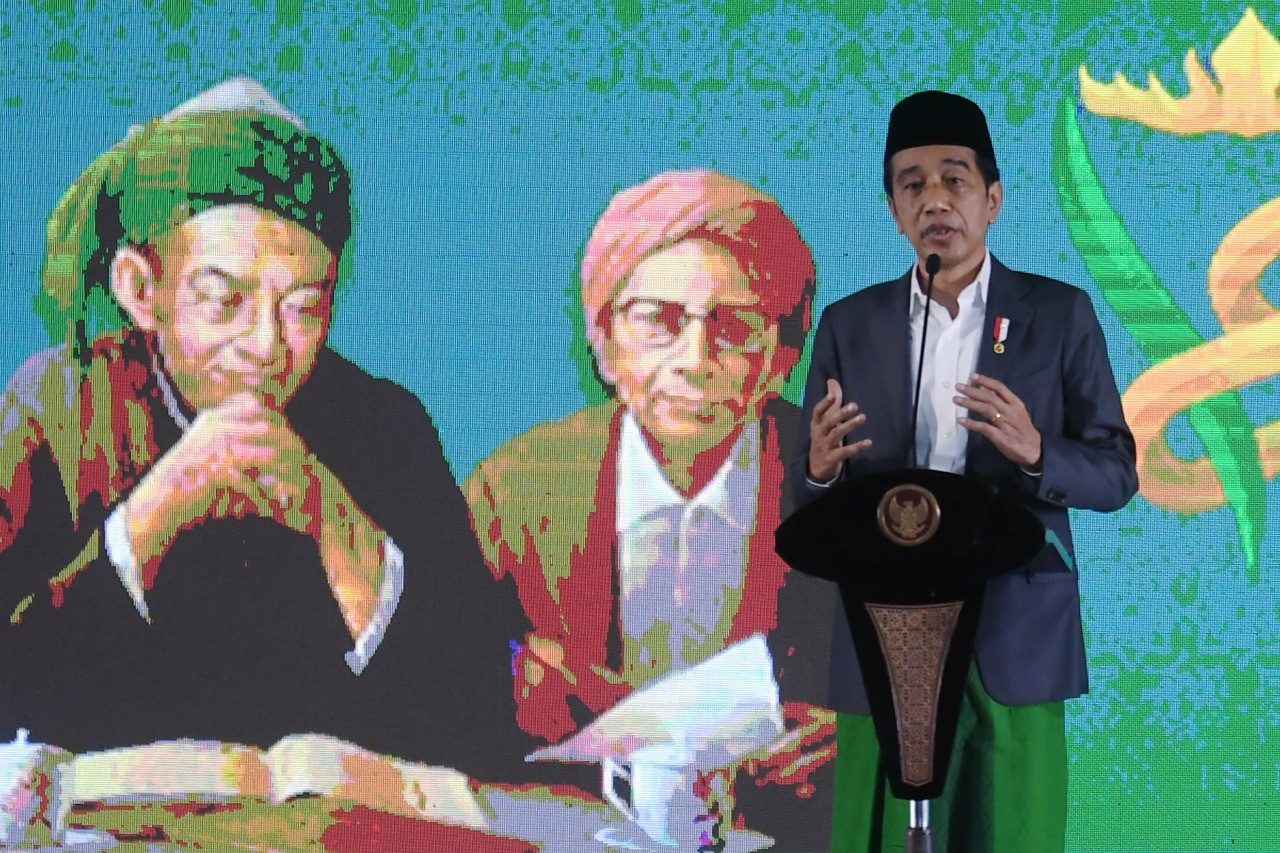
ahdlatul Ulama (NU) opened its 34th muktamar (national congress) on Wednesday with words of praise from President Joko “Jokowi” Widodo as he thanked the nation’s largest grassroots Muslim organization for its large role in supporting government initiatives.
The congress was held in Lampung after a year-long delay and a politically charged tussle over the date the congress would be held following developments in the country’s COVID-19 situation. The event foregrounds a chairmanship race that observers say could entrench the group further in national politics.
The muktamar, the organization’s most important gathering, is traditionally held every five years to elect new leadership and address national issues.
In his opening remarks at the Daarussa'adah pesantren (Islamic boarding school), Jokowi lauded the organization for helping guide Indonesia’s Muslim community through the pandemic, highlighting its crucial role in persuading Muslims to adhere to health protocols and take part in the national COVID-19 vaccination program.
“On behalf of the government […] on behalf of the people [and] the state, I express my gratitude and great respect to Nahdlatul Ulama for helping the government comfort the public and the community during the pandemic," the President said.
He also thanked NU for safeguarding tolerance and pluralism, the state ideology Pancasila and the 1945 Constitution, as well as supporting “unity in diversity” in the country.
“We hope we can continue to protect and care for the country and the nation we love,” he added.
The organization has enjoyed close political connections to the government, particularly after Jokowi chose NU’s former leader, Ma’ruf Amin, as his running mate in the 2019 presidential election. The group was also instrumental in suppressing radical voices among Indonesian Muslims as the Islamic State (IS) gained influence in the mid-2010s.
NU general chairman Said Aqil Siradj, who is seeking reelection, took particular note of the President’s choice of attire – a grey suit, a green sarong and a black peci cap.
“We are rich in symbols, including those worn by the President today – the peci and sarong – the symbols of Nusantara Islam,” said the senior Islamic scholar, referring to the brand of moderate Islam he began promoting in 2015 to help the government push back against rising extremism.
He also said NU would continue to promote religious moderation to strengthen the nation’s integrity.
“Those who do not understand NU's attitude toward [Hizbut Tahrir Indonesia] and the [Islam Defenders Front] perhaps do not understand how heavy the mandate of moderating the extreme poles is in this country," he said.
Said is vying for the NU leadership against Yahya Cholil Staquf, the older brother of Religious Affairs Minister Yaqut Cholil Qoumas, among other NU candidates.
The group is expected to appoint its new leader on Thursday evening.
Said Aqil has been credited with institutionalizing Islam Nusantara as NU’s official ideology during his decade-long tenure in the organization,.
This vision of Islam formalizes the moderate Islamic customs, traditions and principles advocated by the late Abdurrahman Wahid, the group’s long-serving leader and a former president, who promoted them within the organization after becoming NU chairman in 1984.
Framed as the antidote to a perceived increase in religious conservatism in the country, the concept has received strong endorsement from Jokowi.
More concessions
But this recognition from a largely practical and economically minded president could have unintended consequences for the grassroots group, which has, in recent decades, strived to stay apolitical.
In his remarks, Jokowi openly offered agricultural, mining and forestry concessions to NU youth and students, sparking debate over the organization’s place in national politics.
“I see that the potential within NU is there. It's just a matter of weaving it together. There are many technology-related [businesses], and there are a lot of tech-savvy people in NU," said the President.
NU’s head of economic empowerment, H. Eman Suryawan, welcomed Jokowi’s offer, hinting that it might be something the incoming NU leader would consider.
“The President’s offer is in line with the idea of NU’s independence. This must be welcomed with better organizational preparedness and mature leadership,” Eman said in a statement.
A similar sentiment was expressed by the chairman of the NU executive council’s (PBNU) Agricultural Institute, Al Amin Nasution, who said that mature leadership would keep NU more focused going forward.
“NU's achievements as an organization over the past ten years have been very good. Coupled with the President's offer, NU will definitely become more independent going forward," he said.
Back to nonpartisanship?
But the close alliance between the Jokowi administration and NU is also facing increased criticism.
Factions within NU are concerned that its close alignment with the government violates the principle of political neutrality established by Wahid during the organization’s 1984 muktamar in Situbondo, East Java.
Experts say the alliance has limited NU’s ability to criticize the regime when it pursues policies that are not well-received by NU’s rank-and-file.
Azyumardi Azra, a noted Islamic scholar, said it would be hard for the organization to wean itself off of politics, given its long history and tradition in the political sphere.
Even so, he believed it was better for the group to maintain some measure of autonomy.
“NU should maintain its role as a critical partner of the government,” Azyumardi told The Jakarta Post on Wednesday.