TheJakartaPost
Please Update your browser
Your browser is out of date, and may not be compatible with our website. A list of the most popular web browsers can be found below.
Just click on the icons to get to the download page.


Popular Reads
Top Results
No results found. Please check your search term and try again
Can't find what you're looking for?
View all search results
Popular Reads
Top Results
No results found. Please check your search term and try again
Can't find what you're looking for?
View all search resultsGlowing with ‘jamu’: Skincare brands rely on traditional recipes
Change text size
Gift Premium Articles
to Anyone
Share the best of The Jakarta Post with friends, family, or colleagues. As a subscriber, you can gift 3 to 5 articles each month that anyone can read—no subscription needed!
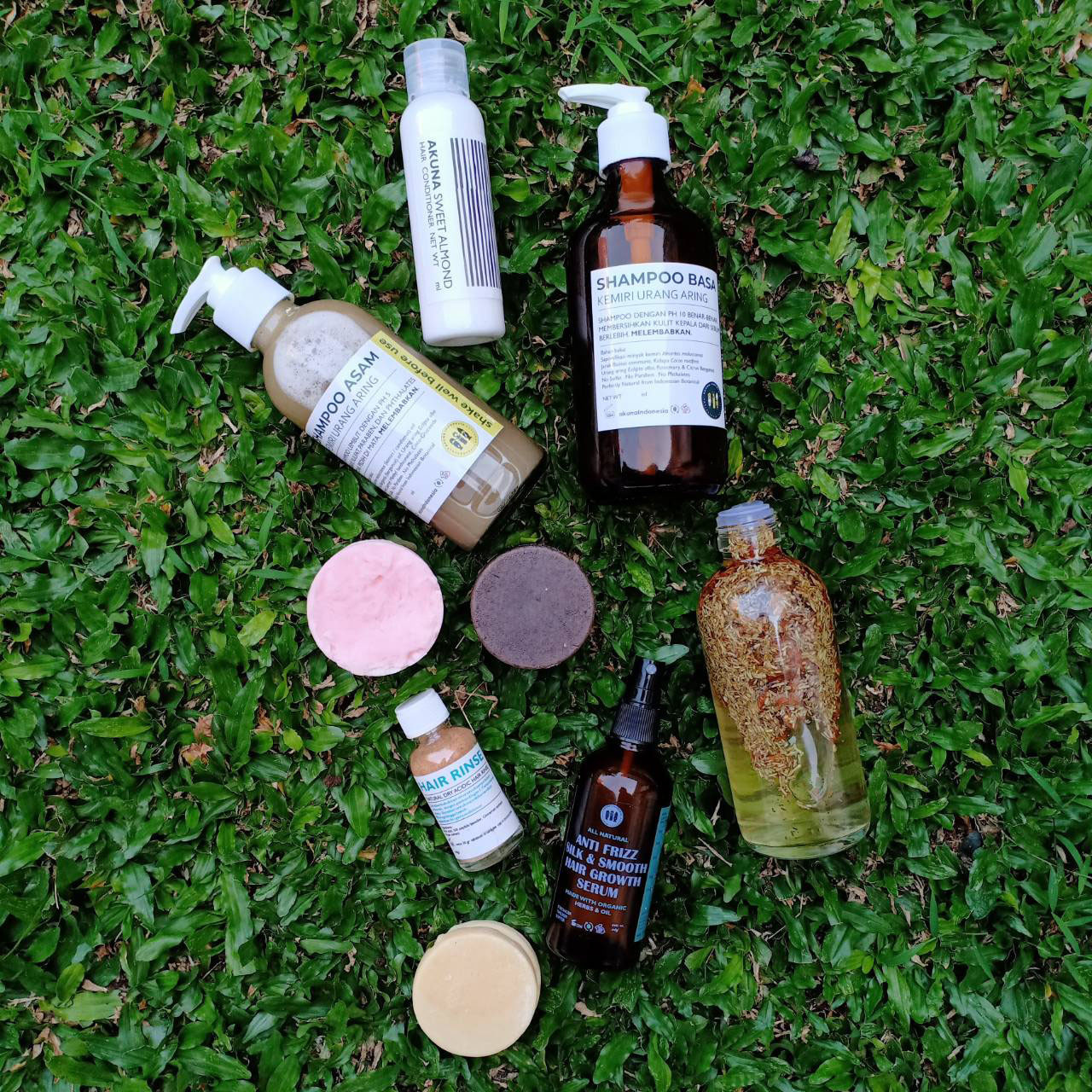
Companies like Juara Skincare and Akuna Indonesia have brought the traditional medicine jamu to modern skin treatments.
Indonesians have long scrubbed their skins with natural jamu concoctions in the pursuit of beauty and vigor. Still, modern-day skincare enthusiasts tend to dismiss it due to its strong herbal smell, which may be unpleasant to those unaccustomed to it.
However, jamu doesn't have to smell that way, a fact that has inspired companies like Juara and Akuna Indonesia to repackage the ancient medicine with all-new scents and standardization.
Inspired by the multipurpose ingredients in jamu, Juara was established 15 years ago in New York by three friends: Metta Murdaya, Yoshiko Roth-Hidalgo and Jill Sung. It was, however, only in 2006 that Juara evolved into the award-winning, full-fledged brand it is known as today.
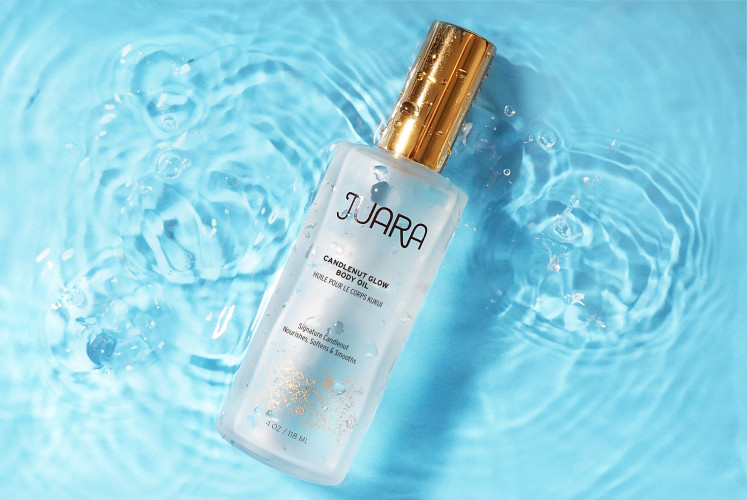
Some of its best-known products today are the Candlenut Body Creme as well as the Clove Flower and Turmeric Anti-Aging Serum.
"Candlenut oil — used extensively in Indonesia and Southeast Asia in cooking, traditional medicine and beauty treatments — is particularly high in Omega 3 and 6 essential fatty acids, which is vital for beautiful skin inside and out," said Fani Kunarinta, manager of marketing and sales at PT Juara Beauty Indonesia.
As for cloves, a plant native to the Maluku Islands, the plant’s flower has been traditionally used in spa treatments, such as boreh. It is believed to have the properties of brightening and evening skin tone "by inhibiting melanin synthesis in the skin" and is an ingredient in the company's anti-aging serum.
Another company, Akuna Indonesia, is celebrating its sixth year this month. It was created by two sisters from Yogyakarta, Wulan and Dina Hardjosoediro. The journey started when Wulan, now living in Jakarta, tried to treat her acne-prone skin.
"It used to be that acne would continue to appear if I didn't take medication from the doctor," said Wulan. When she tried to look for an alternative, it so happened that the family had been making their own shampoo and soap since the sisters were young — from which the sisters learned what herbal medicines were trusted by which regional tradition to treat which ailment. With that knowledge in hand, they tried to formulate their own.

"From there, we researched and tested [the formula] scientifically until we had 127 variants and subvariants of crafted body treats," said Wulan.
According to the sisters, the pandemic hasn't slowed down the company's sales. Its sunscreen and hair delicacies have been flying off the shelves.
"Our sunscreen is developed from candlenut oil, while our hair delicacies — including shampoo, conditioner, hair rinse and hair serum — are developed from various spices and flowers to provide an optimal treatment for the scalp to be free of irritation and hair loss," said Dina.
Natural, inclusive
Wulan and Dina believe that everyone deserves treatment tailored to their needs, especially when they live in a region like Indonesia, which is abundant in traditions and natural produce.
Kristyan Fideiyani, a 30-year-old civil servant from Jakarta, is one of many Indonesian women who require specific treatment for their skin.
"I have a condition that requires me to be selective and to avoid products that contain harmful chemicals, such as sodium lauryl sulfate and parabens, as much as possible," said Kristyan, who makes her own soap for personal use. "For shampoo, I haven't been in the mood to make it, so I just look for one that is suitable and natural."

Kristyan found Akuna through Instagram. According to her, while its products were satisfactory, it took her several tries to find the variant that suited her best.
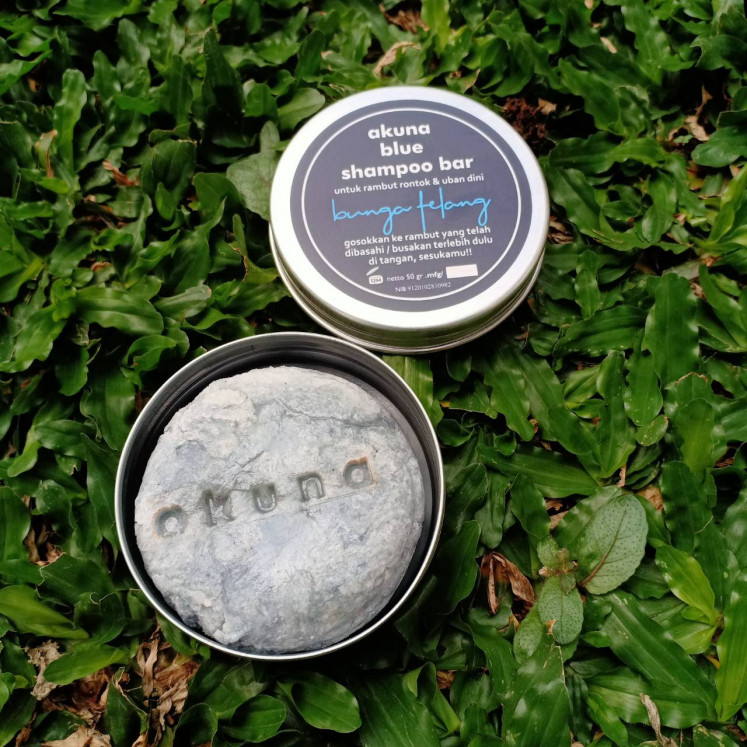
"Initially, I bought a package of four shampoos. The first and second shampoo didn't work for me, but the third shampoo suited my scalp and hair nicely. Fortunately, the [other shampoo bars] can also be used [as soap] so they don't go to waste."
On the other hand, Fadila Putri, a 29-year-old private employee from Bandung who still prefers her prescribed skincare due to hormonal acne problems, immediately hit it off from the first purchase.
"I'm trying to replace the hygiene products that I use every day with local products that are safe and natural. I chose Akuna because the price is affordable compared to similar products," said Fadila, who recently gained more awareness about the benefits of natural products.
"I often watch videos from Zaidul Akbar about the advantages of rhizomes, so I'm even more convinced that those from nature are better than synthetic," she said, referring to a famed doctor known for his Islamic approach to medicine.
From Indonesia, for Indonesia
The Juara team conducted various studies and received much help. It eventually sold its wholesale account to Apthorp Pharmacy on the Upper West Side of New York in February 2005.
The PETA-certified, cruelty-free brand continuously expands its research to improve current products and develop new products, including its recent Nourishing Body Oil and FDA-approved hand sanitizer.
For Akuna, these quality products didn't appear overnight, but the challenge is a bit different here in the home of jamu.
"The challenge lies in scientific testing because there are not many studies and published journal articles regarding herbal medicine. This means we really have to do our own research and tests for our products," said Wulan.
According to Inggrid Tania, chairwoman of the Indonesian Medical Association for the Development of Traditional Medicine, there have been quite a lot of entrepreneurs who have consulted with her about developing their own skincare lines from natural ingredients.
Inggrid, who is also a consultant for the Food and Drug Monitoring Agency (BPOM), said these kinds of skincare were categorized as thematic cosmetics — cosmetics that were based not only on natural Indonesian ingredients but also on traditions.
"[Our products have a lot of potential], such as temulawak [Javanese ginger] and temu kunci [fingerroot]. It was found that these roots have anti-aging and anti-acne properties due to their high antioxidant content. These two are popular commodities — primarily exported to South Korea to be used by their skincare industry," said Inggrid.
"We are born and raised in Indonesia, a tropical country, so the ingredients that are most suitable for us are usually the ones that grow here, in a tropical climate," Inggrid said.
Ingredients alone are not enough, however. According to Inggrid, entrepreneurs also require skills, knowledge and creativity to manufacture quality beauty products.
"If the method is incorrect or if the product is using additives or preservatives that are low in quality or exceeding the recommended amount, even if it is made from Indonesian ingredients, the product might end up irritating the consumer's skin," said the doctoral candidate in the philosophy of traditional medicine.
ohmg