TheJakartaPost
Please Update your browser
Your browser is out of date, and may not be compatible with our website. A list of the most popular web browsers can be found below.
Just click on the icons to get to the download page.


Popular Reads
Top Results
No results found. Please check your search term and try again
Can't find what you're looking for?
View all search results
Popular Reads
Top Results
No results found. Please check your search term and try again
Can't find what you're looking for?
View all search resultsCOVID-19 third wave takes hold in Jakarta
Government to focus on hospitalization in pandemic handling.
Change text size
Gift Premium Articles
to Anyone
Share the best of The Jakarta Post with friends, family, or colleagues. As a subscriber, you can gift 3 to 5 articles each month that anyone can read—no subscription needed!
A
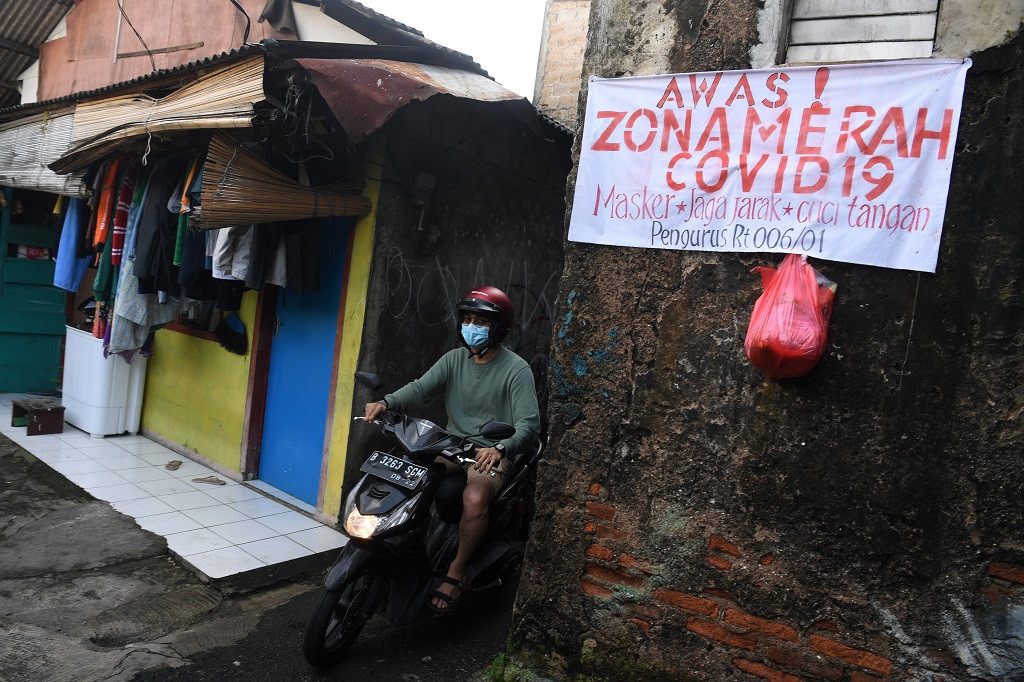
third wave of the coronavirus pandemic has begun to take hold across the country, with the Omicron variant of the virus believed to have driven a surge in cases and hospitalization in the capital, where more than 90 percent of the population has been vaccinated.
On Thursday, the country saw 8,077 new confirmed COVID-19 cases, the highest official daily caseload since August last year when the country was struggling to contain the Delta-induced second wave, which peaked at 56,757 cases a month earlier.
While studies have shown that Omicron is less virulent than its predecessors, experts have warned that the high transmissibility of the variant could lead to a spike in cases that could disastrously overwhelm the healthcare system.
Jakarta has seen an increase in hospitalization as cases begin to soar again, triggering calls for the government to tighten curbs and put a break on in-person education.
The capital’s COVID-19 bed occupancy rate (BOR) increased from 8 percent on Jan. 3 to 38 percent on Wednesday, according to the Health Ministry’s website. As the only province with a two-digit BOR, Jakarta has once again become the epicenter of the pandemic. The BOR at hospitals nationwide stood at 10 percent on Wednesday.
Despite its high vaccination rate, Jakarta has seen its number of active COVID-19 cases triple in the past week from 4,300 cases on Jan. 18 to 14,000 on Wednesday, with its daily cases increasing from 670 to 1,886 within the same period.
In recent days, new COVID-19 clusters have begun emerging in the capital, bringing back the collective memory of the early days of the first and second waves.
The Social Affairs Ministry building in Central Jakarta, for instance, has been put under lockdown until at least Jan.31 after 60 of its workers tested positive for the virus, while 90 schools in Jakarta have been closed after their students and teachers, who have just restarted in-person learning, contracted the virus.
Self-isolation
Health Minister Budi Gunadi Sadikin told a press conference on Thursday that he was confident that Indonesia would be able to control the third wave, arguing that Omicron, which is believed to be the culprit behind the surge, was milder and thus unlikely to overwhelm the nation’s healthcare system.
“The Omicron variant has higher transmissibility but a lower fatality rate, since most patients recover without needing to be hospitalized,” the minister said.
The Health Ministry has recorded 1,988 Omicron cases in the country since reporting its first case in mid-December. Of those cases, only 854 people were hospitalized, more than 90 percent of whom were either asymptomatic or showed mild symptoms.
An expert staffer at the Office of the Presidential Chief of Staff, meanwhile, released a statement asking asymptomatic COVID-19 patients to self-isolate at home, claiming that some Jakarta citizens have found it difficult to access hospital services. “The public should not panic. The [World Health Organization] has said that Omicron is milder than Delta. We only need to be proportionally cautious,” said Abraham Wirotomo.
Indonesia reported its first Omicron deaths last week. The victims were a woman who had just returned from the Netherlands and a man in South Tangerang, Banten.
It is unclear, however, how many new COVID-19 patients have lost their lives to the virus. The country reported 20 COVID-19 deaths on Tuesday, the highest since Nov. 12, 2021. The figure, however, fell to seven on Thursday, according to government data.
Budi said that the government would ensure that only those with moderate and severe symptoms would be hospitalized and that it would prioritize vulnerable people — the elderly, those with immunodeficiency and those who have yet to be vaccinated. Furthermore, he added, the government was still able to increase the number of hospital beds from 80,000 to 130,000, if deemed necessary.
The minister argued that for Omicron it was important to focus the national pandemic strategy on the hospitalization rates. “Going forward, we will focus our strategy based on hospitalization figures. Even if daily COVID-19 cases are now around 7,000, we will take into consideration how many of those are hospitalized,” he said.
Raising PPKM level
Zubairi Djoerban, the head of the COVID-19 task force at the Indonesian Medical Association (IDI), has called on the government to suspend in-person learning and raise the level of the public activity restrictions (PPKM), which currently remains at level 2.
“With daily infection cases soaring past 7,000 [as of Tuesday] and the positivity rate going past 10 percent, these are indicators that in-person learning is no longer safe,” Zubairi wrote on his Twitter account on Wednesday.
“Please consider calls to cancel the 100 percent in-person learning and raise the public activity restrictions [PPKM] level.”
While the government might be looking to allocate hospital beds to COVID-19 patients with severe symptoms going forward, Masdalina Pane of the Indonesian Epidemiologists Association (PAEI) said that some people might have little option but to isolate themselves in hospitals, even with mild symptoms, because their houses are not suitable for independent isolation.
She urged the government to mobilize neighborhood unit (RT) COVID-19 task forces to provide isolation centers, particularly for densely packed neighborhoods, in collaboration with Puskesmas (community health centers).
“These local task forces can repurpose unused buildings as independent isolation centers, with medical supervision from the medical workers at local Puskesmas. This way, people with only mild symptoms will not drive up the country’s BOR figures,” she told The Jakarta Post on Thursday. (ahw)