TheJakartaPost
Please Update your browser
Your browser is out of date, and may not be compatible with our website. A list of the most popular web browsers can be found below.
Just click on the icons to get to the download page.


Popular Reads
Top Results
No results found. Please check your search term and try again
Can't find what you're looking for?
View all search results
Popular Reads
Top Results
No results found. Please check your search term and try again
Can't find what you're looking for?
View all search resultsRI posts $718m budget surplus in Q1
State earnings reached Rp 484t driven by tax, nontax, custom and excise revenues.
Change text size
Gift Premium Articles
to Anyone
Share the best of The Jakarta Post with friends, family, or colleagues. As a subscriber, you can gift 3 to 5 articles each month that anyone can read—no subscription needed!
I
ndonesia recorded a budget surplus for the third month in a row in March supported by the improving domestic economy and rising commodity prices.
The state budget posted a Rp 10.3 trillion (US$718 million) surplus in the January-March period, in contrast with a Rp 143.7 trillion deficit in the same period last year, recent data from the Finance Ministry show.
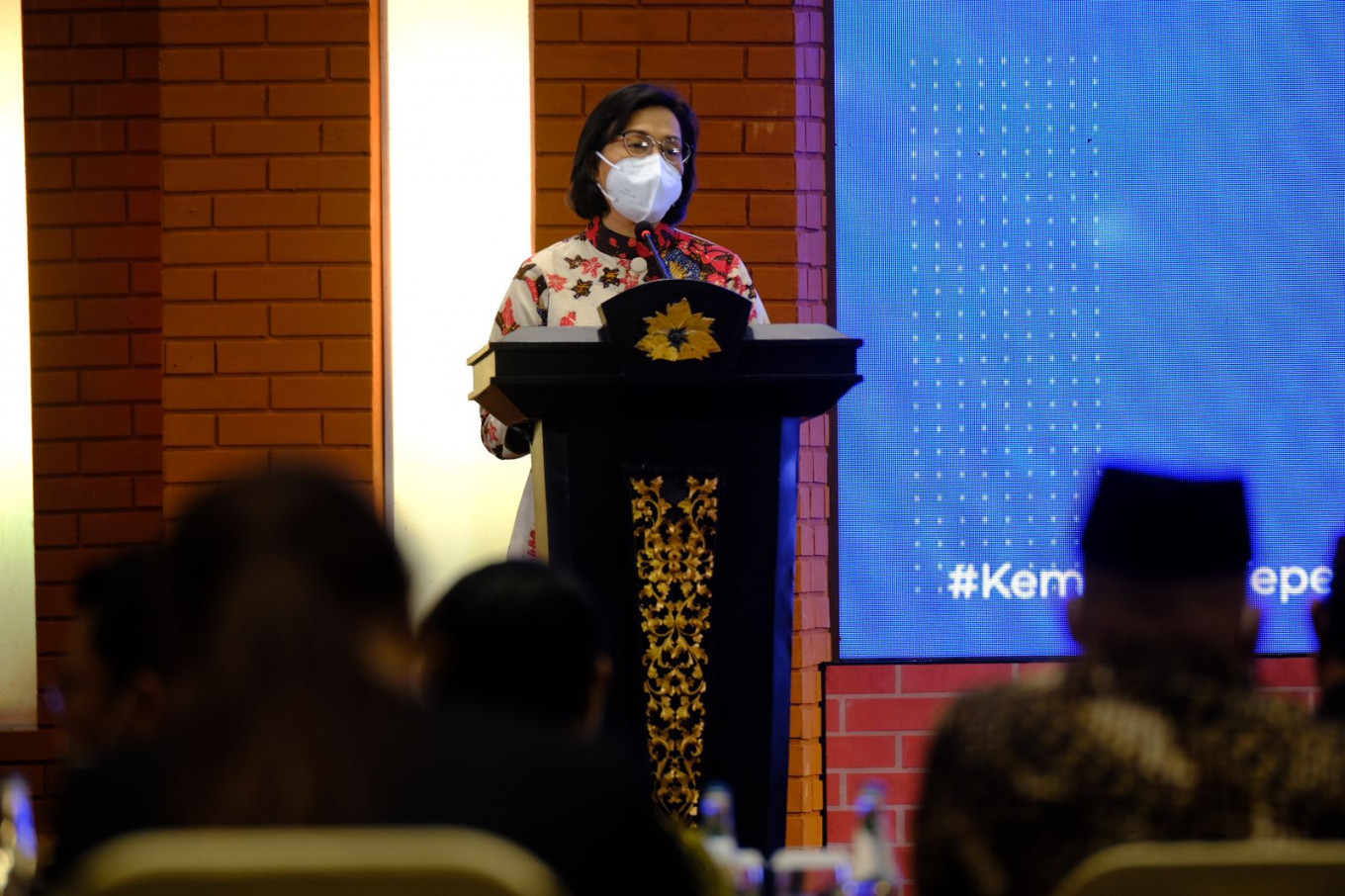
“This shows that our revenue is growing strongly not only due to the commodity windfall but also a fairly solid and evenly distributed economic recovery,” Finance Minister Sri Mulyani Indrawati said in a press conference on Wednesday.
Read also: High oil prices put new strains on state budget
State revenues reached Rp 484.83 trillion, 26.3 percent of the state budget allocation, and higher than the Rp 373.37 trillion recorded in the first quarter of 2021.
The high revenue was driven by tax, non-tax and customs and excise revenues, which rose 41.4 percent,11.8 percent and 27.3 percent year-on-year to Rp 322.5 trillion, Rp 99.1 trillion and Rp 79.3 trillion, respectively.
Rising non-tax revenue was supported by higher Indonesian crude oil prices, which stood at around US$84.99 per barrel, and by rising coal and mineral commodities prices.
Indonesia’s top exports include crude palm oil (CPO), coal and metals like aluminum, copper and nickel, all of which have seen price surges in the weeks following Russia's invasion of Ukraine. The two Eastern European countries are also big exporters of coal and these metals.
Read also: Ukraine war may bring windfall to Indonesia's trade balance
“On the revenue side, state budget performance has improved. However, on the expenditure side, there is [room] for improvement to anticipate subsidy payments and compensation,” Sri Mulyani said.
Expenditure realization reached Rp 490.6 trillion, 18.1 percent of the Rp 2.71 quadrillion earmarked in the budget for this year.
Fuel oil and liquefied petroleum gas (LPG) subsidy realization in the January-March period rose 146 percent year-on-year (yoy) and 111 percent yoy, respectively, to Rp 3.2 trillion and Rp 21.6 trillion.
Expenditure disbursements contracted 6.2 percent yoy in March, deeper than the 0.1 percent yoy contraction recorded in February, led by a significant decrease in ministry and agency spending, which amounted to Rp 150 trillion in March, declining 25.6 percent compared with Rp 201.6 trillion disbursed in the same month last year.
Non-ministry and agency spending, as well as transfers to regions and village funds, grew 10.6 percent yoy and 2 percent yoy, respectively. The distribution of village funds, which saw a deep contraction in the previous month, showed 2.1 percent growth.