TheJakartaPost
Please Update your browser
Your browser is out of date, and may not be compatible with our website. A list of the most popular web browsers can be found below.
Just click on the icons to get to the download page.


Popular Reads
Top Results
No results found. Please check your search term and try again
Can't find what you're looking for?
View all search results
Popular Reads
Top Results
No results found. Please check your search term and try again
Can't find what you're looking for?
View all search resultsNew e-commerce rules planned to limit access to foreign goods
The government is mulling over regulations directed in part at keeping some foreign products off domestic platforms.
Change text size
Gift Premium Articles
to Anyone
Share the best of The Jakarta Post with friends, family, or colleagues. As a subscriber, you can gift 3 to 5 articles each month that anyone can read—no subscription needed!
N
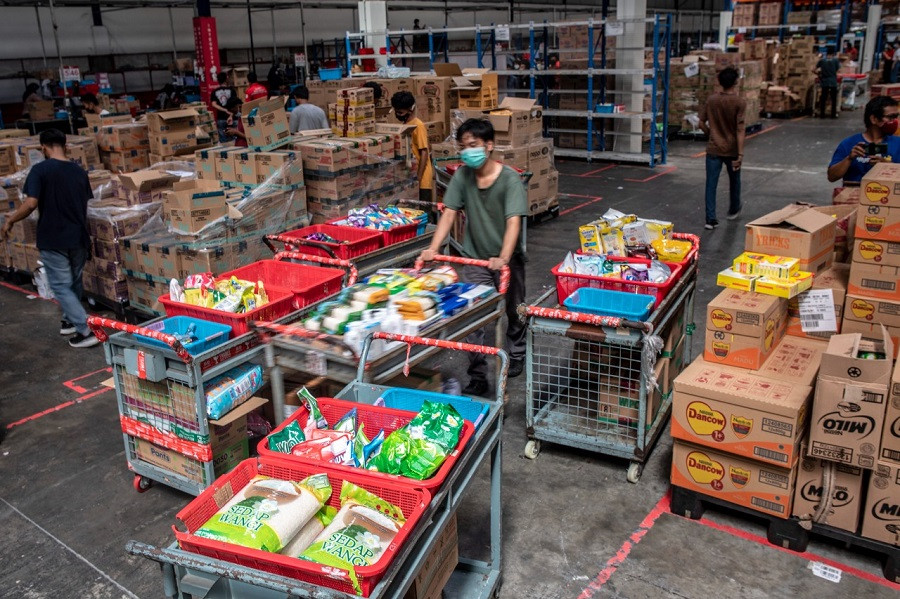
ew rules for e-commerce platforms are meant to keep some foreign products out of the domestic market in what the government calls an effort to create a level playing field.
Trade Minister Muhammad Lutfi and Cooperatives and Small and Medium Enterprises (SMEs) Minister Teten Masduki said on Monday that the planned rules aimed to protect local micro, small and medium enterprises (MSMEs) from the “onslaught of foreign products” offered by foreign e-commerce firms.
“It won’t be easy [to implement] such a regulation. The government will be careful not to violate free trade provisions. But the Indonesian market is very large, many foreign products are not made yet in Indonesia,” Teten said at a media gathering in Jakarta, as reported by Kontan.
At a G20 Trade and Investment Ministerial Meeting (TIMM) in Sorrento, Italy, last year, the trade minister voiced his concerns about the absence of adequate international rules to regulate digital competition among MSMEs, saying this would create “victors” that might kill off small businesses and industries in emerging economies.
Critics have demanded rules to prevent predatory pricing in e-commerce, arguing that the dumping of imported goods at uneconomically low prices could shut out local MSMEs.
Read also: International trade might ‘kill’ local MSMEs, minister warns G20 meeting
Teten went on to say that the government planned to limit the range of foreign goods sold by foreign e-commerce firms operating in Indonesia, for instance by ensuring that foreign products sold on such platforms would need to cost no less than US$100 per product.
“So local products, such as hijabs, can remain competitive,” he said, adding that imported products may be sold on e-commerce platforms if they were brought into the country by domestic importers.
A 2020 report by consultancy McKinsey & Company predicted that, by adopting digital technology, local MSMEs could contribute $140 billion to the country's gross domestic product by the year 2030.
Furthermore, a Mandiri Institute study from the same year found that digitalized MSMEs could help Indonesia reduce by 1.5 percent the economic burden on its GDP caused by the COVID-19 pandemic.
As of November 2020, the number of SMEs using online platforms has risen to around 10.2 million, the SMEs minister said during a webinar hosted by Indonesian fintech firm KoinWorks in the same year.
Read also: Govt helps MSMEs tap Chinese markets through special e-commerce platform
“The important point in the [new] rules is creating a level playing field. For example, there would be an obligation to obtain a distribution permit from the Food and Drug Monitoring Agency [BPOM],” said Lutfi, as reported by Kontan.
The Trade Ministry would require foreign e-commerce companies to provide information on a product’s country of origin, Lutfi added, citing a similar policy implemented in China, where such information was used to ensure that distributed goods were produced locally or at least using raw materials originating from the country.