TheJakartaPost
Please Update your browser
Your browser is out of date, and may not be compatible with our website. A list of the most popular web browsers can be found below.
Just click on the icons to get to the download page.


Popular Reads
Top Results
No results found. Please check your search term and try again
Can't find what you're looking for?
View all search results
Popular Reads
Top Results
No results found. Please check your search term and try again
Can't find what you're looking for?
View all search resultsRI to lobby UN over nuke subs supervision
Government’s concerns ʻwell-foundedʼ
Change text size
Gift Premium Articles
to Anyone
Share the best of The Jakarta Post with friends, family, or colleagues. As a subscriber, you can gift 3 to 5 articles each month that anyone can read—no subscription needed!
I
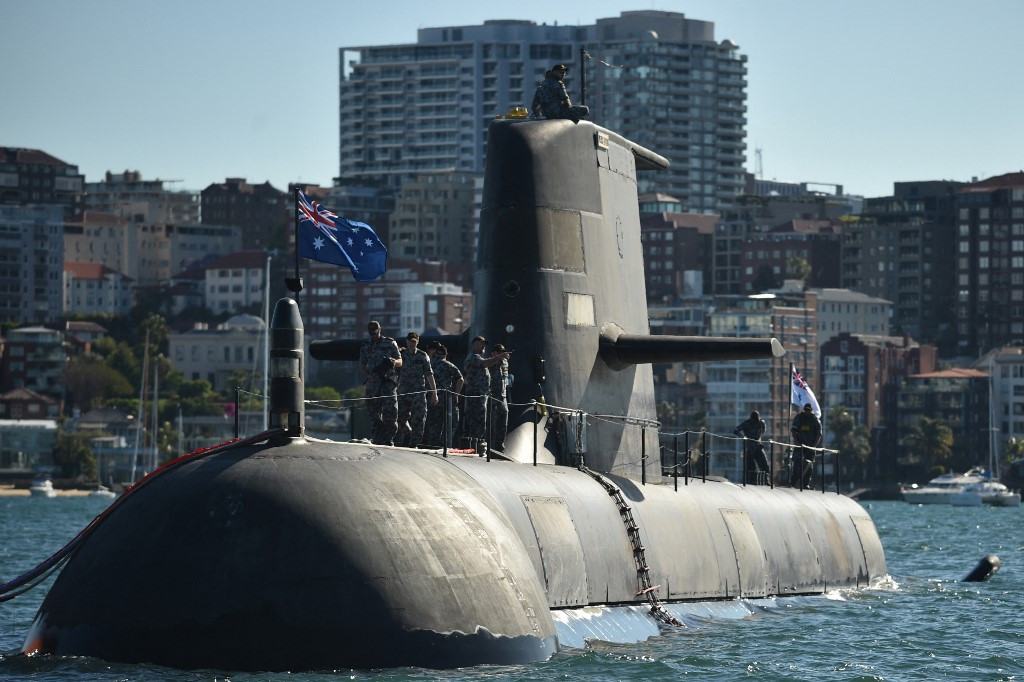
ndonesia plans to put the problems surrounding nuclear submarine technology front and center at a crucial United Nations review of the nuclear non-proliferation treaty later this month, even as neighboring Australia plans to acquire such vessels with the help of the nuclear-armed United States and United Kingdom through the AUKUS pact.
Speaking at a press conference on Sunday night, the Foreign Ministry’s Multilateral Affairs Director General Tri Tharyat confirmed that Indonesia had submitted a draft working paper to the UN that called for tight supervision by the International Atomic Energy Agency (IAEA) for any country looking to develop nuclear-powered submarines.
In its submission, the government said it “notes with concern the potential consequences” that transferring such nuclear technology could have for the global non-proliferation regime. It does not directly reference Australia, and officials have reportedly said that it was not a direct response to the AUKUS pact.
“The working paper, now known as the Indonesian Paper, [is our effort] to raise awareness on this issue. It is also our concrete effort to save lives, and most importantly, to fill in the void in international law regarding nuclear-powered submarines,” the senior ministry official said.
There are currently only six countries in the world with nuclear-powered submarines: the US, the UK, Russia, France, China and India. Brazil and Australia, however, are developing their own nuclear-powered arsenals, although the governments of both countries have stressed that they have not violated any international regulations and that they continue to follow IAEA rules.
However, Tri said that other countries would continue to stand against the development of such technology, particularly due to the fear that its supervision would be difficult and that it might lead to more countries developing their own nuclear weapons.
The paper also raised the issue of potential nuclear leakages and radiation, which the government insists is likely to occur during the transportation, maintenance and use of nuclear-powered submarines.
Nuclear leakages at sea will be more difficult to manage than discharge from land-based nuclear plants, he said, and would be detrimental to maritime resources.
“We want to bridge these sharp differences [between countries for and against nuclear-powered submarines] by providing concrete solutions,” Tri told reporters on Sunday.
The paper would be tabled as part of the discussion for the upcoming 10th Review Conference of the Nuclear Non-Proliferation Treaty (NPT) to be held in New York, the US, from Monday through to Aug. 26.
At the conference, officials said Indonesia would call for the supervision of nuclear technology development by the IAEA, while urging countries to adhere to global commitments to realize a nuclear-free world.
The Australian government, along with its AUKUS counterparts, said in a joint statement on Sunday that the three countries are “working closely with the IAEA” and insisted the acquisition of nuclear submarines will serve to “strengthen the global non-proliferation regime and closes the door to any potential misuse of these elements.”
Australia announced in February that its bid to acquire nuclear-powered submarines was making "significant progress,” as US and UK experts were flown to Australia to advise on the project.
The AUKUS pact and the acquisition of nuclear technology had previously been a source of tension between Indonesia and Australia, further complicated by fears of an imminent arms race brewing in the Indo-Pacific region.
The AUKUS pact is said to strengthen the US’ hold in the Indo-Pacific by making Australia the only non-nuclear weapons-wielding country with nuclear-powered vessels, capable of traveling long distances without surfacing.
A study released in December by the Australian Strategic Policy Institute said that such submarines would offer a significant advantage in deterring aggression from China or elsewhere, AFP reported.
But Dewi Fortuna Anwar, a senior researcher of international politics and foreign policy at the National Research and Innovation Agency (BRIN), said Indonesia’s decision to raise the issue was not to specifically target Australia, even though it might have acted as a trigger.
“We can’t see Indonesia’s gripe with the nuclear-powered submarine only as an issue with Australia, since this is not only a bilateral issue,” Dewi said on Monday. “If more countries start to develop their own nuclear-powered submarines, this can endanger the NPT.”
Dewi said that Indonesia’s concern over the lack of supervision by the IAEA on the development of nuclear submarine technology was well founded and that raising the issue at the NPT conference would help to deter countries from potentially misusing weapons-grade uranium.
“A nuclear-powered submarine in itself is dangerous. It’s lethal and it will also carry its own weapons. There is also the problem of the raw material itself [uranium]. So, concerns about the misuse of weapons-grade materials should be cause for alarm,” she told The Jakarta Post.