Can't find what you're looking for?
View all search resultsCan't find what you're looking for?

View all search resultsWe tend to believe that the people or the organizations whom we trust with our money are trustworthy.
ndonesia can take pride in the fact that it is considered the world’s most-generous country. The World Giving Index in 2021 confirmed the country as the world’s most-generous country with a score of 69 percent or up from 59 percent in the last annual index published in 2018, when the country was also ranked first in the WGI.
The Southeast Asian nation is also one of the most religious nations in the world, arguably contributing to the fact that many Indonesians are charitable, generous people. The act of giving or helping others is indeed an integral part of many religious teachings.
In Islam, for example, a religion embraced by around 86.7 percent of Indonesia’s population, there are several types of charities such as zakat and infaq (voluntary charity to a group of people), to name but a few. As for zakat, it is considered a religious obligation in Islam and is one of its five pillars.
It is also a religious duty for Muslims who meet the necessary criteria of wealth to help the needy. Indonesia’s National Zakat Agency (BAZNAS) in 2022 sets the target of distributing zakat, infaq and sadaqah (ZIS) and other “social-religious funds” amounting to Rp 26 trillion (US$1.75 billion). If the target can be achieved, around 56 million people can receive the funds.
In Christianity, there is a tithe or a one-tenth part of something paid as a contribution to a religious organization or a compulsory tax to the government. Tithes are normally voluntary and paid in cash or cheques.
In Hinduism, giving or making a donation to others is called dana punia, which consists of the words dana (gift, donation) and punia (holy, kind). So, dana punia means a gift or a donation “based on a holy heart or giving something without expecting anything in return”.
Similarly, Buddhism promotes economic wellbeing in society by its stress on the virtue of generosity and teaches its disciples, both monks and laymen, to practice giving, to be generous and to be bountiful.
It goes without saying that charity is part and parcel of the lives of many religious Indonesians. However, this generosity has enabled certain people to take advantage of the situation for their own gain, making the country a fertile breeding ground for charity-fund embezzlement.
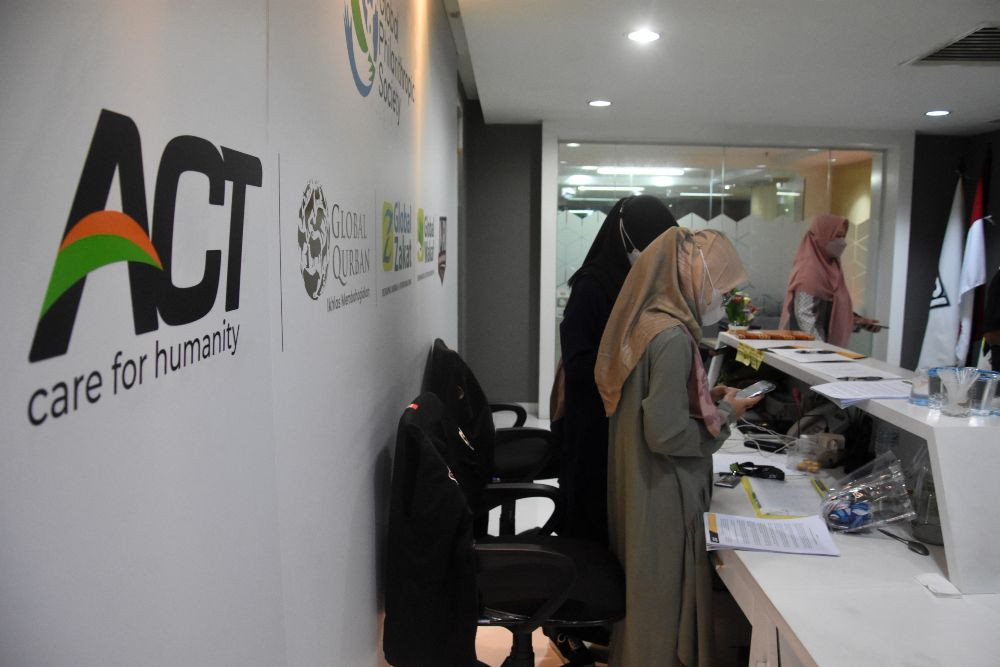
Indonesia was recently rocked and shaken by the news of one of the country’s popular humanitarian-organizations Aksi Cepat Tanggap (ACT) that was implicated in the embezzlement of its charity funds. The organization is one of the most-successful charities in Indonesia, having collected US$6.7 million in donations in 2020 alone. Following the alleged embezzlement, the police interrogated two senior executives of the charitable organization. Investigators have also been questioning its founder and former president, as well as its current president Ibnu Hajar.
The country’s Financial Transaction Reports and Analysis Centre (PPATK) has also frozen 60 accounts affiliated with the organization at 33 financial institutions and discovered transactions worth $1.9 million made between ACT and a company owned by one of its founders.
So how could this scandal unfold? The way many Indonesians view the act of giving or charity may be the root of the problem.
For many of us, we treat charity or giving donations as a “trust-based” action. We tend to believe that the people or the organizations whom we trust with our money are trustworthy. We also often (mistakenly) assume that those who run charity organizations must be “good” people. We rarely question them, let alone in a formal way, in terms of how our money is used and who exactly will receive our money, much less double-check whether those who receive our money are those who truly deserve it.
Religion also influences the way we think about charity. When making charity or donations, we believe it is our pure intention that matters, assuming that God is privy to our pure intention in making donations or giving charity. So, no matter how our money will be used later, it is no longer our business. We believe that God has “recorded” our noble intentions even though the people who manage our charity money might misuse it.
There is nothing wrong with religion teaching about the ethics of charity. However, we should not overlook two fundamental aspects that can make our noble intentions manifest in the right way and our noble intention reach those who truly deserve our money: accountability and transparency. We should draw a line between “showing off” and demanding accountability and transparency for every penny that we donate, especially when it entails a huge amount of money.
Demanding how our money is used and ensuring that it reaches those who truly need it is a noble act in itself. It is not enough for us to become a generous people. In fact, we should also become responsible in our generosity. The role of religious figures is also crucial. They should educate their followers not only about the importance of giving charity but also about ensuring that their charity funds are well targeted and really help those who are really in need.
Equally, there is nothing to be ashamed of in being such a generous nation. If anything, Indonesia should wear it as a badge of honor. Our generosity can be a powerful social capital for the nation still rampant with poverty, currently at the level of 10.14 percent. However, for the country to make the most of this huge potential, the mindset of the people when it comes to giving charity needs to change.
Indonesians must begin to treat charity as a serious, professional matter, beyond a religious issue. The government can also play its role by strengthening supervision and regulations governing charity, including by making it possible for the people to have access to information that allows them to trace their money, and to thereby ensure accountability and transparency in this noble act.
***
The writer is a staffer at the Cabinet Secretariat. These views are personal.
Share your experiences, suggestions, and any issues you've encountered on The Jakarta Post. We're here to listen.
Thank you for sharing your thoughts. We appreciate your feedback.
Quickly share this news with your network—keep everyone informed with just a single click!
Share the best of The Jakarta Post with friends, family, or colleagues. As a subscriber, you can gift 3 to 5 articles each month that anyone can read—no subscription needed!
Get the best experience—faster access, exclusive features, and a seamless way to stay updated.