TheJakartaPost
Please Update your browser
Your browser is out of date, and may not be compatible with our website. A list of the most popular web browsers can be found below.
Just click on the icons to get to the download page.


Popular Reads
Top Results
No results found. Please check your search term and try again
Can't find what you're looking for?
View all search results
Popular Reads
Top Results
No results found. Please check your search term and try again
Can't find what you're looking for?
View all search resultsWhy food estates do more harm than good and must end
The government has no answer to the question about whether the value of food estates exceeds or at least equals the loss of forests.
Change text size
Gift Premium Articles
to Anyone
Share the best of The Jakarta Post with friends, family, or colleagues. As a subscriber, you can gift 3 to 5 articles each month that anyone can read—no subscription needed!
Why food estates do more harm than good and must end
The commemoration of National Nature Conservation Day every Aug. 10 signifies the value of “nature” and “conservation” for Indonesia, home to much of the world’s biodiversity.
In 2020, the United Nations Food and Agriculture Organization ranked Indonesia in the top-10 countries with the largest forest area and the top-three countries with the most tree species.
However, the abundance of Indonesia's forest resources today is still far less than what the country possessed decades ago. Global Forest Watch noted that Indonesia has lost 9.95 million hectares in the last two decades. In 2014, Indonesia even dethroned Brazil as the country with the highest deforestation rate despite the moratorium on forest clearing.
The drivers of deforestation vary, with land use conversion to agricultural and commodity-driven production sitting at the top of the list. Nonetheless, the recent mega-scale agricultural program known as “food estates” has sparked fears about more forest cover loss that Indonesia will suffer in the future.
Looking back at history, food estates are not a new concept. In 1995, then-president Soeharto issued Presidential Decree No. 82, which outlined a 1-million-ha peatland development project (PLG) in Central Kalimantan.
In 2010 the government of then-president Susilo Bambang Yudhoyono established a food estate in Merauke regency, Papua, called the Merauke Integrated Food and Energy Estate (MIFEE). It did not stop there. The government built another food estate in East Kalimantan in 2015. Those projects failed to alleviate food needs; instead they put tremendous pressure on the environment.
Experts have noted that previous food estates failed because the government ignored the scientific principles in their development. At least four essential requirements must be considered, namely land and climate suitability, infrastructure for irrigation and transportation, cultivation and technological feasibility and social and economic feasibility.
The current government seems to be confident that lessons learned from previous food estate projects will lead the recent food estate development to success. The government has issued general guidelines for developing a food estate area. The new project calls for developing food estates in Central Kalimantan and North Sumatra, which also began in 2020, and in South Sumatra, Papua, and East Nusa Tenggara (NTT) in the following years.
The forest policy revolving around food estates, however, has stirred quite a controversy. In 2020, the government issued a regulation on the provision of forest areas for food estates, which allowed the use of protection forests for food estates.
Not only did the regulation contradict the 1999 Forestry Law, the regulation also justified deforestation. This regulation was then revoked with the issuance of Government Regulation No. 23/2021 on forestry management, one of the derivative regulations of the Job Creation Law. The new regulation allows the use of protection forests for food estates but is limited to “protection forests which no longer hold protection functions”. This clause is ambiguous since there are no clear criteria for determining how the protection forests have lost their protection functions.
Lately, the agriculture minister and several other ministers claimed the success of the food estate programs in Central Kalimantan, NTT and North Sumatra. The euphoria over the big harvests there was reported by various media, indicating the government’s intention to continue and expand the project.
However, the government seems to lack transparency when it comes to fundamental information related to the project. There are not enough details as to the risks of converting forests to food estate areas. The government has no answer to the question about whether the value of food estates exceeds or at least equals the loss of forests.
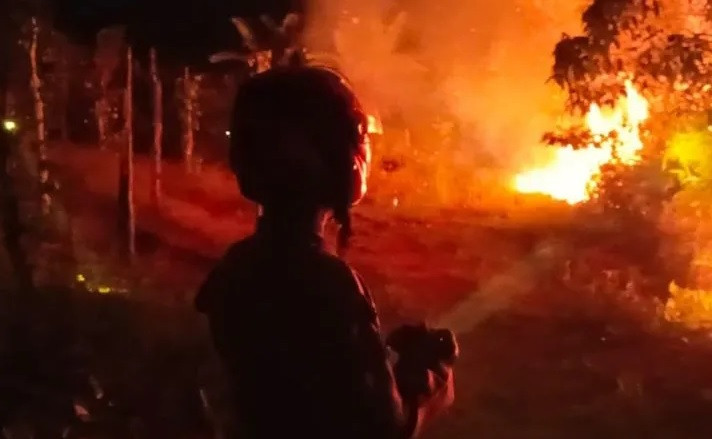
Beyond the loss of forests, the ecological concern extends to peatland destruction. Some of the area used for food estates in Central Kalimantan is located in the peatland ecosystem, formerly the area for the PLG Project. The cultivation in the peatland area involved draining, which led to surface subsidence, carbon loss and fire-prone peat soil.
As a consequence of the past failed projects, land and forest fires repeatedly occurred in 1997-1998, 2015 and 2019. This pattern only shows the possibility of other forest fires to recur in the future due to the current food estate project there.
The food estate projects, particularly in peatlands, should stop, considering the failures of the past. Peatland is a carbon sink in its natural condition but can turn into a carbon ticking bomb when falsely managed.
Furthermore, the use of protection forests for food estates should be reconsidered. Instead of conversion, restoration should be an option for the forests that have lost their protection function. A clear and detailed safeguard that follows international standards should also take place when conducting a strategic environmental assessment for establishing a food estate; so that the risks can be mitigated.
The conflict of interest in food estate projects might be huge. The worst perspective would be that the whole program is a mere land-clearing exercise that leads to massive deforestation under the guise of food security. The World Bank has highlighted that the problems for most Indonesian families are high food prices, which are generally caused by soaring production and logistics costs.
Food issues are structural, ranging from an inefficient supply chain, limited use of technology and overlapping regulations to the declining number of young farmers. Would the food estate program address those complex food issues?
Food and forests are equally crucial to livelihoods. We cannot solve our food issues by frantically cutting down our forests. If anything, it will only bring us closer to a food crisis.
***
Dian Yuanita is a project and business development manager in an agribusiness consulting company and Sekar Yunita is an MSc candidate in Tropical and International Forestry, Georg-August-Universität Göttingen, Germany.