Can't find what you're looking for?
View all search resultsCan't find what you're looking for?

View all search resultsA major flaw in Chrystia Freeland's world view is that it equates "liberal democracy" with Western nations and fails to recognize the democratic achievements of the "in between" nations like Indonesia and other ASEAN states.
t might be called a framework for the future of geopolitical relationships, and it is an approach that has much potential though the details still need to be figured out as regards its implications and possible ways of implementation.
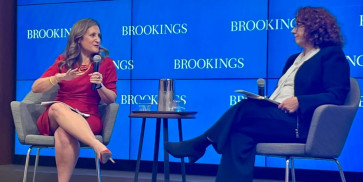
I am referring to the speech that Canadian Deputy Prime Minister and Finance Minister Chrystia Freeland delivered on Oct. 11 at the Brookings Institution in Washington, DC. In it, she posited a possible blueprint on how democracies should deal with the new era of geopolitical tensions and conflicts.
Freeland said that the previous era, which started on Nov. 9, 1989 with the collapse of the Berlin Wall and the communist regimes in Eastern Europe, followed by the collapse of the Soviet Union, was now over.
The “flat world” theory of author and journalist Tom Friedman was not successful, Freeland explained, as the world had opened up and the “end of history” definitely did not happen.
In her speech, Freeland pressed the idea that liberal democracies should enhance their relationships, primarily through trade and interconnected and interdependent supply chains among themselves.
This could be called geopolitical reliance or, as Freeland quoted United States Treasury Secretary Janet Yellen, “friend-shoring”, in which “democracies must make a conscious effort to build our supply chains through each other’s economies”.
Yet, the first pillar of this blueprint won’t work with just better economic relationships among the Group of Seven plus Australia, New Zealand and South Korea. Such a strategy would have to bring real and practical benefits to the people of these nations, and not just the default outcomes of new trade agreements.
The leaders of these nations will also have to be very creative at doing a better job in involving and engaging their citizens in this attempt at “enhanced solidarity” among themselves.
What was intriguing about Freeland’s speech was, however, the remaining part about the second and third pillars of what has now been dubbed the “Freeland doctrine”. In this part of her speech, Freeland distinguished between the rest of the world minus Western liberal democracies and the world led by autocrats and dictators.
She called this second group the “in between” nations, or countries that shared many common values with the West, especially in terms of democracy and human rights, but which still had a unique identity, a proud history often darkened by the forces of colonialism and imperialism, and quite a number of internal challenges.
Obviously, several Southeast Asian nations, including Indonesia, Malaysia, Thailand, Singapore, belong to this group. Timor-Leste, which deserves much more attention, is certainly a core member.
Perhaps even Brunei would be part of this group if Sultan Hassanal Bolkiah loosened his grip on absolute power, something that should happen before the handover to the crown prince.
All South Asian countries except Taliban-ruled Afghanistan should be part of this group, along with the Pacific nations that are always framed today in the optics of the competition between China and the West.
These days, the risk of resuscitating the Non-Aligned Movement is very high and this is comprehensible, which is why Western leaders like Freeland should first ask themselves if such countries really want to step up their partnerships with Western liberal democracies that are consolidated, though clearly in a crisis.
How can Canada, the European Union or the US really step up their relationships with the “in between” countries without framing this effort in terms of the West’s rivalry with China?
First of all, it is a matter of substance. After that, it is an issue of style and tactics.
Regarding the former, for example, can the West really step up its commitment to climate finance? Can the G7 nations really invest, even through shared debt, to support the transition to a greener economy in Southeast Asia or Western Africa, or make a pledge for the survivability of Pacific nations? Can they come up with massive support to fund social protection schemes through their finance ministries?
What about huge investments for education, including public schools and universities, and health care? What about thousands of scholarships and short-term work permits that carry the condition that recipients must go back to their own countries at the end of their programs?
We know that government aid is not a panacea and it is often very controversial, but a smarter way of providing development assistance, coupled with gigantic investments in the economy, could really help these nations.
To start with, Western countries should better coordinate their development work with third countries, eliminating duplication and avoiding a good amount of administrative costs. In terms of tactics and approach, the Western world should probably pay attention to the efforts and style of Australian Foreign Minister Penny Wong.
Wong has the toughest job of restoring Australia as a reliable, serious and committed partner in Southeast Asia and the Pacific, confronting China but without irritating or provoking Beijing.
After all, dealing with autocracies and dictatorships would be inevitable, as Freeland explained in her third pillar.
The West still needs the oil and gas dictatorships and to tackle China, but it also has to work with all of them in a respectful manner.
This is probably what German Chancellor Olaf Scholz is going to do on his visit to China, which was highly criticized for a lack of coordination with his European counterparts and a mission that should have been preceded by an official, high-level EU delegation.
Freeland’s speech in Washington could prompt a rethinking, a conversation about the now unequal and unbalanced relationships between the West and those countries whose imperfect democracies, no matter what, are an achievement in and of themselves.
Freeland concluded her speech with the following statement: “As we set out to build a new world together, let that inspire us to build one in which all liberal democracies cannot just survive, but thrive.”
The real challenge will be to ensure that “liberal” stops being synonymous with the Western world and democracies “in between” can thrive using their own formulas and priorities and, most importantly, with tons of respect and unconditional funding from the West.
***
The writer is a cofounder of ENGAGE and comments on social inclusion, youth development, regional integration, SDGs and human rights in the Asia-Pacific context.
Share your experiences, suggestions, and any issues you've encountered on The Jakarta Post. We're here to listen.
Thank you for sharing your thoughts. We appreciate your feedback.
Quickly share this news with your network—keep everyone informed with just a single click!
Share the best of The Jakarta Post with friends, family, or colleagues. As a subscriber, you can gift 3 to 5 articles each month that anyone can read—no subscription needed!
Get the best experience—faster access, exclusive features, and a seamless way to stay updated.