TheJakartaPost
Please Update your browser
Your browser is out of date, and may not be compatible with our website. A list of the most popular web browsers can be found below.
Just click on the icons to get to the download page.


Popular Reads
Top Results
No results found. Please check your search term and try again
Can't find what you're looking for?
View all search results
Popular Reads
Top Results
No results found. Please check your search term and try again
Can't find what you're looking for?
View all search resultsRethinking Indonesia’s food self-sufficiency post-Davos
As part of the wider national food security agenda, protein self-sufficiency requires a circular agriculture approach that integrates cereal production and pastureland planning and management for livestock feed, which is still highly dependent on imports.
Change text size
Gift Premium Articles
to Anyone
Share the best of The Jakarta Post with friends, family, or colleagues. As a subscriber, you can gift 3 to 5 articles each month that anyone can read—no subscription needed!
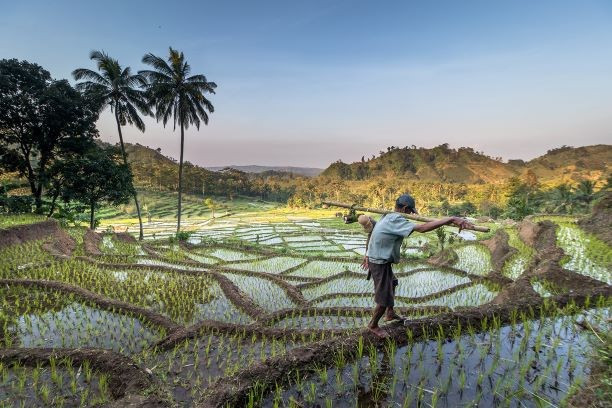 A farmer walks among rice fields in Brebes regency, Central Java, in this undated photo from Imperfect Frame, a nationwide documentary project supported by the Tourism Ministry launched in 2017. (Imperfect Frame/Marius Moragues) (Courtesy of Marius Moragues/-)
A
t last week’s World Economic Forum (WEF) Annual Meeting in Davos, Switzerland, President Prabowo Subianto sent a familiar and powerful message: Food self-sufficiency is back at the center of Indonesia’s national agenda. Weeks before the event, Prabowo announced that the country had achieved rice self-sufficiency in 2025, with national production exceeding domestic consumption and no imports required for public needs.
When a president brings “self-sufficiency” to a global stage, it becomes a promise not only to citizens at home but also to investors and partners, watching whether Indonesia can secure its domestic fundamentals. Yet the real test begins after the speech. What does “self-sufficiency” mean in practice? And how should it be measured?
At Davos and in domestic announcements, the government has emphasized progress and ambition: securing staple supplies, sustaining rice output and strengthening domestic production across strategic commodities.
The logic is clear. In a world where supply chains are fragile and conflict can disrupt trade, relying too heavily on imports looks increasingly risky. For Indonesia, food self-sufficiency is a political priority precisely because it intersects with economic resilience.
In his Davos speech, President Prabowo also said that within the next four years, Indonesia would become self-sufficient in the other food products: corn, sugar and protein.
When protein is mentioned, the President aims not only to keep people full but also to ensure that they eat better. Meat, milk and eggs as livestock products are central to that nutrition goal. However, animal-based food commodities remain dependent on foreign supply. Beef and fresh milk in particular still require imports to fill the gap.

According to official estimates from the Agriculture Ministry, domestic beef production reached around 473,900 tonnes in 2025, while national consumption was projected at around 724,200 tonnes. The story was even more striking for fresh milk, according to data from Statistics Indonesia (BPS): Domestic production stood at around 808,400 tonnes in 2024, while total demand reached 4.7 million tonnes.