Can't find what you're looking for?
View all search resultsCan't find what you're looking for?

View all search resultsIt is ironic when the government in Jakarta ask Papuans, including Lukas, to follow the law, but at the same time practices tyranny and injustice in the easternmost territory.
apua is again in turmoil since the Corruption Eradication Commission (KPK) named Governor Lukas Enembe a suspect. The KPK has summoned the two-time governor twice for questioning, but he has failed to turn up, citing health reasons. Finally, KPK chief Firli Bahuri visited Lukas in Jayapura, with many describing the move as a violation of the KPK Law and code of ethics.
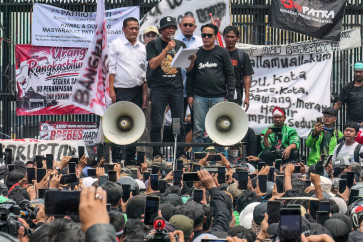
The graft case has divided the Papuan people, with many of his supporters pledging to protect him even from enforcement of the law.
In fact, politics also plays a part in the KPK investigation into Lukas, who is a popular figure in Papua, as many have alleged the law enforcement is an act of criminalization to assassinate his character for a particular purpose.
People’s resistance to, if not obstruction of justice, in the Lukas case owes its origin to various long-standing problems in Papua, which the government has failed to resolve until today.
Lukas’ refusal to comply with the KPK’s summons is influenced, at least indirectly, by the habitus embedded in the community in perceiving law enforcement in Papua.
Habitus is a disposition system that contains schemas of perceptions, thoughts and actions in the form of lifestyles, values and expectations that certain social groups hold. Habitus is obtained from the experience of individuals or groups interacting, which is influenced by past events and is the result of learning and socialization.
Habitus is formed with the influence of economic, social, cultural and symbolic capital. Individuals and groups will use it to perceive, understand, appreciate and evaluate their social environment. In habitus, there is a struggle between objective phenomena and the subjective experiences of specific individuals or groups.
Dominant power relations influence the formation of habitus. Human actions in habitus do not always have to be influenced by awareness and obedience to the rules. Habitus gives direction both as a driver and a barrier for individuals to act and allows individuals to improvise freely and autonomously.
It is ironic when the government in Jakarta asks Papuans, including Lukas, to follow the law, but at the same time practices tyranny and injustice in the easternmost territory. From a legal aspect, habitus in Papua is shaped by power relations that tend to be oppressive toward indigenous Papuans (OAP). The OAP have been enduring injustice in the forms of human rights violations, violence, economic and political discrimination, racism, deprivation of customary rights, and exploitation of natural resources.
The state should first and foremost set a good example of law enforcement in Papua by bringing to justice those who commit injustices in Papua. The disrespect for the law Lukas and his supporters have displayed can be seen as a form of freedom to improvise freely and autonomously from the habitus. Their behavior is an expression of “rebellion” against the power relations that denigrate their existence as Papuans.
In other words, their action can be considered a strategy by the OAP, who are generally viewed as weak as a result of decades-long oppression. This is not to say that they do not obey or understand the law.
The OAP have been educated to understand the law since their youth in the context of absolute customary Law. But for the national law, the OAP no longer see it as an absolute system due to the nuances of skepticism toward its enforcement.
The national law is seen as justifying injustice in Papua. This is the manifestation of the objective phenomenal struggle where on the one hand, the OAP understand corruption and the law must be enforced to eradicate it. On the other hand, however, their subjective experiences show the law never gives them the justice they deserve.
Both Lukas’ supporters and opponents interact with people with political, economic, social and cultural capital, who can define the course of the case involving the governor.
Although Papuan society is fragmented in viewing the Lukas graft case, in general the governor can be perceived as a representation of the “oppressed” OAP. His resistance is also seen as an effort to fight for justice and OAP rights. This is an interesting phenomenon because it is difficult to find a character who can relatively unite and “represent” the interests of the diverse Papuan people.
In a show of support for Lukas and the OAP interests he is defending, the Papuan Customary Council has confirmed him as kepala suku (tribal leader) of a large ethnic Papuan people. The government seems to be starting to realize the importance of the OAP's “representational” value as an effort to solve the problems plaguing Papua. This can be seen in the appointment of three interim governors in the three newly formed Papuan provinces.
The political context has turned the enforcement of the law against Lukas into a unique and complex case that deserves extra attention. This uniqueness stems from the economic and political discrimination and injustice that most of the OAP still feel. The graft case, in the end, is not only about an investigation process in which the law must be enforced, but more importantly, the state’s assurance that justice prevails in Papua and the indigenous people obtain appreciation and recognition on the same terms as other citizens of Indonesia.
Such intention to realize equality before the law in Papua must be followed by efforts to produce a habitus representing an egalitarian position for the OAP. A habitus that is based on scientific knowledge, cultural recognition and promotion of justice is needed to advance Papua.
It remains to be seen, however, the end game of the Lukas case.
***
The writer is a senior researcher at the Department Politics and Social Change, Centre for Strategic and International Studies (CSIS) Jakarta.
Share your experiences, suggestions, and any issues you've encountered on The Jakarta Post. We're here to listen.
Thank you for sharing your thoughts. We appreciate your feedback.
Quickly share this news with your network—keep everyone informed with just a single click!
Share the best of The Jakarta Post with friends, family, or colleagues. As a subscriber, you can gift 3 to 5 articles each month that anyone can read—no subscription needed!
Get the best experience—faster access, exclusive features, and a seamless way to stay updated.