Can't find what you're looking for?
View all search resultsCan't find what you're looking for?

View all search resultsHouse Deputy Speaker Sufmi Dasco Ahmad confirmed on Sunday that the Tuesday plenary meeting was scheduled to pass the bill that would replace the century-old law inherited from the Dutch colonial regime.
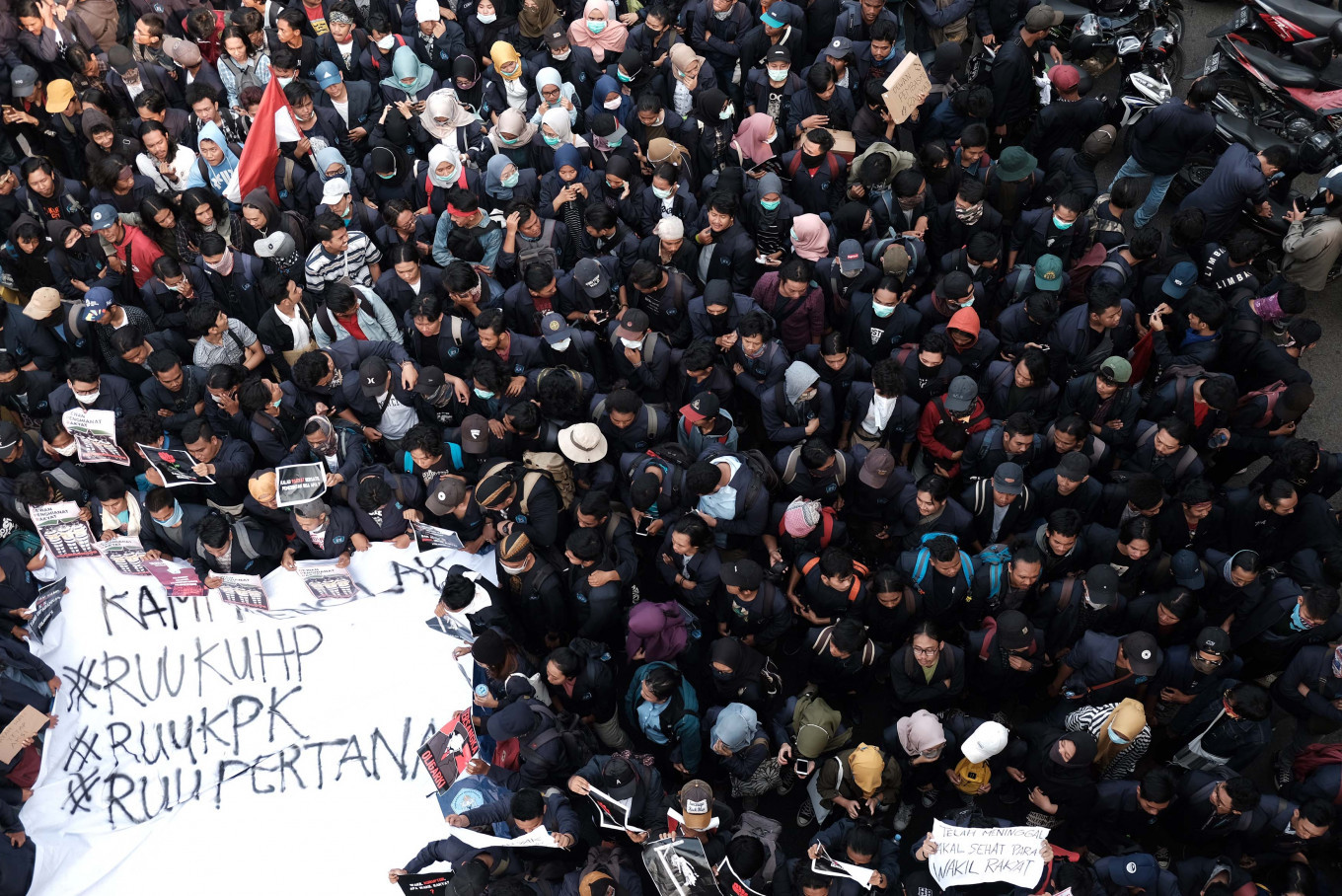
A coalition of some 40 civil groups that have been keeping tabs on the bill rejected the plan because it still maintains some controversial articles, from the ones that criminalize insults to the president to those that ban non-Pancasila ideologies, although the government said it had softened the provisions.
"[We demand lawmakers -- and the government] to delay the passing of the bill. Instead, [they must] reopen discussions to improve [some problematic articles] so any new revisions would not threaten our democracy," Indonesian Legal Aid Foundation (YLBHI) chairman Muhamad Isnur said.
Citra Referandum of the Jakarta Legal Aid Institute (LBH Jakarta), which is also part of the coalition of civil groups, said it rejected the passing of the bill until problematic provisions were revoked. “We appreciated some improvement to certain provisions. But there are still problematic articles in the latest draft, such as presidential insults, ban on ideologies that contradict [Indonesia's founding ideology of] Pancasila, cohabitation and many others.”
Still problematic
The government claims to have watered down some other contentious provisions, such as the ones regulating presidential insult, death penalty and cohabitation, after listening to the wishes of the public. The government held a series of public consultations involving certain members of the public, such as students and law experts, between August and October at the instruction of President Joko “Jokowi” Widodo in response to growing public opposition to the planned revisions.
Deputy Law and Human Rights Minister Edward "Eddy" OS Hiariej said last week that the bill gives death-row convicts a 10-year probation to demonstrate their good behavior so their death sentence can be commuted to life imprisonment or 20 years in prison.
The latest version of the bill, released by the government on Saturday, maintains that insulting a sitting president is a crime, although it has reduced the maximum penalty from 3.5 years in prison to three. The provisions are not applicable to criticisms made during a demonstration, but critics say having the provisions enacted can still curb free speech.
Meanwhile, the latest changes to the ban on non-Pancasila ideologies the government made late last month created even vaguer provisions. The government expanded the long-existing ban on disseminating or promoting communism, Marxism-Leninism to all "other ideologies that contradict Pancasila" without clear definition of what constitutes anti-Pancasila or which institution has the authority to decide.
Read also: Critics slam vague ban on ideologies in penal code bill
The bill also retains articles that make holding demonstrations without a permit punishable by six months in prison if the protests turn violent, “harm the public interest” or disrupt public services.
"Compared to the 2019 version [of the bill], the latest draft is better, but there are some problematic articles that could still be improved,” Erasmus Napitupulu of the Institute for Criminal Justice Reform (ICJR), also a member of the civil group coalition, said. “No matter how small the chance for improving the problematic articles, [the government and lawmakers] must pay attention to [the efforts].”
The bill also maintains articles that carry punishments of one-year imprisonment for fornication and six months for nonmarital cohabitation, disregarding criticism from activists who said that criminalizing the individual acts violated the right to privacy.
Consensual sex between unmarried people and nonmarital cohabitation are currently not a crime under the existing Criminal Code -- only adultery is prohibited.
A step away from being law
The bill is one step away from being passed into law after lawmakers and the government unanimously endorsed the bill on the evening of Nov. 23 and agreed to bring it to a coming House plenary session. Lawmakers, according to Dasco, had accommodated public opinion.
The deliberation of the bill has been going on for decades. In September 2019, the plan to pass the revisions to the penal code was postponed following mass student protests in Jakarta and other regions in response to draconian articles.
Read also: House agrees to postpone four problematic bills, including revised KUHP
The government and lawmakers resumed the deliberation in June last year and released the first complete draft in July of this year. But policymakers revised the document twice after holding some public consultations and following a series of deliberations at House Commission III, overseeing legal affairs.
The latest draft bill was released by the government on Saturday.
Albert Aries, a spokesperson for the government’s drafting team, said on Sunday that there was still a chance to reopen another series of discussions despite the House’s plan to pass the bill on Tuesday.
“If this happens and provisions are changed, it will be up to the government and lawmakers to decide whether or not they will approve [the changes],” he said without elaborating.
Share your experiences, suggestions, and any issues you've encountered on The Jakarta Post. We're here to listen.
Thank you for sharing your thoughts. We appreciate your feedback.
Quickly share this news with your network—keep everyone informed with just a single click!
Share the best of The Jakarta Post with friends, family, or colleagues. As a subscriber, you can gift 3 to 5 articles each month that anyone can read—no subscription needed!
Get the best experience—faster access, exclusive features, and a seamless way to stay updated.