TheJakartaPost

Please Update your browser

Your browser is out of date, and may not be compatible with our website. A list of the most popular web browsers can be found below.
Just click on the icons to get to the download page.


Jakarta Post

House factions reject closed-list elections

Yerica Lai (The Jakarta Post)
Jakarta
Thu, January 5, 2023 Published on Jan. 4, 2023 Published on 2023-01-04T22:10:26+07:00

Change text size

Gift Premium Articles
to Anyone

Share the best of The Jakarta Post with friends, family, or colleagues. As a subscriber, you can gift 3 to 5 articles each month that anyone can read—no subscription needed!

P

ro-government and opposition parties put on a united front on Tuesday against a push to ditch the current open-list proportional representation format for legislative elections, which allows voters to have an influence over legislative candidates put forward by political parties. 

A member of the ruling Indonesian Democratic Party of Struggle (PDI-P) is challenging the 2017 General Elections Law at the Constitutional Court, seeking to restore a closed-list system, in which voters solely vote for parties that in turn exclusively decide the winning candidates proportionate to the number of votes won.

In a joint statement released on Tuesday, eight of nine political factions in the House of Representatives stressed their shared opposition to changing the current open-list system, describing the prevailing mechanism as “progressive and characteristic of our democracy” that should be maintained.

The statement was signed by the pro-government Golkar Party, Gerindra Party, Nasdem Party, National Awakening Party (PKB), National Mandate Party (PAN) and United Development Party (PPP), as well as opposition parties the Democratic Party and the Prosperous Justice Party (PKS).

An open-list system, the statement said, was a “beautiful coalescence of the requisite close bond between the people and their representatives and the participation of political party institutions that must still be upheld.”

The eight parties called for the Constitutional Court to “participate in safeguarding the progress of Indonesian democracy” and remain consistent in its decision in 2008 that changed the country’s electoral system into the fully open system after decades of adopting a closed-list system.

Indonesia, which is set to hold general elections in 2024, moved from the closed-list to the fully open-list proportional representation system in the 2009 election to increase the directness of democracy, with voters gaining more power over whom they elect at the expense of political parties that nominate candidates.

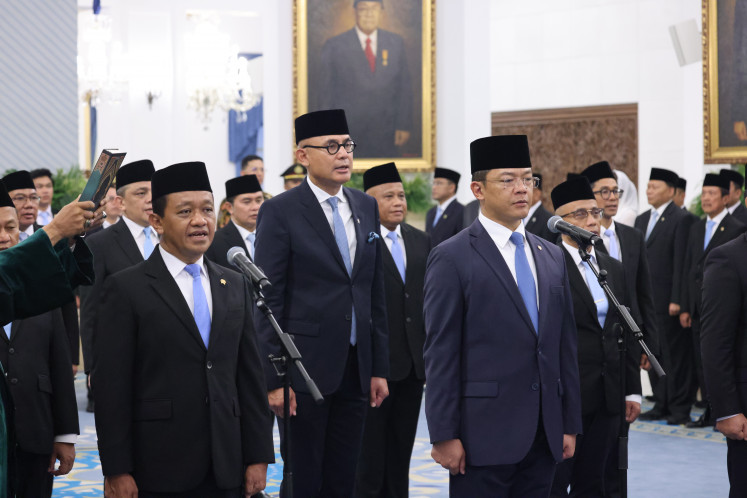
Despite growing opposition, the PDI-P, which has long sought the return of the closed-list ballot, is standing its ground, saying that the open-list format encourages vote-buying and a total victory for individuals over parties in elections.

“The party led by Megawati Soekarnoputri is not a political party that is designed only to win elections, but to also carry out political regeneration and education to fight for the people's aspirations. Thus, the basis for the legislative elections should be competence, not popularity as occurs in the open-list system,” PDI-P secretary-general Hasto Kristiyanto said on Tuesday.

Plaintiffs challenging the elections law at the Constitutional Court include Demas Brian Wicaksono, a member of the PDI-P’s Probolinggo branch, and Yuwono Pintadi, a self-proclaimed NasDem member, whom NasDem has disowned as his membership has not been renewed since it expired in 2019.

Election watchdogs and experts also oppose the idea of reinstating the closed list, stressing that it would distort popular sovereignty, and called for the court to reject the petition. 

“Options as to which legislative election system to adopt should be the result of a consensus among lawmakers who must uphold meaningful participation in their decision-making process," said Titi Anggraini of the Association for Elections and Democracy (Perludem). "In this case, it is not the authority of the Constitutional Court to determine which electoral system is constitutional to adopt in organizing legislative elections."

Senior political researcher at the National Research and Innovation Agency (BRIN) Firman Noor said that a closed-list system would only benefit political elites as there would be no more "constituent intervention" in shaping the face of the legislative bodies, either at local or national levels.

“Consequently, of course, our democracy could potentially become increasingly threatened by pervasive elite forces. Even in an open system, the nuances of elitist democracy can already be felt, especially if you use a closed mechanism,” Firman said in a statement.

Strong opposition to the reinstatement of the closed-list system surfaced after General Elections Commission (KPU) chairman Hasyim Asy’ari hinted on Dec. 29, 2022 at the possibility of returning to the old system.

He at the time advised prospective legislative candidates to refrain from early campaigning and erecting roadside billboards because ballot papers would not contain candidates’ names in a closed-list election.

Hasyim has been candid about the commission’s preference for the closed-list system due to its lower cost and simpler ballot design. He later downplayed his earlier remarks, saying they had been taken out of context.

Your Opinion Matters

Share your experiences, suggestions, and any issues you've encountered on The Jakarta Post. We're here to listen.

Enter at least 30 characters
0 / 30

Thank You

Thank you for sharing your thoughts. We appreciate your feedback.

Share options

Quickly share this news with your network—keep everyone informed with just a single click!

Change text size options

Customize your reading experience by adjusting the text size to small, medium, or large—find what’s most comfortable for you.

Gift Premium Articles
to Anyone

Share the best of The Jakarta Post with friends, family, or colleagues. As a subscriber, you can gift 3 to 5 articles each month that anyone can read—no subscription needed!

Continue in the app

Get the best experience—faster access, exclusive features, and a seamless way to stay updated.