Can't find what you're looking for?
View all search resultsCan't find what you're looking for?

View all search resultsThe value of imported secondhand clothing is actually quite small, amounting to US$272,146 in 2022, but it jumped by more than 500 percent compared with the previous year, Statistic Indonesia data show.
he government has put attention to banning imported secondhand clothing on the grounds of the Indonesian market to protect local industries from thrifting practices. But businesses claimed that unsolved bribery and smuggling in the country may stand in the way to effectively enforce the policy.
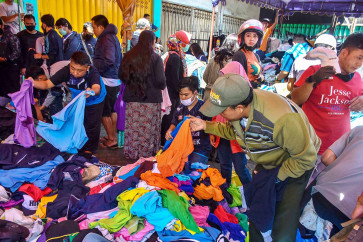
Thrifting refers to shopping for used items at discounted prices. In some countries the goods in question are imported secondhand in large quantities, allowing it to be sold at a far cheaper price than locally made items.
President Joko “Jokowi” Widodo addressed the issue as “greatly disrupting the domestic industry” and has kickstarted two of his ministries to take concrete measures against the trend.
Imported secondhand clothing for many years has made frequent appearances in Indonesia, as a weakened global economy caused goods to flow to places with strong domestic demand.
The value of imported secondhand clothing is actually quite small, amounting to US$272,146 in 2022, but it jumped by more than 500 percent compared with the previous year, Statistic Indonesia data show.
The growth skyrocketed, while value on regular imported clothes saw a slowdown by 12.34 percent and 3.55 percent for knitted and non-knitted items, respectively, in the same period.
Local businesses have hailed the recent government move to contain the influx of imported secondhand goods, but many chose to take it with a grain of salt.
Import of secondhand clothing has been prohibited under Trade Ministry regulation No. 51/2015. The regulation has been amended twice with the newest officially imposed in 2022.
Under the regulation, the Trade Ministry has confiscated and wiped out around Rp 20 billion ($1.3 million) worth of imported secondhand clothing, most recently in Pekanbaru, Riau, and Mojokerto, East Java.
Read also: Indonesia remains a paradise for thrift shoppers
Aep Uwo, who chairs the local textile smallholder’s association in Majalaya, a district in West Java, told The Jakarta Post thrifting was hurting local industries because imported secondhand clothing did not create many jobs as it only benefited businesses selling those goods instead of involving a vast supply chain in the textile industry.
However, Aep doubts the recent policy would effectively curb the trend, arguing the government has not done enough to address corruption that is becoming the root of these problems.
“[Resolve] everything that’s remotely illegal, be it from small ports or individuals from customs who let [illegal] textile goods in. […] Don’t turn a blind eye, those individuals exist,” Aep said on Thursday.
The rise of digital platforms is believed to also exacerbate the trend, as the public becomes more accustomed to thrifting through social media and e-commerce channels.
The Cooperatives and Small and Medium Enterprises Ministry has asked many e-commerce platforms in Indonesia to get involved with the thrifting ban by holding a meeting on Thursday. This includes having tech firms take down all online shops engaged in such activities and to bar disobeying sellers from selling online again.
Haung Harimba Rachman, the ministry’s small and medium enterprises (SMEs) undersecretary, said on Thursday it sought to ensure that links to thrift shops in search engines will be gone in a few days to lessen thrifting practices.
The social media platform TikTok said it would comply with the policy, but said implementing it would be tricky in this particular case, given that sellers on the platform do not always insert a title or related keywords, making them hard to identify.
The government also plans to include secondhand footwear into the ban, which is also becoming popular as thrifting goods, especially after a report showing donated secondhand shoes in Singapore has reached Indonesian markets instead of being recycled as promised.
The Indonesian Footwear Association’s executive director Firman Bakri, doubted the effectiveness, citing it might be in vain as well.
“When the idea is just to create rules prohibiting importation of secondhand shoes, I don’t think that’s much of a solution,” Firman told the Post on Thursday.
“If rules are just rules, this won’t solve anything because the problem lies in the jalan tikus [small, illegal ways in]. Resolving that needs to be top priority,” he added.
Trade Minister Zulkifli Hasan admitted, shutting down all these illegal chains and ways in is the trickiest part to this thrifting ban implementation, saying that there needs to be a special task force assigned to tackle this very problem as well as voluntary reports from the public.
Read also: China leads live commerce boom, will ASEAN be next?
Eisha Maghfiruha Rachbini, a researcher at the Institute for Development of Economics and Finance (Indef), said on Thursday the domestic textile industry needed to boost productivity as well, pointing that a ban on imported goods alone was not enough to help lift local manufacturers.
She explained that there were many factors contributing to lack of productivity, such as human capital, high costs, and technology and bureaucracy, each of which needs a special remedy.
Share your experiences, suggestions, and any issues you've encountered on The Jakarta Post. We're here to listen.
Thank you for sharing your thoughts. We appreciate your feedback.
Quickly share this news with your network—keep everyone informed with just a single click!
Share the best of The Jakarta Post with friends, family, or colleagues. As a subscriber, you can gift 3 to 5 articles each month that anyone can read—no subscription needed!
Get the best experience—faster access, exclusive features, and a seamless way to stay updated.