TheJakartaPost
Please Update your browser
Your browser is out of date, and may not be compatible with our website. A list of the most popular web browsers can be found below.
Just click on the icons to get to the download page.


Popular Reads
Top Results
No results found. Please check your search term and try again
Can't find what you're looking for?
View all search results
Popular Reads
Top Results
No results found. Please check your search term and try again
Can't find what you're looking for?
View all search resultsHouse kicks off process for asset forfeiture bill
The draft bill recognizes two types of asset forfeiture, namely conviction-based that depends on a court ruling in a criminal case and non conviction-based that permits asset confiscation without any ruling, but under limited circumstances.
Change text size
Gift Premium Articles
to Anyone
Share the best of The Jakarta Post with friends, family, or colleagues. As a subscriber, you can gift 3 to 5 articles each month that anyone can read—no subscription needed!
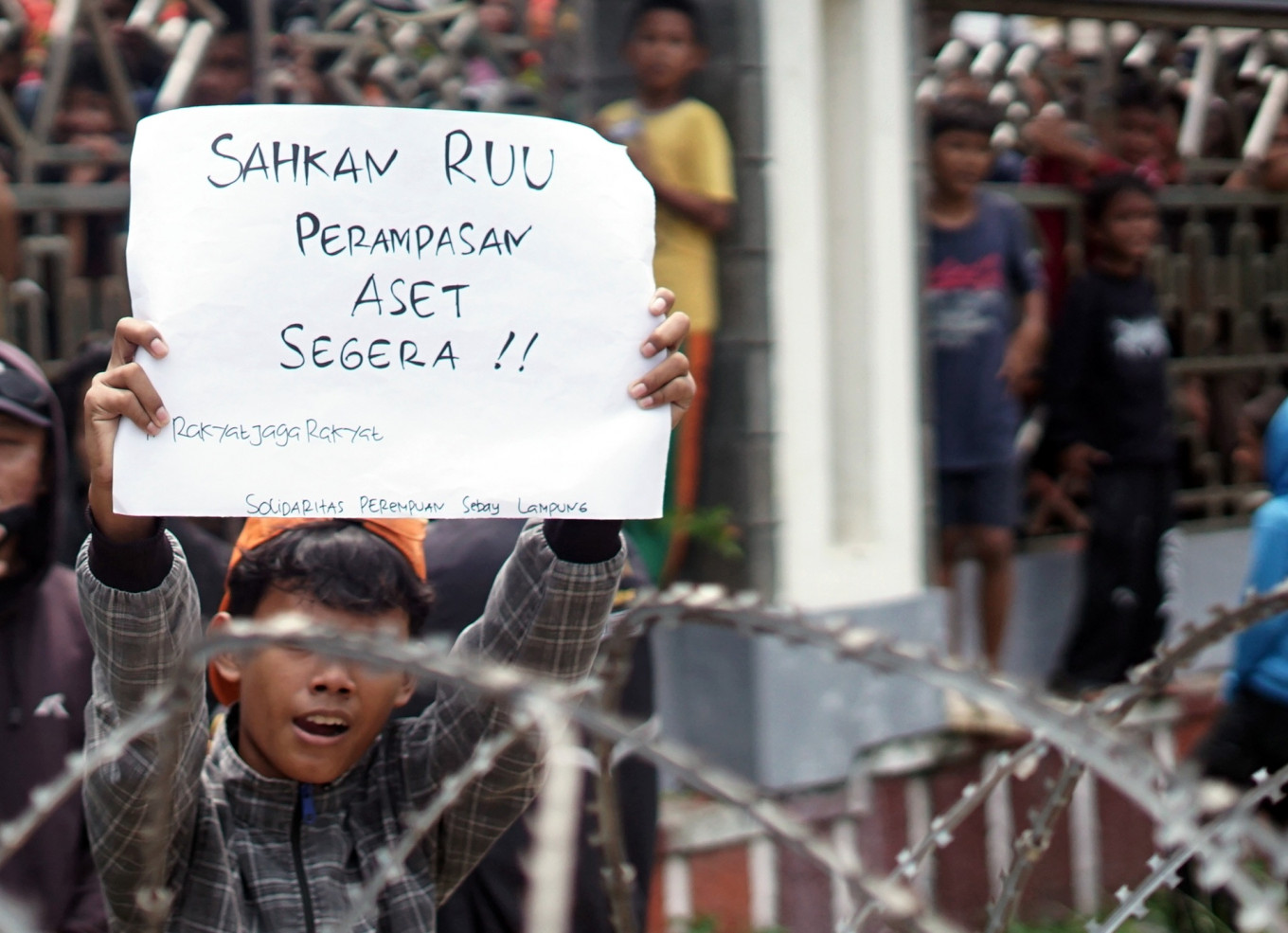 A protester holds a banner calling for the passage of the asset forfeiture bill during a protest on Sept. 1, 2025, at the Lampung Provincial Legislative Council (DPRD) in Bandar Lampung, Lampung. During the protest, rallygoers urged the government to pass the long-awaited asset bill and improve welfare for teachers and lecturers in the country, as well as for the legislature to cut lavish allowances for lawmakers. (Antara/Ardiansyah)
T
he House of Representatives has started discussion on the long-stalled asset forfeiture bill that is expected to strengthen the country’s fight against corruption by allowing the state to seize ill-gotten assets, with lawmakers stressing the need for caution in allowing confiscation before a conviction from the court.
The draft law, first proposed in 2008, has repeatedly stalled due to resistance from House parties. But hopes for progress rose after President Prabowo Subianto took office in October 2024 after an election campaign that emphasized an anti-graft commitment.
On Thursday, lawmakers of House Commission III, which oversees legal affairs and law enforcement, began reviewing a preliminary draft of the bill in its first hearing of this year’s sitting session, marking the first step toward the deliberation of the long-awaited regulation.
The preliminary draft was prepared by the House Expertise Body (BKD), and it must be approved as a House initiative bill in a plenary session. After then, it can be deliberated by the legislature and the government for passage into law.
In her opening remarks in the Commission III meeting on Thursday, lawmaker Sari Yuliati from pro-government Golkar Party said the proposed legislation is intended to support efforts against corruption, terrorism, narcotics crimes and other offenses motivated by financial gain.
“Law enforcement should not only punish perpetrators with prison sentences, but also recover and return state financial losses arising from criminal acts,” said Sari, who chaired Thursday’s meeting.

Read also: Prabowo’s leadership challenge and the case for asset forfeiture reform