TheJakartaPost

Please Update your browser

Your browser is out of date, and may not be compatible with our website. A list of the most popular web browsers can be found below.
Just click on the icons to get to the download page.


Jakarta Post

Employers, workers clash over new rule allowing pay cut

Workers are threatening mass protests and a lawsuit over the new regulation, while employers say without it, there would be layoffs.

Vincent Fabian Thomas (The Jakarta Post)
Jakarta
Mon, March 20, 2023 Published on Mar. 17, 2023 Published on 2023-03-17T17:22:03+07:00

Change text size

Gift Premium Articles
to Anyone

Share the best of The Jakarta Post with friends, family, or colleagues. As a subscriber, you can gift 3 to 5 articles each month that anyone can read—no subscription needed!

T

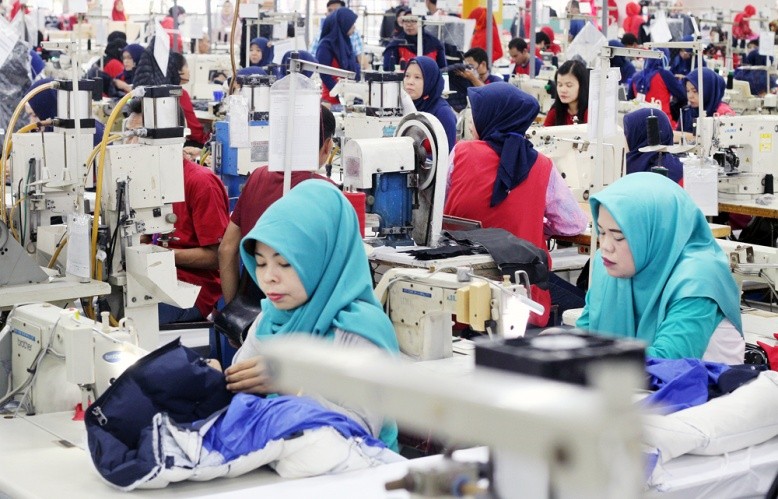
he government has allowed employers to temporarily reduce their workers’ pay by up to a quarter to lighten the burden of industries heavily impacted by slower exports amid weakened global demand.

Article 8 of Manpower Minister Regulation No. 5/2023 states that employers can adjust wages to no less than 75 percent of the normal amount for 6 months since the provision took effect on March 8.

The same regulation allows firms to temporarily cut working hours to less than the usual 40 hours a week.

Only businesses that operate in the textile, footwear, leather goods, furniture or children’s toys industries and rely heavily on demand from the United States and Europe may avail themselves of those options, according to Article 3 of the regulation.

Confederation of Indonesian Workers Unions (KSPI) chairman Said Iqbal contested the provision and said workers would respond with a protest in front of the ministry’s building and file a lawsuit with the State Administrative Court (PTUN).

The rule may be against the law, he said, arguing that it could push workers’ pay below the minimum wage, as many were already close to that threshold.

The regulation was structured in a way that allowed businesses to misuse it to pay their workers much lower wages, he said in a statement on Wednesday, adding, “This can be harmful for our country.”

Other labor unions, including the Confederation of Indonesian Prosperity Trade Unions (KSBSI) voiced similar concerns, saying the rule could undermine workers’ rights and welfare.

Read also: Employers, workers still locked horns over 2023 minimum wage

Indonesian Employers Association (Apindo) deputy chairman on manpower Anton J. Supit told The Jakarta Post on Friday that the regulation was not perfect but good enough to help industries stay afloat so that they did not have to resort to layoffs.

Anton said the regulation allowed firms to adjust working hours based on incoming orders, while the 75 percent floor ensured workers were still paid well enough during the difficult times.

If firms were still forced to pay in full, even when there were no orders, he warned, that could result in more layoffs, or, in the worst-case scenario, companies might not live to see another day.

“The regulation should help a lot, though it still cannot rule out layoffs entirely, but I want to be clear that, if conditions improve in less than six months, we may not need to use the policy. We may even consider overtime,” Anton said.

Read also: Textile industry faces layoff storm amid ailing exports

Orders in the footwear industry were down by an average of 50 percent compared to this time last year, while businesses selling textiles and other export commodities, such as furniture and rubber, had seen 30 percent fewer orders from buyers, he said.

According to Workers Social Security Agency (BPJS TK) records, more than 900,000 workers had claimed their retirement savings in response to layoffs as of November 2022, and Anton projected the figure could exceed 1 million for the full year, as not all workers were laid off through formal mechanisms.

“I do not have the latest numbers, but I am sure there are more to come,” Anton said.

Indah Anggoro Putri, the ministry’s director general of development of industrial relations and labor social security, defended the regulation, saying it would benefit both companies and workers amid slower demand from the global market.

“We want to make sure that, despite the adjustment, workers are not paid far too little. This, on the contrary, can help safeguard their purchasing power,” Indah told Kontan on Thursday.

Your Opinion Matters

Share your experiences, suggestions, and any issues you've encountered on The Jakarta Post. We're here to listen.

Enter at least 30 characters
0 / 30

Thank You

Thank you for sharing your thoughts. We appreciate your feedback.

Share options

Quickly share this news with your network—keep everyone informed with just a single click!

Change text size options

Customize your reading experience by adjusting the text size to small, medium, or large—find what’s most comfortable for you.

Gift Premium Articles
to Anyone

Share the best of The Jakarta Post with friends, family, or colleagues. As a subscriber, you can gift 3 to 5 articles each month that anyone can read—no subscription needed!

Continue in the app

Get the best experience—faster access, exclusive features, and a seamless way to stay updated.