Can't find what you're looking for?
View all search resultsCan't find what you're looking for?

View all search resultsRoads, transportation hubs clogged with travelers.
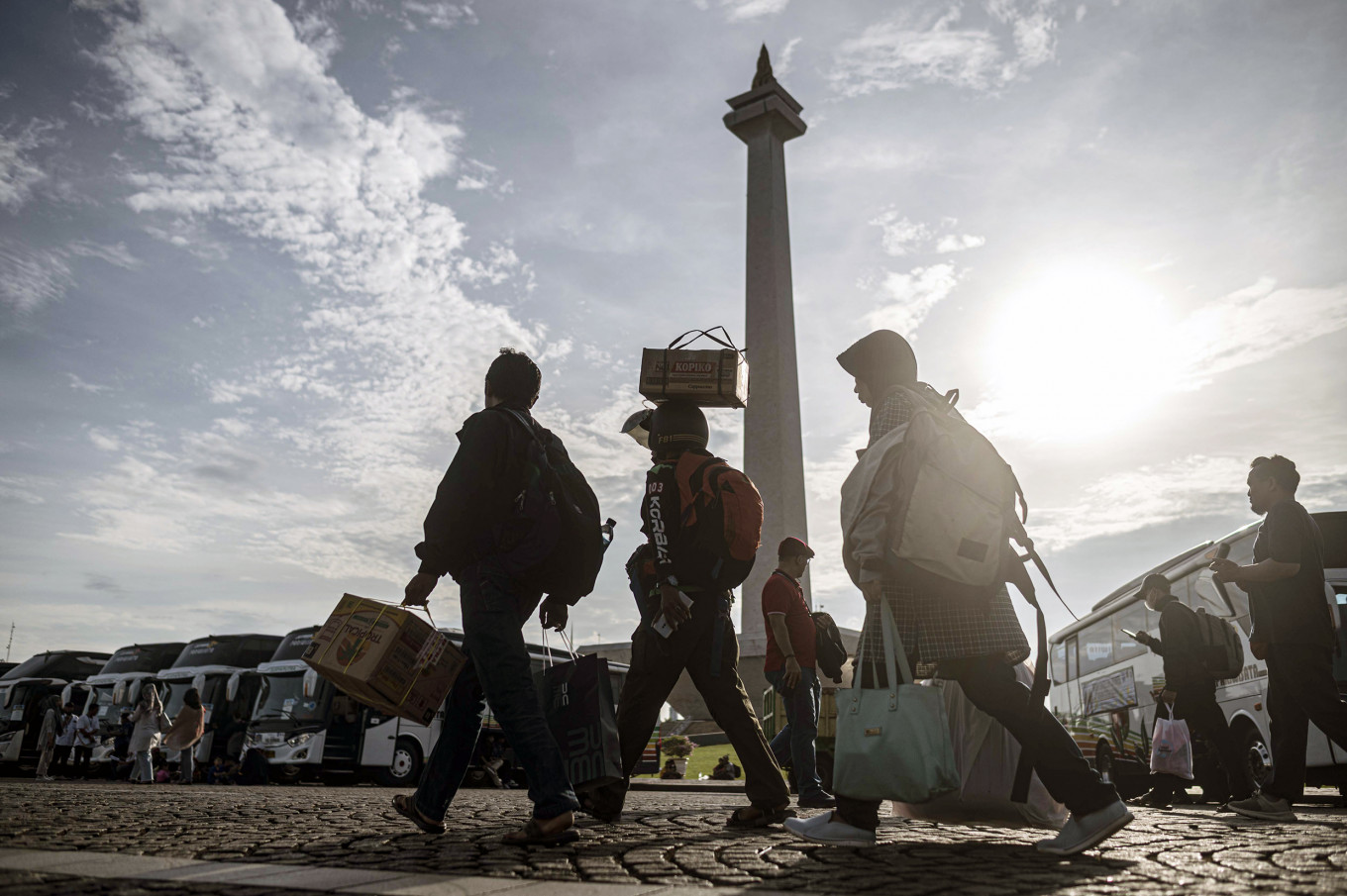
ith the country’s biggest homecoming mudik (exodus) season in recent memory now in full swing, public transportation hubs and thoroughfares across the country have been clogged with millions of Indonesians making their journeys back home.
Wednesday, the start of a seven day Idul Fitri holiday period, saw the Jakarta-Cikampek toll road, which is the main passageway for cars leaving Jakarta eastward, pummeled by heavy traffic.
West Java Police spokesperson Sr. Comr. Ibrahim Tompo said based on police monitoring on Wednesday noon, there were lines of cars that stretched 60 kilometers.
This was despite the enactment of a one-way toll road policy from the Cikampek toll-road stretching all the way to the Kalikangkung toll gate in Central Java, which has also seen a drastic increase in traffic.
Read also: Mudik one-way arrangement starts on Trans-Java Toll Road
National Police chief Gen. Listyo Sigit Prabowo said the Kalikangkung toll gate had seen close to a three-fold increase in traffic by Tuesday night, as the volume was expected to only pick up close to Idul Fitri.
According to Transportation Ministry estimates, cars are the most popular choice for mudik-goers this year, with around 27 million people preferring to use it to travel back to their hometowns.
The police have estimated that the peak of traffic for mudik this year would happen on Wednesday, while the Transportation Ministry estimated that the peak would instead occur on Friday, the eve of Idul Fitri.
The Merak and Ciwandan ports in Banten, which ferries cars and motorcycles from Java to Sumatra, respectively, have also seen a spike in the number of travelers.
The Ciwandan port averaged around 800 to 1,200 motorcycles ferried per trip as of Wednesday morning, up from the 200 to 300 motorcycles averaged in the days prior, Kompas.id reported.
Merak port, meanwhile, carried a total of 13,280 cars on Tuesday, up from the total of 10,650 cars ferried on Monday.
State-owned railway company PT Kereta Api Indonesia (KAI) also reported that long-distance trains heading out of the capital had reached an occupancy rate of 100 percent on Wednesday, as a total of 41,900 passengers traveled out of Jakarta’s Pasar Senen and Gambir stations, Kompas.com reported.
With no health restrictions in place, the government expects some 123 million Indonesians to perform mudik this year amid a slight increase in the country’s COVID-19 cases.
To this end, President Joko “Jokowi” Widodo said last week that while the caseload uptick was not a cause of concern, the public should still get themselves vaccinated and practice health protocols.
Read also: Jokowi urges public to get vaccinated ahead of Idul Fitri
Dangers ahead
As record numbers of mudik travelers have been expected this year, observers urged authorities to be cautious of the high volume of motorbikes, the second most popular mudik transportation option, set to crowd the country’s arterial roads.
The Transportation Ministry estimated some 25 million Indonesians will travel on motorbikes, despite repeated warnings from authorities on the dangers of doing so.
“Aside from having the potential to cause traffic jams on [arterial] roads, the large number of travelers using motorbikes makes traffic accidents more prone to happen,” transportation expert Djoko Setijowarno said earlier this week. “Moreover, there are a lot of travelers on bikes bringing their children or even toddlers, leading to their safety often being neglected.”
While the government had campaigned for holidaymakers to instead use public transportation to travel to their hometowns, Djoko said the lack of public transportation options remained a stumbling block.
Djoko added that authorities needed to pay extra attention on how it planned to manage the rest areas of toll roads across Java and the traffic heading into Merak and Bakauheni, which were inundated with severe traffic jams last year.
Return traffic
While authorities are still setting their sights on the peak of the mudik flow, preparations have also been made to handle the counter-mudik flow, which will see millions of people heading back to the country’s metropolitan areas.
According to the Transportation Ministry, the peak of the counter flow will happen on April 25, the last day of the collective mandatory leave.
“The peak return flow is expected to happen two days after [Idul Fitri], on Tuesday, April 25, which will see 17.7 million people [on the move]," Hendro Sugiatno, the Transportation Ministry’s Land Transportation director general said earlier this week.
The ministry’s estimate echoed that of Jasa Marga, as the state-owned toll road operator said earlier this month that some 176,000 cars would pass the Jakarta-Cikampek toll road on its way back to Jakarta on April 25.
To help alleviate traffic, authorities are hoping to stagger the return to Jakarta by enacting an odd-even policy and a one-way traffic policy on the Trans-Java toll road from Kalikangkung to Cikampek from April 24 to April 26, as well as from April 29 until May 1, the weekend following Idul Fitri.
Share your experiences, suggestions, and any issues you've encountered on The Jakarta Post. We're here to listen.
Thank you for sharing your thoughts. We appreciate your feedback.
Quickly share this news with your network—keep everyone informed with just a single click!
Share the best of The Jakarta Post with friends, family, or colleagues. As a subscriber, you can gift 3 to 5 articles each month that anyone can read—no subscription needed!
Get the best experience—faster access, exclusive features, and a seamless way to stay updated.