TheJakartaPost
Please Update your browser
Your browser is out of date, and may not be compatible with our website. A list of the most popular web browsers can be found below.
Just click on the icons to get to the download page.


Popular Reads
Top Results
No results found. Please check your search term and try again
Can't find what you're looking for?
View all search results
Popular Reads
Top Results
No results found. Please check your search term and try again
Can't find what you're looking for?
View all search resultsMosque politicization: Seizing votes from houses of worship
The politicization of mosques runs counter to the primary functions of a mosque as a place of worship and spiritual and social development.
Change text size
Gift Premium Articles
to Anyone
Share the best of The Jakarta Post with friends, family, or colleagues. As a subscriber, you can gift 3 to 5 articles each month that anyone can read—no subscription needed!
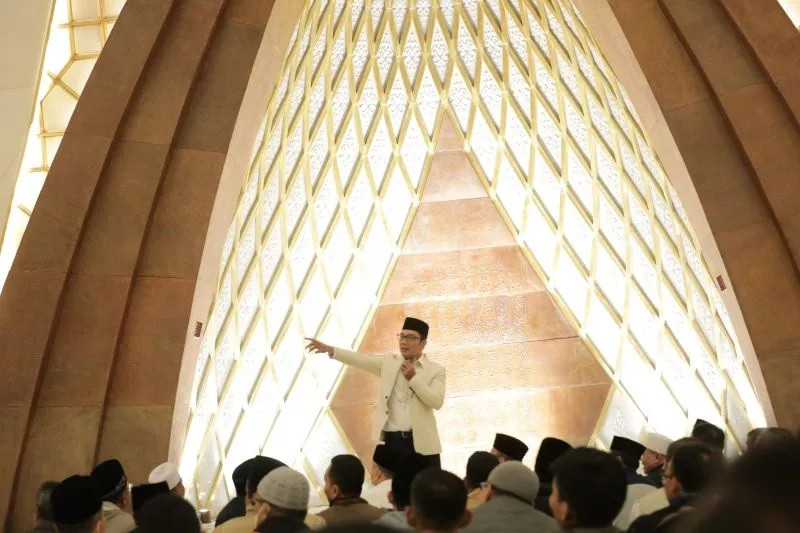
In the last few months, all presumptive presidential candidates have visited mosques allegedly for political purposes. In March, former Jakarta governor Anies Baswedan visited Al-Akbar Grand Mosque in Surabaya, East Java, while Central Java Governor Ganjar Pranowo toured Banten Grand Mosque in West Java in May.
Gerindra Party chairman Prabowo Subianto attended a youth gathering at Istiqlal Mosque in Jakarta last month as a speaker. He refrained from displaying his political ambitions despite temptations from the floor to do so.
The Election Supervisory Body (Bawaslu) has expressed concerns about the potential misuse of places of worship, including mosques, for political activities and reminded all political parties and candidates not to break the rule.
Law No 7/2017 on elections prohibits the use of houses of worship for campaigning and other political purposes. Recently, Religious Affairs Minister Yaqut Cholil Qoumas stated publicly to protect mosques from any politicization agenda.
However, Prosperous Justice Party (PKS) politician Mardani Ali Sera insists that there is nothing wrong with mosque politicization. In fact, in every election, gaining control of houses of worship, especially mosques, and religious figures has been crucial in winning voters’ hearts and minds.
All candidates will fight it out for support from Muslim voters in this majority-Muslim country. They are approaching and seeking a blessing from prominent and charismatic religious figures such as ustads, kyai (religious teachers), habaib (prophet descendent) by visiting their Islamic boarding schools and mosques.

It is widely known that the politicization of mosques is common during elections. It refers to the practice of using mosques as a means to promote certain political agendas. It obviously runs counter to the primary functions of a mosque as a place of worship and spiritual and social development. Furthermore, this practice can lead to polarization, a hostile atmosphere and horizontal conflict within the community.
Mosque politicization can be identified from the following criteria. First, the use of the pulpit as a political platform. During Friday prayer, a preacher has the authority to deliver political messages to support a certain candidate. Second, the distribution of political campaign materials in mosques. Third, fundraising agenda around a mosque to support a certain political candidate. Fourth, the use of a person-to-person approach inside the mosque to direct one’s vote for a particular candidate. Lastly, direct involvement in political campaigns through the mosque.
Mosques belonging to individuals or groups are more prone to politicization. Unlike in other majority Muslim countries like Saudi Arabia, United Arab Emirates, Malaysia and Brunei Darussalam where the state fully controls the mosques and all activities there, in Indonesia the management of mosques and their regulation is far less stringent. Apart from issuing building permits and registering mosques, the authorities in the country do not have control over mosques because of their ownership status.
In Indonesia, each mosque can operate independently. The majority of mosques in the country are independent, managed from, by and for the community or institutions. As the government has no direct control of the mosque, there is no government budget allocated for the mosques’ routine spending, such as honorariums for imams, preachers and Quran teachers.
During the presidency of Soeharto, the government initiated in the 1980s a state project to build 999 mosques in almost all regions across the country. The project, called Pancasila Mosque and run by the Amal Bhakti Muslim Pancasila Foundation (YAMP), was part of Soeharto’s efforts to maintain his grip on Muslims. The source of funding came from the bureaucracy, police and military budgets. It ended in 2009 and the mosques eventually were handed to the community.
There are 663,596 registered mosques across the country according to the Religious Affairs Ministry. Only about 5 percent of them belong to, hence are controlled by, the government.
The Indonesian Mosque Council (DMI) set the number higher at around 800,000. The problem is the DMI has no further data about the mosques, including their names and addresses.
As the elections draw near, the politicization of houses of worship, particularly mosques, is likely to expand, with all its consequences to society. Politicians and political parties will intensify their visits to the places of worship to win the sympathy and eventually votes of the congregation.
It is imperative for the Religious Affairs Ministry, the DMI and the country’s largest Islamic organizations Nahdlatul Ulama and Muhammadiyah to stand against the politicization of mosques otherwise it will increase polarization, hostility and conflict in society. Mosques, as well as other houses of worship, are supposed to be centers of the propagation of peace, religious tolerance and moderation.
The role of Bawaslu will be no less crucial in preventing the politicization of houses of worship. It will only need fortitude in upholding the election rules to prevent any misuse of places of worship for political gains.
***
Aji Sofanudin is a senior researcher at the National Research and Innovation Agency (BRIN). Ahalla Tsauro is a master’s student at the National University of Singapore. The views expressed are their own.