TheJakartaPost
Please Update your browser
Your browser is out of date, and may not be compatible with our website. A list of the most popular web browsers can be found below.
Just click on the icons to get to the download page.


Popular Reads
Top Results
No results found. Please check your search term and try again
Can't find what you're looking for?
View all search results
Popular Reads
Top Results
No results found. Please check your search term and try again
Can't find what you're looking for?
View all search resultsThe role of tax digitalization for economic stability
A very long bureaucratic process certainly hampers the productivity of taxpayers in the production of goods and services, affecting cash flow and decreasing economic productivity.
Change text size
Gift Premium Articles
to Anyone
Share the best of The Jakarta Post with friends, family, or colleagues. As a subscriber, you can gift 3 to 5 articles each month that anyone can read—no subscription needed!
T
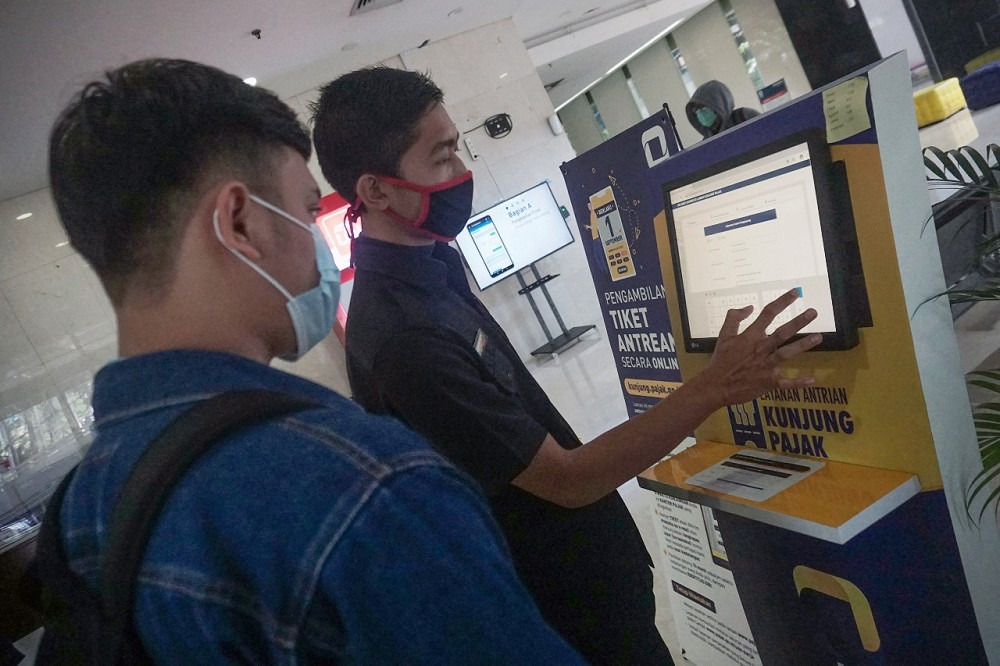
he digitalization of the tax system is one of the important agendas of the Taxation Directorate General in tax reform. Through the Tax Administration Core System Renewal (PSIAP) project and the development of an information system based on commercial off-the-self (COTS), the process is easier for taxpayers carrying out tax obligations.
Unfortunately, the various benefits of tax digitalization that are understood by the public today are in practical areas such as improving the quality and ease of service, productivity and accountability. Until now, the impact of digitalization in supporting Indonesia's economic stability has received little attention.
Understanding the relationship between tax and the economy is crucial. Especially now that the world is facing various types of crises such as the pandemic, in politics, energy and security. Therefore, a number of countries have conducted research to find the connection between tax system digitalization and economic stability.
For instance, Russia, which currently ranks 38th in the world in the development of digital technology, shows the impact of tax system digitalization to economic sustainability. Research by Volgograd State Technical University revealed that efficient tax administration had increased funding for the state budget by 5.8 trillion rubles (US$69.34 billion), up 9.1 percent from the previous year. Thus, the digitalization of the tax system can expand the fiscal space.
Studies in Organization for Economic Cooperation and Development (OECD) countries also have shown that digitalization has a positive relation to tax revenue and economic growth. This theory is in line with the Taxation Directorate General's Strategic Plan 2020-2024, which believes tax administration reform has the potential to increase the tax ratio by 1.5 percentage points.
The tax ratio compares the total revenue to the gross domestic product (GDP). Thus, if Indonesia's GDP is Rp 19.58 quadrillion (US$1.3 trillion) as shown by Statistics Indonesia in 2022, then the additional tax revenue from digitalization will be Rp 296.25 billion. This value is greater than the total health budget in 2022.
The increase in tax revenue from digitalization also increases a country's GDP. The second benefit of digitization is transparency. Russia’s tax authority has implemented verification of legal identity through its website. Russia has even implemented a system to monitor real-time transactions. Thus, taxpayers who intend to engage in the shadow economy can be prevented. This scheme also applies in the United States because all transactions made by taxpayers can be traced by tax authorities using a single identification number.
In Indonesia, when the PSIAP digitalization project is implemented in 2024, taxpayers can access the progress of the application digitally and get notification of the tax debt through the taxpayer's account. Indonesia through this tax reform has also implemented the integration of National Identity Number and Taxpayer Identification Number to facilitate data exchange between institutions. Thus, the tax system will be more credible and accountable because the monitoring process will be carried out by various parties.
In addition, the interaction between tax officers and taxpayers could be minimized so that loopholes in corruption and bribery can be closed. With the exchange of data between various institutions and jurisdictions, investment turnover, flow of funds and tax avoidance loopholes can also be suppressed.
Transparency between countries can eliminate the utilization of tax haven countries. Thus, investment will flow fairly to different countries and contribute to the development of economic activity throughout the country. It will create business expansion, employment, labor productivity, export expansion, technology transfer and economic growth.
Digitizing the tax system is also able to reduce compliance costs incurred such as waiting time, printing, transportation costs and disputes. For example, Russia has managed to reduce the number of audits from a total of 87,900 audits to 10,900 audits since the implementation of the digital system.
A very long bureaucratic process certainly hampers the productivity of taxpayers in the production of goods and services, affecting cash flow and decreasing economic productivity.
Speed, ease, certainty and low compliance costs will encourage compliance from taxpayers. Studies by Cambridge University show evidence that low transaction costs can increase cross-border productivity, and boost contractual relationships and economic performance over time.
At this point, the role of digitalization in tax reform to improve economic stability in Indonesia is crucial. Therefore, the government needs to develop the system continuously even after the PSIAP project has been implemented.
The OECD has developed a Digital Transformation Maturity Model (DTMM). This method is to ensure that the digitization process in a country can continue to develop from the emerging level to the aspirational level.
The aspirational level is when a country's tax system is able to implement real-time services as the vision of tax administration 3.0 (OECD, 2020). This aspirational level requires the consistency of tax authorities in conducting extensive cooperation with various institutions and the entire community, access to various data sources and extensive use of artificial intelligence.
In conclusion, the tax reform carried out by Taxation Directorate General needs to be viewed positively because it will have a major impact on the Indonesian economy. Meanwhile, improvement should continue to be carried out by Taxation Directorate General so that Indonesia’s digital tax system would reach the aspirational level in the DTMM model as the vision of the OECD tax administration 3.0.
***
The writer is a staff member at the Taxation Directorate General, The views expressed are her own.