TheJakartaPost
Please Update your browser
Your browser is out of date, and may not be compatible with our website. A list of the most popular web browsers can be found below.
Just click on the icons to get to the download page.


Popular Reads
Top Results
No results found. Please check your search term and try again
Can't find what you're looking for?
View all search results
Popular Reads
Top Results
No results found. Please check your search term and try again
Can't find what you're looking for?
View all search resultsIslamic New Year, migration and humanitarian principles
To deny the freedom of mobility is to undermine human dignity. With migration attesting to laws of human dignity, refusing hospitality toward any fleeing individuals merely undervalues their intrinsic importance to God's world.
Change text size
Gift Premium Articles
to Anyone
Share the best of The Jakarta Post with friends, family, or colleagues. As a subscriber, you can gift 3 to 5 articles each month that anyone can read—no subscription needed!
T
he world is engulfed in geopolitical tensions and seemingly endless humanitarian crises. As a result, from 2011 to 2022, the United Nations High Commissioner for Refugees (UNHCR) reported that a staggering 712.5 million people were forcibly displaced.
Among the displaced persons, 248.12 million individuals were forced to leave their homes behind, embarking on arduous, if not dangerous, journeys to unfamiliar lands. This is also the case of thousands of the minority ethnic Rohingya people, who have fled their homes in Myanmar by boats to escape persecution in the last few years, many of them landing in Aceh.
It is unfortunately common for these forced migrants to encounter bias or resentment from the host communities. This brings to mind a situation that unfolded in the 7th century, when Muhajirun were driven out from Mecca to Medina, with its echo seen today in the migrations of individuals amid desperate distresses.
Muslims commemorate this event as the dawn of the Islamic Hijri year, derived from the word hijra, which signifies migration. However, contrary to most expectations, the Muhajirun, as newcomers, were warmly welcomed by the Ansar, the local inhabitants.
The welcome or rejection of migrants can be explained through the lens of social identity theory propounded by Tajfel & Turner (1979). Social identity is the product of a process of social categorization, where individuals classify themselves into certain categories or groups based on attributes such as race, skin color, religion, gender, place of origin, political orientation and more, ultimately leading to the splitting of societies into two groups: an “in-group” and an “out-group”.
In short, the consequences of such group differentiation often lead to intergroup behavior and, frequently, intergroup conflict. The local population and the migrants represent two social group. In this context, the local population represents the dominant social group, while the migrants are the subordinate group.
This warm welcome of the Muhajirun by the Ansar can be placed simultaneously with the values in Islamic theology, namely mu'ākhā (brotherhood), ḍiyāfa (hospitality), ijāra (protection and support), amān (security), jiwār (neighborliness), sutra (protection) and kafala (guaranteeing someone's well-being), what Jureidini and Hassan (2020) labelled as components for dignifying migrants and opposing to objectifying them.
Furthermore, under normal conditions, Islam opposes any form of coercion concerning mobility. The freedom to choose mobility is considered a form of safeguarding human dignity, protected by sharia law, as stated in the Quran, Surah Al-Isra' verse 70.
To deny the freedom of mobility is to undermine human dignity. With migration attesting to laws of human dignity, refusing hospitality toward any fleeing individuals merely undervalues their intrinsic importance to God's world.
Moreover, Islam does not limit the behavior of dignifying migrants only to fellow Muslims. The Prophet Muhammad (peace be upon him) explicitly emphasized the need to protect the life of a non-Muslim seeker of asylum under the guardianship of Ummu Hani.
The infusion of Islam into the hearts of the Ansar eradicated the significance of origin attributes in the process of social categorization. Despite their different origins, the Ansar did not categorize the Muhajirun as an out-group.
In the aftermath of the Arab Spring in 2011, we witnessed millions of Muslims in the Middle East and North Africa (MENA) region transform into refugees and asylum seekers. According to the UNHCR, 178.4 million people were forcibly displaced within MENA countries.
During the period from 2011 to 2022, nearly 60 percent of the world's refugees and asylum seekers originated from member states of the Organization of Islamic Cooperation (OIC), with 70 percent of them migrating to fellow OIC countries.
We cannot refute that these percentages were considerably impacted by the proximity, be it geographic closeness or shared language, between the source and destination countries as found by Echevarria & Gardeazabal (2018) using the gravity model widely employed in international trade research.
Nonetheless, these findings shed light on the undeniable concentration of geopolitical tensions and humanitarian crises in the MENA region vis-à-vis the OIC over the past decade. It also underscores the significant burden carried by OIC countries in hosting refugees. But above all, how do Muslims, who are directly involved and interact with the influx of Muslim migrants, respond to this phenomenon?
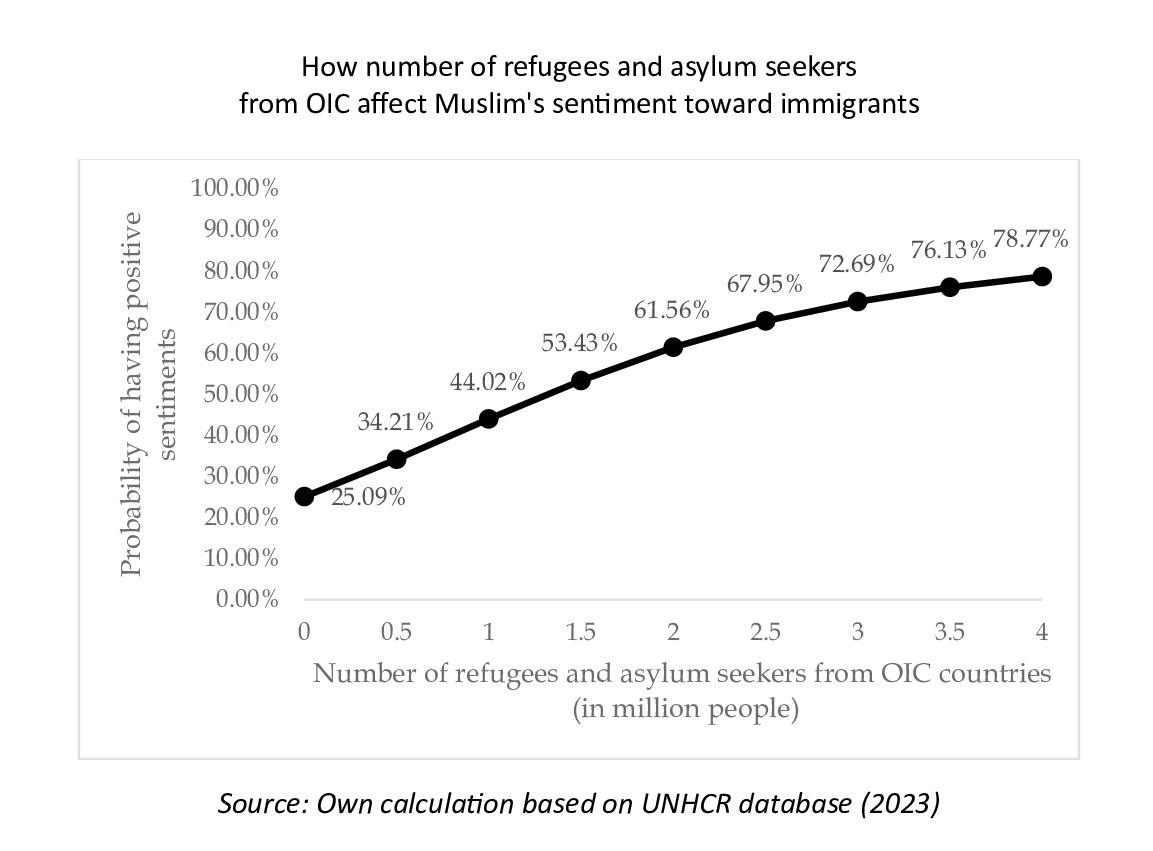
Based on our calculations from the seventh wave of the World Values Survey in 2017-2022 involving 39,849 respondents from 35 countries, the perception of Muslims toward migrants becomes more positive as the number of refugees and asylum seekers from OIC countries increases. On average, every additional 500,000 refugees and asylum seekers from OIC countries will increase a Muslim's positive sentiment toward migrants by 6.71 percent.
This increase in probability does not follow a linear pattern. Once the number of refugees and asylum seekers from OIC countries reaches 4 million individuals, the likelihood of a Muslim holding a positive sentiment toward migrants rises significantly to 78.77 percent. Moreover, it is noteworthy that religious Muslims, in particular, exhibit 5.97 percent greater friendliness toward migrants.
We hope that the inspiring interaction between the Ansar and the Muhajirun serves as a beacon of light for contemporary Muslims. These highlight the importance of prioritizing and embracing migrants. Such inclusive attitudes are crucial in a world where individuals are seeking refuge and assistance.
By extending a helping hand to fellow human beings, even in times of limited resources, we embody the true essence of humanitarianism. As a result, the Ansar received special recognition in the Quran because they selflessly prioritized the needs of the Muhajirun above their own, despite their own impoverished circumstances.
Hence, the Islamic Hijri New Year, which will fall tomorrow, should stand as an emblem of extending aid with understanding to the oppressed, reinforcing the significance of safeguarding refugees and embracing the needy without prejudice.
***
Askar Muhammad is an economist affiliated with the Institute for Demographic and Poverty Studies (IDEAS). Fithra Faisal Hastiadi is the executive director of Next Policy and a lecturer at the School of Economics, University of Indonesia. This article draws from a previously unpublished thesis authored by Askar under the supervision of Fithra.