Can't find what you're looking for?
View all search resultsCan't find what you're looking for?

View all search resultsIf we expect much more from the Western Alliance in terms of defending and promoting human rights and democratic practices in Southeast Asia, we should also demand much more from those nations in the region that, though imperfectly, are democracies.
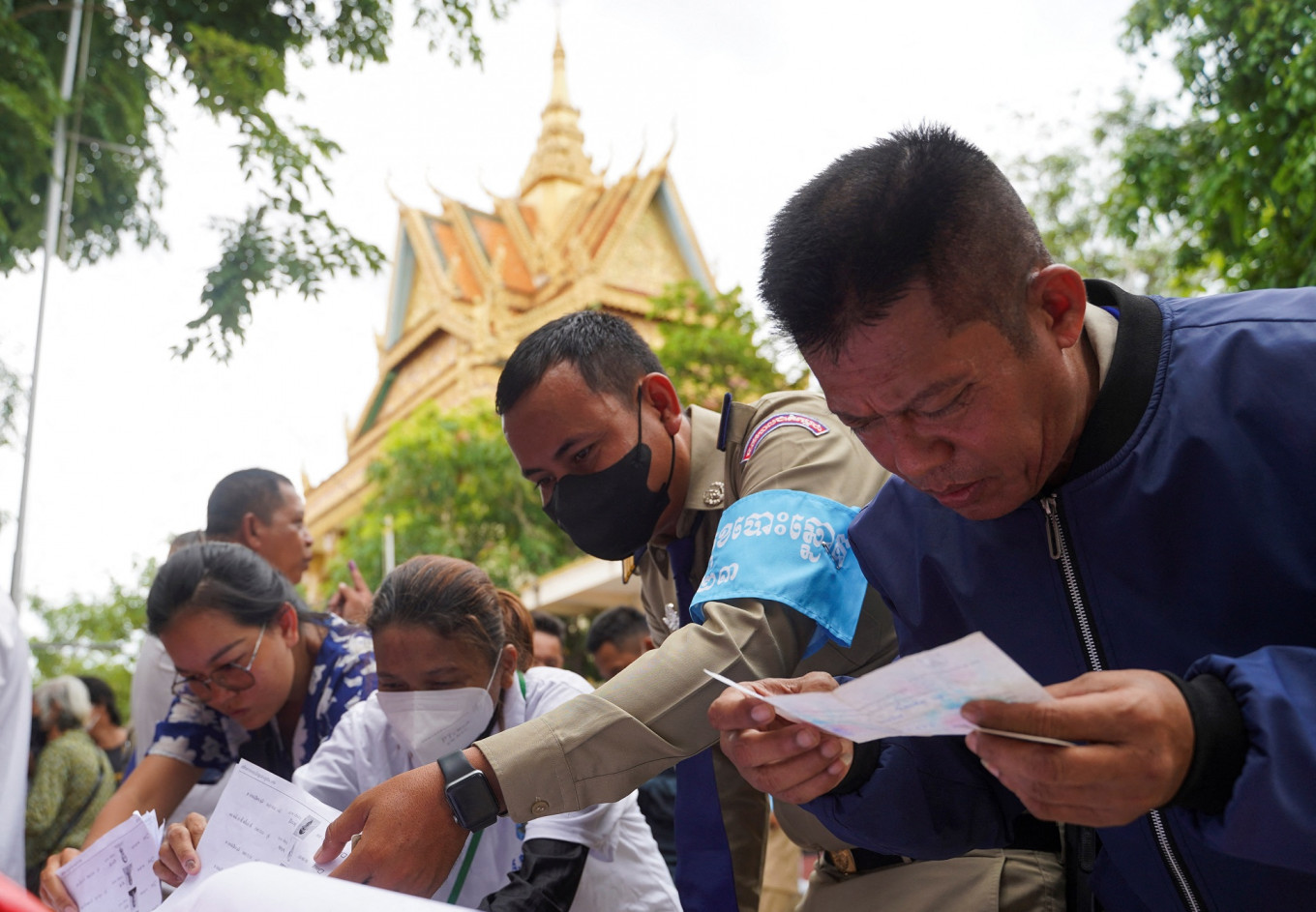
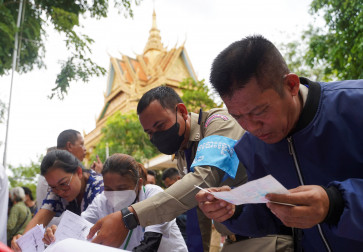
here is actually not much to write about the recent elections in Cambodia. As resignation and despair mounts, it is hard to imagine how democracy and respect for human rights can bounce back in the country.
Will the much-gossiped passing of the baton between Prime Minister Hun Sen and his eldest son, Hun Manet, herald some change? Will the handover really happen and when?
There are so many known unknowns about the future of the regime in Phnom Penh. Yet what we know for certain is that another chapter of the ongoing and unrelenting disrespect for democracy in Southeast Asia will be added.
Amid this dispiriting landscape, what could be done to push back against the authoritarianism consolidating in the region? It is an easy game for Beijing but it is a real conundrum for those members of the international community who, at least on paper, embrace not only democracy at home but have it embedded in their foreign policy.
A clear example is the European Union.
As explained by David Hutt, a research fellow at the Central European Institute of Asian Studies, the EU is now going to face a real conundrum. Will Brussels, he wonders, go hard, soft or will it engage the regime in Phnom Penh?
It seems that engagement is the only way possible. Dealing with an authoritarian state is a complex affair. You can go hard on certain aspects but then you also might be forced to compromise.
An interesting development would be if democratic members of the international community that have a high stake in the region like the United States, Australia, Canada, New Zealand and the EU, came up with a sort of joint approach to this dilemma.
I wish I could include on this list also India, but it is better to move on. At the same time, we should also expect something more from countries in the Southeast Asian region that albeit democratic, have been extremely shy at embracing the values and principles embedded in their political systems and bringing them abroad.
Perhaps we can call the Western nations hypocritical on many fronts but at least they are at pains to justify the pursuit of their economic interests with a more principled and “daunting” approach to foreign affairs, one supposedly focused on doing always the good thing: promoting human rights and democracy abroad.
But at least they try to make some noise.
Instead, other like-minded nations do not even bother to pretend to “act” nobly. You know which countries I am referring to.
It is high time that Japan and South Korea emboldened their foreign policies with a stronger emphasis on human rights and respect for a fair, inclusive and just rule of law.
My reflection here is not exclusively centered on what is going on in Hun Sen’s family and in the country they rule. Instead, mine is a broader consideration that should propel those nations espousing democracy and human rights to do more.
And if we must settle for engagement, let’s call it “tough” engagement, let’s do it properly and not from a position of deference just because trade and economic interests have to be prioritized.
In the past, the West tried to promote this approach around the idea of the Community of Democracies, that, though as an initiative is still standing, actually never took off. With a secretariat based in Warsaw, it looks much more focused on dealing with what is going on now in Ukraine and Russia these days.
While such a focus is understandable, the community should do a better job at also focusing on the Asia Pacific provided that its Asian members, Japan and South Korea (there is also India actually) are ready to invest on it.
Perhaps opening an office of its Secretariat in Seoul or Tokyo could be an interesting move, possibly less controversial and more acceptable than opening a NATO one in the region.
Its founding document, the Warsaw Declaration Toward a Community of Democracies, which was signed in 2000 laying out its key pillars and principles, remains relevant (proof of this is that many of the initial signatories backed away from it, ask Venezuela and Russia).
Indonesia, Thailand and the Philippines, together with Japan, were among the countries who decided to sign the document even though probably no one seemed interested enough to remember.
Perhaps one of the major problems is that the community is seen as too much of a Western tool, too focused on responding to the fears of Eastern European nations, and lacking any Asian (or Latin American) soul.
The Asian signatories of it apparently lack the political will to revive the community and ensure that it could pivot to East, well beyond the Urals.
But could the community be a blueprint, even an informal one, to start with, for the whole Asia Pacific?
The whole point of this piece is that, if we should expect much more from the Western Alliance in terms of defending and promoting human rights and democratic practices in Southeast Asia, we should also demand much more from those nations in the region that, though imperfectly, are democracies.
While the Western Front, including Japan and South Korea, should be more assertive, it is also fair to expect more from countries like Indonesia, Malaysia and Thailand.
And, I say this with some uneasiness, we should also include the Philippines and Singapore.
Even if the Move Forward Party in Bangkok lost the “premiership” game, there is still a high possibility that they will have a very big voice in any government led by the Pheu Thai Party.
This can be a game changer for the foreign policy not only of Thailand but also of the whole region.
If Myanmar remains the most difficult foreign policy challenge for ASEAN, finding a way to vocally and genuinely promote democracy and human rights in the region is the second biggest conundrum.
Hun Sen and his family have the formal, though very questionable legitimacy of the people of Cambodia and they will continue to advocate his own narrative and perspective over the South East Asia region.
The same can be said for the ruling regimes of Vietnam and Laos and Brunei, even though the latter could be slowly swayed away towards a more open future.
Probably, from a Southeast Asian perspective, investing in a Warsaw-based Community of Democracy is a silly idea.
What is not silly at all, though, is for the democratic camp of ASEAN to do more for universal principles and values in the region.
For now, I dream of a true democrat like President Ramos-Horta of Timor-Leste stepping in to the debate, showing some wisdom and real bravery because being a minnow does not preclude you from also being a giant.
A giant that, despite the formalities, already belongs to ASEAN.
***
The author comments on social inclusion, youth development, regional integration, SDGs and human rights in the context of Asia Pacific.
Share your experiences, suggestions, and any issues you've encountered on The Jakarta Post. We're here to listen.
Thank you for sharing your thoughts. We appreciate your feedback.
Quickly share this news with your network—keep everyone informed with just a single click!
Share the best of The Jakarta Post with friends, family, or colleagues. As a subscriber, you can gift 3 to 5 articles each month that anyone can read—no subscription needed!
Get the best experience—faster access, exclusive features, and a seamless way to stay updated.