TheJakartaPost
Please Update your browser
Your browser is out of date, and may not be compatible with our website. A list of the most popular web browsers can be found below.
Just click on the icons to get to the download page.


Popular Reads
Top Results
No results found. Please check your search term and try again
Can't find what you're looking for?
View all search results
Popular Reads
Top Results
No results found. Please check your search term and try again
Can't find what you're looking for?
View all search resultsPreventing forest, land fires in the new era of 'global boiling'
The hotter temperatures and prolonged drought could still dry out vegetation, providing highly combustible fuel for fires, allowing them to spread faster and further.
Change text size
Gift Premium Articles
to Anyone
Share the best of The Jakarta Post with friends, family, or colleagues. As a subscriber, you can gift 3 to 5 articles each month that anyone can read—no subscription needed!
T
housands of people fled disastrous wildfires on the island of Rhodes in Greece recently. A few weeks earlier, Canadian cross-border haze created doomsday-like scenes in New York. The question amid the forecast of an extreme El Niño within the next few weeks in Indonesia is how we prevent recurring forest and land fires despite the reported hottest days in history.
The era of global warming has ended and “the era of global boiling has arrived”, United Nations Secretary-General António Guterres has said after scientists confirmed July was on track to be the world’s hottest month on record (The Guardian, July 27, 2023). It is a record that will be broken again and again.
In July, the average global temperature reached just over 17 degrees Celsius. This is already over 1.5 degrees above the pre-industrial level, which the world has committed to prevent. The UN World Meteorological Organization stressed that this would not mark a permanent breach of the 1.5-degree limit set out in the Paris Agreement, which refers to long-term warming (The Jakarta Post, July 29, 2023).
In Indonesia, the Meteorology, Climatology and Geophysics Agency (BMKG) forecast of a hotter El Niño in the second half of this year has raised the fear of a recurrence of the 2015 forest and land fire disaster that destroyed an estimated 2.6 million hectares of forests in Sumatra and Kalimantan.
The World Bank estimates that the 2015 fires crisis cost Indonesia US$16 billion in losses to forestry, agriculture, tourism and other industries. The haze caused respiratory and other illnesses in hundreds of thousands of people across the region and, according to one study, likely led to over 100,000 premature deaths.
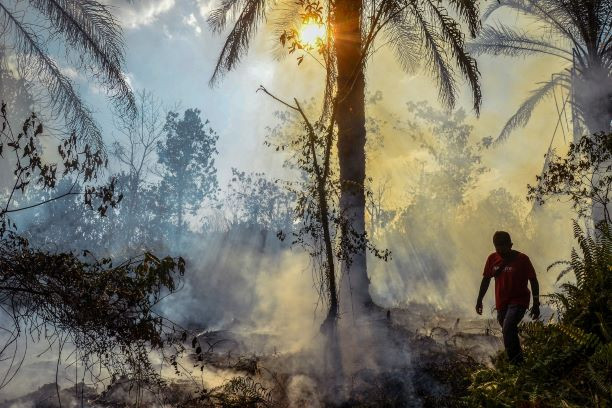
Although meteorologists have said this year’s El Niño will not be as severe as the one in 2015, the hotter temperatures and prolonged drought could still dry out vegetation, providing highly combustible fuel for fires, allowing them to spread faster and further.
Hence, the specter of the 2015 fire disaster should alert the central government, local administrations, big plantation companies and the local community to a steely determination to cooperate in fire prevention, detection and mitigation. During that time, land fires extensively occurred in palm oil-producing regions leading to allegations against palm oil companies as the chief culprits of forest and land fires.
There are at least three bold steps that should be taken by Indonesian stakeholders.
First, we should keep a close watch the slash-and-burn land-clearing practices by some community members. Because land clearing using excavators is very expensive, the common method used is slash and burn, whether for planting, marking land ownership, or resale.
Various studies have shown that the practice of slashing and burning is still rife in Indonesia. This happens on all types of land, be it community land, forest areas controlled by the government, palm oil company concessions, even ecosystem restoration concessions.
The central government should have been aware of the consequence of weak enforcement against this practice. In the past government precautions and response were totally inadequate in the face of recurrent forest and landscape fires, except when Indonesia was hosting the Asian Games in 2018.
But with the global boiling and Indonesia's chairmanship of ASEAN in 2023, there should be no relaxation against this practice.
Second, companies’ fire management, prevention and mitigation systems should be on high alert. The central government and local administrations should check how prepared are the palm oil companies to prevent another emergency of the magnitude of the 2015 fires. Even though tougher rules have been issued requiring plantation firms to restore degraded peatland, we still want to know how the rules have been enforced in the field.
Have plantation companies, notably those in fire-prone peatland areas in Riau and South Sumatra, already built up integrated fire-management systems supported with equipment and technology and the training of firefighting personnel? How is their cooperation with local administrations and smallholders and NGOs? Do they operate an extensive network of fire-monitoring posts and fire towers, ground patrol vehicles and water pumps?
It is imperative for palm oil companies to be geared up to face the threats of land/forest fires in and around concessions throughout their concession areas. Strong commitment on the part of companies to invest in and stay alert for fire prevention is also warranted as fire outbreaks can have immeasurable impacts, not only in legal and reputational costs but also extensive financial losses and health risks to both employees and community alike.
Third, collaboration with the fire monitors of stakeholders is imperative. Determination to prevent land and forest fires should also be prompted by the market and stakeholders’ demand for accountability in fire prevention. With the widespread use of satellite technology, it is easy for concerned government agencies, organizations and NGOs to monitor fire hot spots in any locations, including palm oil concessions.
Producers and consumers of popular branded goods are closely working with many organizations providing satellite monitoring of forest and land fires and issuing daily warnings and alerts anytime a fire is spotted or detected in palm oil plantations.
The palm oil industry has been evolving toward a modern fire-management system and has been embracing sustainability platforms, including those related to the prevention of fires and haze threats.
But certainly, palm oil companies cannot simply erect “walls” around their concessions by installing fire monitoring, detecting and extinguishing equipment and maintaining their own firefighting response teams. Their fire-prevention systems will never be effective without good cooperation with local administrations and local people. Therefore, they should from the outset include the participation and empowerment of surrounding communities in mitigating forest and land fires.
Consequently, it is important for all concerned stakeholders to work together and align efforts to craft and execute a nationwide, multi-stakeholder framework on early warning, detection and mitigation of forest and land fires, supported by a strong grassroots movement to prevent a permanent era of global-boiling.
***
The writers are sustainability analysts.