The Jakarta Post
Please Update your browser
Your browser is out of date, and may not be compatible with our website. A list of the most popular web browsers can be found below.
Just click on the icons to get to the download page.


Popular Reads
Top Results
No results found. Please check your search term and try again
Can't find what you're looking for?
View all search results
Popular Reads
Top Results
No results found. Please check your search term and try again
Can't find what you're looking for?
View all search resultsimf
Economy 1 year ago
PREMIUM
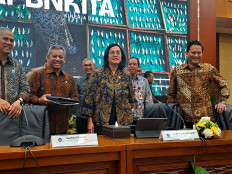
Govt sticks to 5 percent growth target despite IMF's downward revision
The government is holding onto its target for 5 percent gross domestic product (GDP) growth this year despite the International Monetary Fund revising down its projection for Indonesia’s economy in a recent update.

Economy 1 year ago
IMF slashes global outlook as White House says trade talks pick up pace
Worldwide economic output will slow in the months ahead as US President Donald Trump's steep tariffs on virtually all trading partners begin to bite, the International Monetary Fund said on Tuesday, as global finance chiefs swarmed Washington seeking deals with Trump's team to lower the levies.

Economy 1 year ago
PREMIUM
World Bank, IMF expect RI economy to grow 5.1% this year
The International Monetary Fund (IMF) and the World Bank have both kept their projections for Indonesia’s 2025 gross domestic product (GDP) growth unchanged while flagging long-term challenges for emerging economies.
Economy 1 year ago
IMF raises global growth outlook and flags rising economic divergence
Global growth is expected to increase slightly this year while remaining stuck below its pre-pandemic average, the IMF said Friday, flagging the growing economic divide between the United States and European countries.



Economy 2 years ago
IMF sees steady global growth, warns of slowing disinflation momentum
The global economy is set for modest growth over the next two years amid cooling activity in the US, a bottoming-out in Europe and stronger consumption and exports for China, but risks to the path abound, the International Monetary Fund said on Tuesday.
Editor's Picks
Popular
- Indonesia calls for more representative UN amid changing world order
- Safeguarding Indonesia's AI future
- Recentralization concerns in fiscal, education heighten
- Court decision tightens House oversight on free meals funding
- Twenty years on, BRICS faces a defining choice
- Jakarta water shortages worsen as dry season drags on
- Indian arrested for smuggling gold bars to Thailand via N. Sumatra airport
- Singapore’s BDx launches 640MW data center project in West Java
- Govt under pressure as 3 million home drive hits cracks
- Gontor leader’s blunt remarks highlight ‘pesantren’ political independence


