The Jakarta Post
Please Update your browser
Your browser is out of date, and may not be compatible with our website. A list of the most popular web browsers can be found below.
Just click on the icons to get to the download page.


Popular Reads
Top Results
No results found. Please check your search term and try again
Can't find what you're looking for?
View all search results
Popular Reads
Top Results
No results found. Please check your search term and try again
Can't find what you're looking for?
View all search resultsarchaeology
Society 8 months ago
PREMIUM
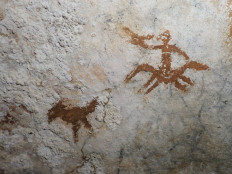
World’s ‘oldest’ rock art discovered in Southeast Sulawesi
The latest rock art found on Muna Island in Southeast Sulawesi, a faded hand stencil made out of ocher that may be made at least 67,800 years ago, might provide more clues for archaeologists about how ancient human migrated through Sulawesi to Australia.

Society 10 months ago
PREMIUM
Explainer: Tracing Fadli Zon’s ‘Out of Nusantara’ ancient humans claim
A hypothesis suggesting that ancient humans came from the prehistoric Indonesian archipelago, or Nusantara, is part of a bigger claim that suggests Indonesia as the oldest civilization in the world, Culture Minister Fadli Zon has said.

Society 10 months ago
PREMIUM
Fadli Zon’s ‘Out of Nusantara’ hypothesis meets pushback
Homo sapiens remains found in a cave in West Sumatra are among the proof used by Culture Minister Fadli Zon to support his ‘Out of Nusantara’ hypothesis, which suggests that ancient humans may have originated in the Indonesian archipelago, and not Africa, before spreading around the world.
Society 1 year ago
PREMIUM
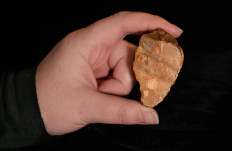
Ancient stone tools could contain clues to early Sulawesi hominins
A recent study led by a team of BRIN archaeologists suggests that the artifacts found at the Calio site in South Sulawesi's Soppeng regency could actually be stone tools, meaning that prehistoric humans lived in the Wallacea region around 500,000 years earlier than previously known.
Science & Tech 2 years ago
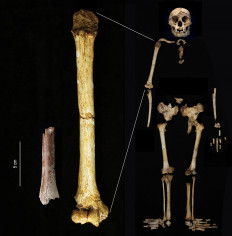
Tiny arm bone unlocks mystery of Indonesia's extinct 'Hobbit' people
Scientists on Tuesday announced the discovery of this incomplete humerus—missing both of its ends—as well as two fossilized teeth from Mata Menge in the So'a Basin of Flores, where the volcano Mount Ebulobo looms over the landscape.
Editor's Picks
Popular
- Popular discontent is justified. Authoritarianism is not the answer
- Recentralization concerns in fiscal, education heighten
- Sugarcane farmers query House over sugar imports
- Govt under pressure as 3 million home drive hits cracks
- Safeguarding Indonesia's AI future
- Power exports to Singapore hinge on regulatory clarity
- Thousands huddle in Bangkok shelters as Thai flood damages seen at $320m
- Prabowo turns to experts to tackle peatland fires after swipe at researchers
- Palestine test for UN ‘resilience’, says Indonesia
- Stocks plunge as IDX lowers minimum price cap


