TheJakartaPost
Please Update your browser
Your browser is out of date, and may not be compatible with our website. A list of the most popular web browsers can be found below.
Just click on the icons to get to the download page.


Popular Reads
Top Results
No results found. Please check your search term and try again
Can't find what you're looking for?
View all search results
Popular Reads
Top Results
No results found. Please check your search term and try again
Can't find what you're looking for?
View all search resultsFeeling better, doing worse?
There is an increasing trend of social economic losses in "natural" disasters due to the rising number of natural hazard incidents together with the increasingly vulnerable population in Indonesia
Change text size
Gift Premium Articles
to Anyone
Share the best of The Jakarta Post with friends, family, or colleagues. As a subscriber, you can gift 3 to 5 articles each month that anyone can read—no subscription needed!
 Set as preferred source

There is an increasing trend of social economic losses in "natural" disasters due to the rising number of natural hazard incidents together with the increasingly vulnerable population in Indonesia.
The United Nations International Strategy for Disaster Reduction (UNISDR) jointly with Leuven Catholic University's Center for Research on Epidemiology of Disasters (CRED) reported recently that 2008 showed an increase in the number of deaths and economic losses compared to the 2000-2007 yearly average.
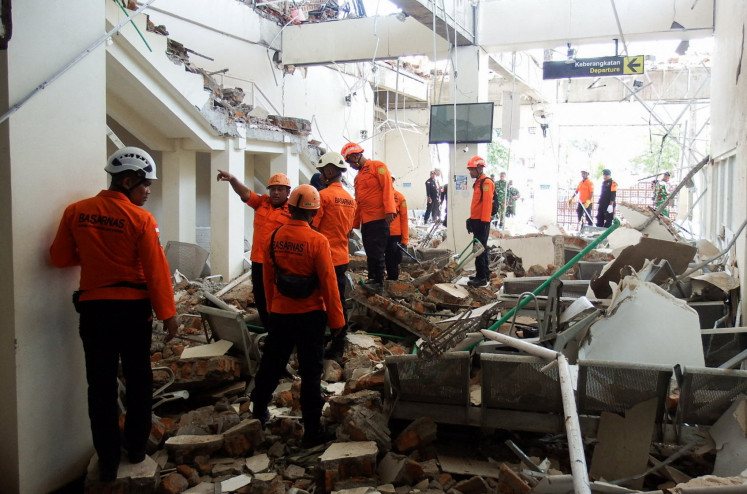
The recent 7.2-magnitude earthquake (S.R.) in the Talaud Islands regency in North Sulawesi, that caused hundreds of injuries and damage to 500 buildings according to the national media, show one important lesson. The people not only live in a vulnerable environment in regard to housing and infrastructure but also lack the infrastructure to react quickly to the warning of a potential tsunami.
We witness floods in many pro-vinces in Indonesia today, which cause losses and damage to livelihood, life and infrastructure, coming together with "the unpleasant guests" such as dengue, malaria and diarrhea (see The Jakarta Post , Feb. 14). Hence, one may be wrong asserting that Indonesia is not moving forward to reduce disaster risks amid the increasing trend of disaster risks.
On the other hand, one may share the optimistic view, asserting that Indonesia is getting better, or far better, at disaster risk management today than in the past. In terms of laws and regulations concerning disaster risks, under the auspices of the National Disaster Management Law 24/2007, followed by various ancillary regulations such as the set up of the National Disaster Management Agency (BNPB) through Presidential Regulation 8/2008 and the government regulation for Disaster Management Implementation 21/2008, Indonesia has gained new momentum for a better risk management policy.
But why do many people feel worse when the government is doing better in anticipating natural disasters? This question was once asked by Aaron Wildavsky in 1977 within the United States' context in his famous paper Doing Better and Feeling Worse: The Political Patho-logy of Health Policy, published by MIT Press. It later became known as the Wildavsky paradox.
But in the Indonesian context today, the paradox can actually be reversed "why are we feeling better while actually we are not doing enough?"
Recent efforts by the BNPB to take the first step in disaster risk reduction, that is, the draft of the National Guidelines for Disaster Risk Assessment (hereinafter NG-DRA) clearly validates the English saying "the devil is in the details." Therefore, the optimistic view may miss the fact of the shortcomings of the NG-DRA draft.
The critical point of this article is to propound why Indonesia needs better national guidelines for the better practice of disaster risk assessment. The notion that disaster risk assessment is the first step towards better disaster risk management planning has been long held by many international scientists working on disaster risk assessment.
The first step is crucial, as it will drive operational policy in the field to reduce future risk, so we and our children may enjoy less disaster risk in the future.
On the contrary, just recently, the BNPB, supported by the Safer Communities for Disaster Risk Reduction (UNDP), recruited seven natural/physical scientists and engineering experts to the NG-DRA for seven selected hazards (i.e. earthquake, tsunami, drought, forest fire, flood, landslide and volcano).
The NG-DRA is one of the top priorities of the BNPB that will later be used by at least 410 regencies and municipalities and 33 provinces. Therefore the NG-DRA is both necessary, important and strategic to the BNPB office, to complete the national guidelines for disaster risk assessment as the benchmark of national disaster risk management planning.
Unfortunatelly, the draft guidlines for disaster risk assessment only recognise the physical events of natural hazards. It does not touch on the social, economic, cultural, political and environmental aspects of disasters. The models offered as the national guidelines for risk analysis/assessment fail to adopt the latest knowledge and latest empirical research results concerning disaster risk and disaster risk analysis.
It fails to recognise the unequal distribution of the death toll in the Indian Ocean tsunami between men and women showed that there is a social and non-natural component in disaster risk.
At least four empirical researches were done in Aceh and Sri Lanka and all came out with the convincing results that women's survival rate is far less than men's. Thus, integrating gender as an important factor that shapes the distribution of risk can no longer be seen as optional but imperative.
Gender analysis of risk does not appear in the draft NG-DRA guidelines. The guidlines also fail to recognise the interplay of gender, age and economic vulnerability which may result in greater risks.
The shortcoming of the guidlines may come from the assumption that the science of doing disaster risk assessment does not really need social sciences contribution but natural science alone.
Therefore, disaster risk assessment taking into account the physical aspects of natural hazards without taking adequate account of the multiple vulnerabilities will guide Indonesia's reform processes toward ineffective and unsustainable disaster risk reduction (DRR) practices and will move the country backward, not forward.
The writer is a Ph.D candidate in Disaster Risk Governance at the University of Bonn.