TheJakartaPost
Please Update your browser
Your browser is out of date, and may not be compatible with our website. A list of the most popular web browsers can be found below.
Just click on the icons to get to the download page.


Popular Reads
Top Results
No results found. Please check your search term and try again
Can't find what you're looking for?
View all search results
Popular Reads
Top Results
No results found. Please check your search term and try again
Can't find what you're looking for?
View all search resultsEditorial: The eastern laggard
Ten years after the launching of new laws on regional autonomy no significant improvements have been made in the capacity of the bureaucratic and physical infrastructure in Indonesia’s eastern region to accelerate its economic development so it can gradually catch up with the western region — Java and Sumatra
Change text size
Gift Premium Articles
to Anyone
Share the best of The Jakarta Post with friends, family, or colleagues. As a subscriber, you can gift 3 to 5 articles each month that anyone can read—no subscription needed!

T
en years after the launching of new laws on regional autonomy no significant improvements have been made in the capacity of the bureaucratic and physical infrastructure in Indonesia’s eastern region to accelerate its economic development so it can gradually catch up with the western region — Java and Sumatra.
A macroeconomic analysis presented at a seminar in Denpasar recently by Jeffrey Kairupan, the chief of Bank Indonesia’s regional office in Denpasar, which covers Bali and the two provinces in Nusa Tenggara, showed how Indonesia’s eastern region has remained the laggard in the national economic development process.
The economy of eastern Indonesia — Sulawesi, Kalimantan, Nusa Tenggara, Maluku and Papua — grew only 5.34 percent in the first half of this year, much less than the 6.5 percent experienced by the nation on the whole.
Yet more discouraging is that this region’s economy remains dominated by the primary sector (agriculture and mining) accounting for a 40 percent share, while the manufacturing ( secondary) sector, which is supposed to add value and generate jobs, contributed only 14.8 percent, way below the national average of 32.61 percent.
It is thus not surprising that while the eastern region accounts for almost two-thirds of Indonesia’s territory, it contributed only 19 percent to the gross domestic product, way below the 23 percent from Sumatra and 58 percent from Java.
The main problem was an acute lack of infrastructure and the inadequate institutional capacity of local administrations.
These barriers not only discourage investment from overseas and the other parts of the country, but also hinder the economic linkages (connectivity) between regencies within the eastern region and between that region and the rest of the country.
The islands in that region cannot supplement each other’s local resources (comparative advantages), as can
be seen in the wide disparities in prices of goods and commodities.
It is quite unfortunate, therefore, that the other islands east of Bali (the country’s main destination for domestic and foreign tourists with up to 4 million arrivals a year) are not able to tap into the multiplier impact of the booming tourism industry in the resort island. Tourist hotels in Bali still depend mainly on imports of fish, meat and other basic goods for tourists.
Whatever investment projects the central goverment is now preparing for the eastern region under its Master Plan for the acceleration and expansion of the national economic development until 2025, basic infrastructure should be the key. Without adequate infrastructure, the various islands in the region will never undergo the process of economic integration with themselves and the rest of the country.
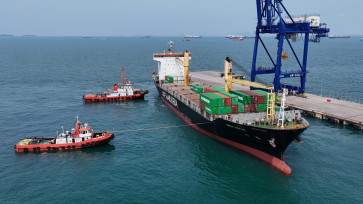
The government should develop at least four major seaports in eastern Indonesia into efficient and well-equipped hubs for inter-island and international trade in efforts to stimulate private investment in sea transport services.
We don’t believe we will be able to lift our national economic growth to between 8 and 9 percenta a year, the target set in the 15-year Master Plan, without a much bigger contribution from the resoure-rich eastern region.
Persistent massive gaps in infrastructure, which hinders economic-connectivitity between the western and eastern regions, could render the Master Plan targets as daydreams.
We need strong leadership to push through public-private partnership projects in infrastructure to jump-start the development of several growth centers in the country’s eastern region.