The Jakarta Post
Please Update your browser
Your browser is out of date, and may not be compatible with our website. A list of the most popular web browsers can be found below.
Just click on the icons to get to the download page.


Popular Reads
Top Results
No results found. Please check your search term and try again
Can't find what you're looking for?
View all search results
Popular Reads
Top Results
No results found. Please check your search term and try again
Can't find what you're looking for?
View all search resultsThe week in review: It takes two to tango
The complexity of eradicating high corruption is not that it is a crime that is more difficult to fight than any other offense, but the entanglements of personal involvement and party interests — particularly when the practice is accepted as a norm rather than an exception
Change text size
Gift Premium Articles
to Anyone
Share the best of The Jakarta Post with friends, family, or colleagues. As a subscriber, you can gift 3 to 5 articles each month that anyone can read—no subscription needed!
 Set as preferred source

T
he complexity of eradicating high corruption is not that it is a crime that is more difficult to fight than any other offense, but the entanglements of personal involvement and party interests — particularly when the practice is accepted as a norm rather than an exception.
This week there were ample examples of how daunting and seemingly distant this nation is from cleaning up its act.
The Financial Transactions Reports and Analysis Centre (PPATK) — the nation’s money laundering watchdog — alleged that dozens of civil servants still in their 20s or 30s had spliced illegal gains into their family bank accounts.
PPATK deputy chief Agus Santoso said the institution had recently submitted a report to law enforcers regarding the suspiciously large bank accounts belonging to dozens of young and low-ranking civil servants.
He admitted he was flabbergasted to find so many junior civil servants possessing such bloated accounts. But most shocking is the fact that most could remain untouched by the law since the PPATK as an institution can not prosecute civil servants given its function as a “financial intelligence unit” only.
According to Agus, since 2002 the PPATK has submitted 1,200 reports concerning suspiciously large accounts belonging to civil servants to the Corruption Eradication Commission (KPK), the AGO and the police, but the response from those institutions has so far been unsatisfactory. “There was a case involving a civil servant that we reported in 2008. Since that time [the civil servant’s] career has soared,” Agus lamented.
Suspicions of personal entanglement also took an unexpected “romantic” turn this week in the midst’s of graft defendant Muhammad Nazaruddin’s latest counter-allegations.
On Anticorruption Day, which fell on Friday, the Corruption Eradication Commission (KPK) announced that it was looking into an alleged affair involving one of its investigators and a graft case witness.
KPK chief Busyro Muqqodas said the commission was investigating the relationship between one of his investigators and corruption witness and Democratic Party lawmaker Angelina Sondakh, who was also earlier implicated by Nazaruddin in the Southeast Asian (SEA) Games graft scandal.
“There are indications that the pair is having a personal relationship and we are investigating this now,” Busyro said, while cryptically describing the affair as a “teenager” relationship.
Meanwhile, Nazaruddin himself had unleashed his latest barrage of accusations, which only seem to implicate further the depth of Democratic Party involvement in the SEA Games case.
He told the Jakarta Corruption Court on Wednesday that Angelina admitted to have received Rp 9 billion (US$990,000) from Sports and Youth Affairs Minister Andi Mallarangeng, in connection with the case.
Nazaruddin said Angelina, who serves on the House of Representatives’ commission overseeing sports, confessed before a party fact-finding team to have received the money from Andi, who is also a Democratic Party politician, and ministry secretary Wafid Muharram, who is now standing trial in the case.
She later allegedly distributed most of the money to Mirwan Amir, the party’s deputy treasurer, and party chairman Anas Urbaningrum. From the Rp 9 billion, Angelina is said to have given Rp 5 billion to Mirwan and several other politicians, Rp 2 billion to Anas and Rp 1 billion to the party’s faction at the House.
The tribulations of Susilo Bambang Yudhoyono’s party are likely to intensify as politicians look to use the new-look KPK to dig further into the politically sensitive Bank Century bailout case. Dragging the case on will potentially be a silver bullet for opposition parties to use to negotiate with the incumbent leader.
Many believe that several new KPK members will align themselves with Golkar as the potential winner of the 2014 general elections. Achmad Basarah, a PDI-P lawmaker, also said his party would use the Century case as a political weapon.
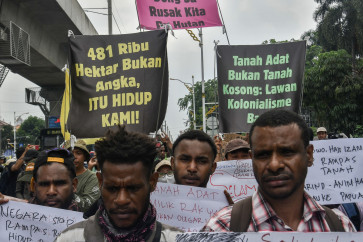
On the security front, two examples highlighted the chaos that seems to be gripping the state as those in charge fumble with their own gains. In Papua more security officers were killed this week leading many to suggest that the heightened presence of security forces may be aggravating the situation rather than helping restore peace.
Andy Denny Manoby, the secretary of the Papua Customary Council (DAP), told The Jakarta Post that the attacks aimed at officers deployed in Papua indicate local resentment toward police and Indonesian Military (TNI) officers.
The Commission for Missing Persons and Victims of Violence (Kontras) in a meeting with police brass in Jakarta suggested a review of security operations in the conflict-ridden region.
Police, however, insisted the security operations were justified and refused to withdraw officers from the region. “We will uphold security there and defend [Papua], as it is still part of Indonesia,” National Police spokesman Insp. Gen. Saud Usman Nasution said.
If the Papuan landscape is dominated by jungle, residents of Jakarta are increasingly faced with a jungle-like atmosphere too, as crime and chaos seem to grow relentlessly as violence is seen being used as a means to resolve conflict.
Teenager Ahmad Yoga Fudholi lost his life on Tuesday, allegedly at the hands of two senior students, identified only as D.R., 22, and E.Z., 24. The assailants are thought to have beaten Yoga to death on the campus soccer field after he took the wrong helmet for his motorbike.
The 19-year-old died a day after Christopher Melky Tanujaya, a 16-year-old, easy-going former math olympics champion, was stabbed to death after exiting a TransJakarta busway station in Pluit, North Jakarta.
What does this say about our society? Nothing we would want to repeat.
— Meidyatama Suryodiningrat