The Jakarta Post
Please Update your browser
Your browser is out of date, and may not be compatible with our website. A list of the most popular web browsers can be found below.
Just click on the icons to get to the download page.


Popular Reads
Top Results
No results found. Please check your search term and try again
Can't find what you're looking for?
View all search results
Popular Reads
Top Results
No results found. Please check your search term and try again
Can't find what you're looking for?
View all search resultsCity to spend more on waste management in 2013
The Jakarta Sanitation Agency plans to spend Rp 900 billion (US$93
Change text size
Gift Premium Articles
to Anyone
Share the best of The Jakarta Post with friends, family, or colleagues. As a subscriber, you can gift 3 to 5 articles each month that anyone can read—no subscription needed!
 Set as preferred source

T
he Jakarta Sanitation Agency plans to spend Rp 900 billion (US$93.26 million) this year to improve the city’s trash management, a 12 percent increase from last year’s Rp 800 billion.
Agency chief Unu Nurdin said that apart from funding the routine spending, the money would be used to revamp old garbage trucks.
“We have more than 700 trucks to transport the garbage from Jakarta to the Bantar Gebang landfill in Bekasi, but more than 500 have been in operation for around 10-20 years and are not in good shape,” he said.
Moreover, Unu said that the agency would use the money to hire permanent drivers so that the trucks available could be used effectively.
Currently, there were only around 300 permanent drivers and the agency usually hired some drivers from an outsourcing company.
The official said that the agency would also add more dump sites at the subdistrict level so that residents would have the proper space to throw away their household garbage.
“We will cooperate with subdistrict officers to seek the space, it doesn’t have to be big, as long as it is enough to hold the trash in the vicinity,” he said.
The agency plans to improve 200 official dump sites it had listed and clean dozens of illegal dump sites.
“But then again, we still have to wait for the 2013 draft budget to be approved by the City Council and Home Ministry first before we can execute that,” he said.
In December, Jakarta Governor Joko “Jokowi” Widodo submitted his 2013 draft budget, laying out plans for the spending of Rp 46.86 trillion ($4.83 billion), which is an increase of 13.32 percent from last year’s budget of Rp 41.35 trillion.
But the approval of the city’s budget has been delayed with the administration and the City Council involved in sluggish deliberations.
The administration has been behind schedule for months, as Government Regulation No. 58/2005 on regional financial management mandates that local governments must finalize their annual budgets one month before the start of the fiscal year at the latest.
Previously, Jokowi ordered the establishment of at least one trash bank at every subdistrict in order to help reduce the volume of trash sent to Bantar Gebang landfill.
Unu said that the trash bank sorted organic and non-organic trash, with organic trash processed into compost and nonorganic trash recycled.
“If the community and all related officers can keep their commitment to implementing the trash bank, it will be able to reduce around 60 percent of garbage in the city,” he said.
Jakarta produces an average of 6,500 tons of solid waste a day. The administration presently relies on the Bantar Gebang landfill, which receives 92 percent of its nonindustrial water, one-third of which comprises plastic and paper.
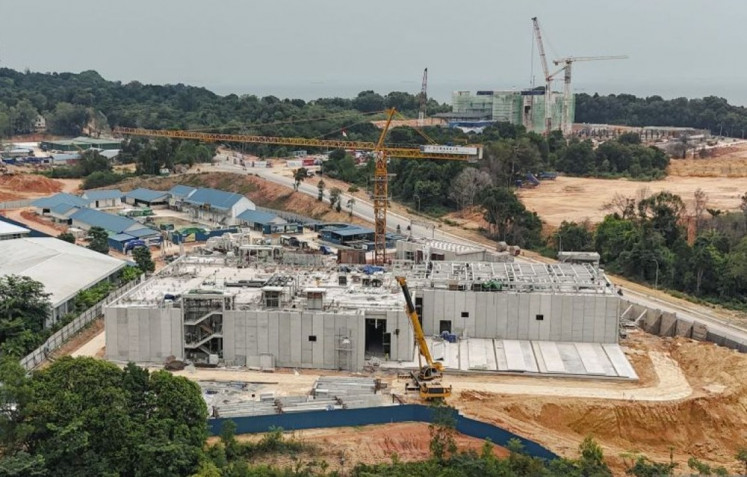
The administration would also accelerate the construction process of an intermediary waste treatment facility (ITF) in Sunter, North Jakarta.
The Sunter facility is one of two planned in the next two years, the other one is the Marunda waste treatment facility. The city opened the Cakung-Cilincing facility in 2011. The facilities are all located in North Jakarta.
The treatment facilities are expected to reduce reliance on the 110-hectare Bantar Gebang landfill. The Sunter facility has been designed to process up to 1,500 tons of garbage each day and the Marunda plant 2,500 tons a day.
The Cakung-Cilincing facility has the capacity to process 400 tons of garbage every day, which will be increased to 1,300 tons per day when it becomes fully operational.