The Jakarta Post
Please Update your browser
Your browser is out of date, and may not be compatible with our website. A list of the most popular web browsers can be found below.
Just click on the icons to get to the download page.


Popular Reads
Top Results
No results found. Please check your search term and try again
Can't find what you're looking for?
View all search results
Popular Reads
Top Results
No results found. Please check your search term and try again
Can't find what you're looking for?
View all search resultsSuccessful GPDRR conference produces ‘Seven Bali Agenda for Resilience’
Change text size
Gift Premium Articles
to Anyone
Share the best of The Jakarta Post with friends, family, or colleagues. As a subscriber, you can gift 3 to 5 articles each month that anyone can read—no subscription needed!
T
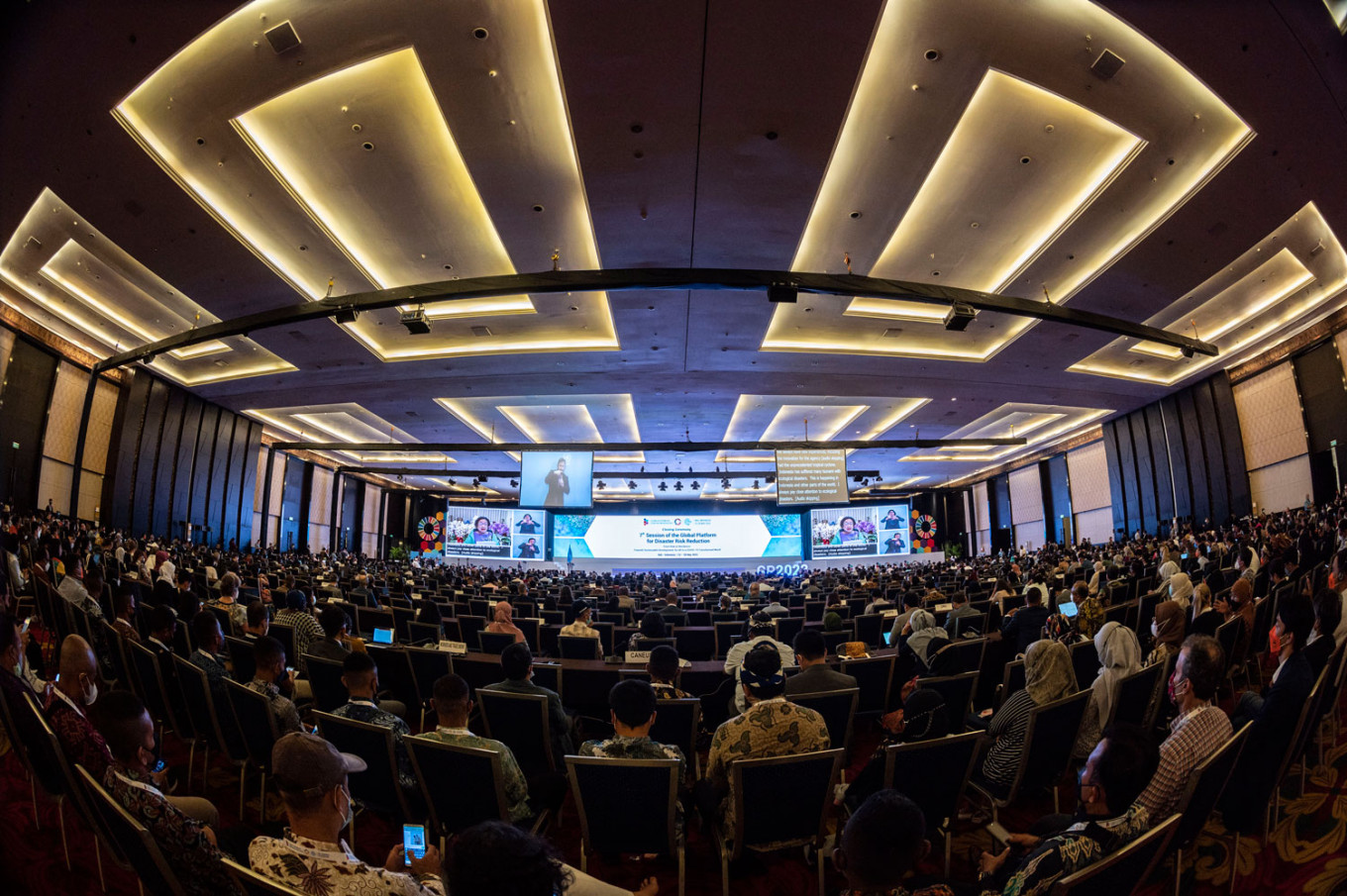
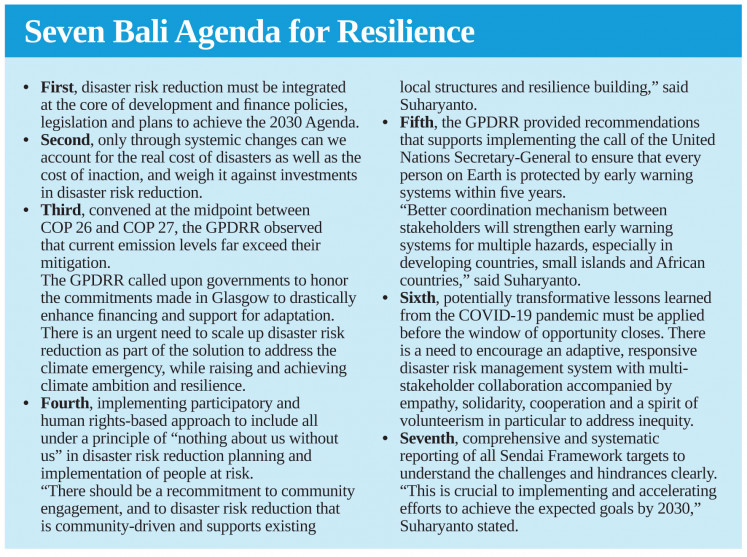
he seventh session of the Global Platform for Disaster Risk Reduction (GPDRR), a multi-stakeholder forum held in Bali from May 23 to 28, has wrapped up successfully with the Seven Bali Agenda for Resilience.
The recommended Seven Bali Agenda for Resilience (see box below) was produced through a series of meetings involving delegates from diverse countries at the Bali Nusa Dua Convention Center (BNDCC).
Thousands of foreign delegates from 185 countries attended the seventh GPDRR session, entitled “From Risk to Resilience: Towards Sustainable Development for All in a COVID-19-Transformed World”, under host Indonesia’s overarching theme of “Strengthening Partnership Toward Sustainable Resilience”.
Speaking at the closing ceremony of the GPDRR, Megawati Soekarnoputri, the fifth president of Indonesia, called on the world to unite and reinforce solidarity to cope with the various threats to humanity, including ecological disasters.
“Overexploitation of natural resources poses a threat to humanity and human civilization. Very often, we are not aware of this [potential for] disaster,” she said via video link.
Megawati also proposed strengthening the World Meteorology Organization (WMO) and scaling up international partnerships with the Meteorology, Climatology and Geophysics Agency (BMKG) in ensuring global disaster preparedness.
Meanwhile, Special Representative of the United Nations Secretary-General for Disaster Risk Reduction Mami Mizutori explained that the UNDRR did not use the term “natural disaster”, as it believed that natural disasters did not exist. Instead, what could potentially change a new hazard into a disaster was human decision.
“The good news is that it is the human decision that turns a disaster into a more dreadful one and it is the human decision that reverses the tendency, reduces the hazardous impacts, minimizes the impact of a danger that hits us,” she said.
Mizutori expressed her appreciation for the diversity she observed during the GPDRR conference in Bali and said she felt proud that the number of disabled people who attended the event had doubled from the previous meeting.
“I am very proud, because the [GPDRR] really mirrors the whole-society approach, which aligns with the Sendai Framework, and people from across the world are represented here,” said Mizutori.
“Once again, I thank Indonesia for this. I am sure that this will become one of the most beautiful legacies that we can leave here, in the center of the conference,” she said.
International Disabilities Alliance (IDA) representative Elham Youssefian explained that it believed in the whole-society approach as well as the whole-government approach, which could be adopted as a primary solution to reducing disaster risks.
“What we mean by the whole-society approach is all communities, irrespective of gender, nationality, race, disabilities, status, custom, color of skin, religion, poverty, economic status, refugee status or refugees,” Youssefian.
“As for the whole government approach, we view that every governmental sector has to be involved and has a specific plan with the awareness of how they will be engaged and what they are eager to do,” she said.
More collaboration
Throughout the meeting, Indonesia pushed for increased international collaboration with an aim of strengthening the culture and education of disaster awareness to reduce risks.
National Disaster Mitigation Agency (BNPB) head Lt. Gen. Suharyanto summed up the GPDRR series in saying, “As the host, Indonesia encourages the international community to enhance cooperation in disaster risk management through collaborations based on the principle of strengthening disaster awareness culture and education to reduce the risks. Second, [we must] invest in science and technology.”
The global platform appealed to countries to accelerate the implementation of all priorities of the Sendai Framework to mitigate disaster impacts and risks. Suharyanto added that the primary recommendations produced at the GPDRR conference had implemented “Think Resilience” for all forms of investment and decision-making by integrating disaster risk reduction policies through Penthaheliks.
Suharyanto lauded Indonesia’s success in organizing the seventh GPDRR session, irrespective of the challenges from the COVID-19 pandemic.
Speaking to the press following the closing of the GPDRR conference, he told reporters that Indonesia’s success was possible due to the hard work and contributions of ministries, institutions, civil society, businesses, academics and the media.
Managing a multinational conference that involved more than 3,300 representatives, over 150 speakers and moderators and more than 3,000 virtual participants required a strong media center in terms of infrastructure and public speaking capabilities, which both delegates and media officers needed, he added. The GPDRR produced much important information that needed to be amplified so that world communities could obtain the information quickly and benefit from the conference.
Foreign journalists covering the conference commended the ease and convenience that the GPDRR media center had provided, particularly in terms of highly accurate and speedy delivery of information.
“I am speaking on behalf of 22 journalists from the group union where I work. We are all happy to be here,” said SG Department Asia-Pacific Broadcasting Union head Natalia Ilieva.
“Everything worked well. The most important thing is that all [supported] each other well. It’s very accommodative, whatever it is,” praised Natalia.
Meanwhile, Director General of Information and Public Communication Usman Kansong underscored the importance of a strong and well-prepared media center with its supporting infrastructure to pave the way for the successful organization of the event.
He said that GPDRR had been jointly organized by the Communication and Information Ministry and the United Nations.
According to Usman, setting up a media center is a standard requirement for organizing a national or international event. “As for Indonesia, a media center aims to facilitate and provide ease for journalists to cover the event well, which at the end of the day serves the public in terms of fulfilling their right to know in line with Article 28 of the 1945 Constitution,” he said.
To ensure the successful organization of the GPDRR, the Communication and Information Ministry started with a preparatory phase in August and September last year, with meetings with National Disaster Mitigation Agency (BNPB), the Foreign Ministry and other stakeholders.
“But it did not become intense until the last two months prior to the event,” he said.
During the preparatory phase, the committee provided required infrastructure and facilities that included a newsroom, a working space, laptops, desktop computers and stable internet/WiFi connections.
The preparatory phase also included providing space for a press conference, resource persons, press releases, photos, etc. “We make sure that we can meet what journalists need to enable them to cover the event well,” he said.
According to Usman, in the first and second days of the event, coordination was a challenge, but this was addressed by continuously making adjustments in response to the arising situations. “We had no significant challenges as we have learned the lessons from previous experiences in organizing international events which we can use as a benchmark,” he said, adding that the Communication and Information Ministry had previously organized numerous international events.
Providing resource persons in every event was also crucial for media. Apart from planned resource persons, such as national and international spokespeople or speakers, the committee had to also be ready to prepare request-based spokespeople for an interview associated with particular issues.
Usman pointed out that every successful event, including the GPRR conference, had two valuable outcomes. First, it demonstrated Indonesia’s ability to organize an international event, which meant the global community would trust the country as host or organizer in the future. Second was that the substance of the event, namely the seven recommendations (see box below) produced at the GPRR conference, could be properly delivered to the people, which encouraged public participation.