TheJakartaPost
Please Update your browser
Your browser is out of date, and may not be compatible with our website. A list of the most popular web browsers can be found below.
Just click on the icons to get to the download page.


Popular Reads
Top Results
No results found. Please check your search term and try again
Can't find what you're looking for?
View all search results
Popular Reads
Top Results
No results found. Please check your search term and try again
Can't find what you're looking for?
View all search resultsBeyond the subak: the story of the award-winning Paving Puzzle
Change text size
Gift Premium Articles
to Anyone
Share the best of The Jakarta Post with friends, family, or colleagues. As a subscriber, you can gift 3 to 5 articles each month that anyone can read—no subscription needed!
 ( Courtesy of Warmadewa University)
S
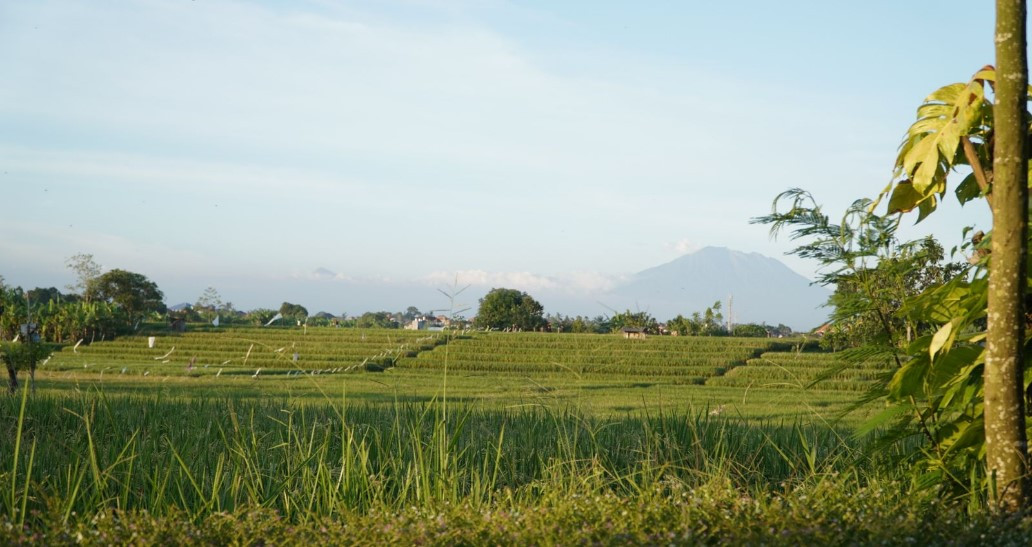
tudents from Universitas Warmadewa, Bali, have highlighted the hidden potential of subak, the traditional Balinese irrigation system that has been recognized by UNESCO as a world heritage.
Through observation and field studies, Warmadewa Muda delegates saw great potential in the utilization of agricultural waste, which has not been optimally managed in Bali's rice fields.
Warmadewa Muda, whose members include Gede Indra Winata Putra, Rani Melianitha Modesta, Priyadi Angga Wiguna, Richard Adrian Pradnyana and Maya Krisnaning Trawoco, identified that straw, husk and rice field snail waste contain many beneficial substances.
Upon closer examination, rice straw contains 37.1 percent cellulose while rice husks (Oryza sativa) contain 86.90 percent silica. The cellulose content can be used as a source of carbon and silica, which has the potential to be used as a cement mixture.
Meanwhile, Pila ampullacea snail shells contain 92.68 percent calcium carbonate, which has the potential to be used as a strengthening mixture for building materials.
Following the research, the delegates drew a deductive correlation by utilizing rice straw, rice husks and snail shells as the main ingredients for making paving blocks. This idea was further innovated into puzzle paving with the aim of strengthening the paving bonds so that they do not easily break or shift when heavy loads are applied and during tremors from earthquakes.
The Paving Puzzle innovation was entered into a prestigious competition organized by the World Invention Intellectual Property Associations (WIIPA) together with Chizal Corporation at the Japan Design, Idea and Invention Expo (JDIE) on July 5 to 6, 2025, in Japan. The event served as a platform for global innovators to showcase their latest ideas and inventions in the fields of design and technology, bringing together the best works from various countries in one international competition platform.
On the global stage, the Warmadewa Muda delegates have showcased Indonesia's research and innovation by winning a silver medal for the Paving Puzzle. The achievement of post-harvest waste research from products that integrate the concept of ecotourism has placed Warmadewa University and Bali at the forefront of global innovation, highlighting that environmental sustainability and economic value can go hand in hand.