TheJakartaPost
Please Update your browser
Your browser is out of date, and may not be compatible with our website. A list of the most popular web browsers can be found below.
Just click on the icons to get to the download page.


Popular Reads
Top Results
No results found. Please check your search term and try again
Can't find what you're looking for?
View all search results
Popular Reads
Top Results
No results found. Please check your search term and try again
Can't find what you're looking for?
View all search resultsIPA affirms readiness to support government agenda in accelerating oil and gas production
Change text size
Gift Premium Articles
to Anyone
Share the best of The Jakarta Post with friends, family, or colleagues. As a subscriber, you can gift 3 to 5 articles each month that anyone can read—no subscription needed!
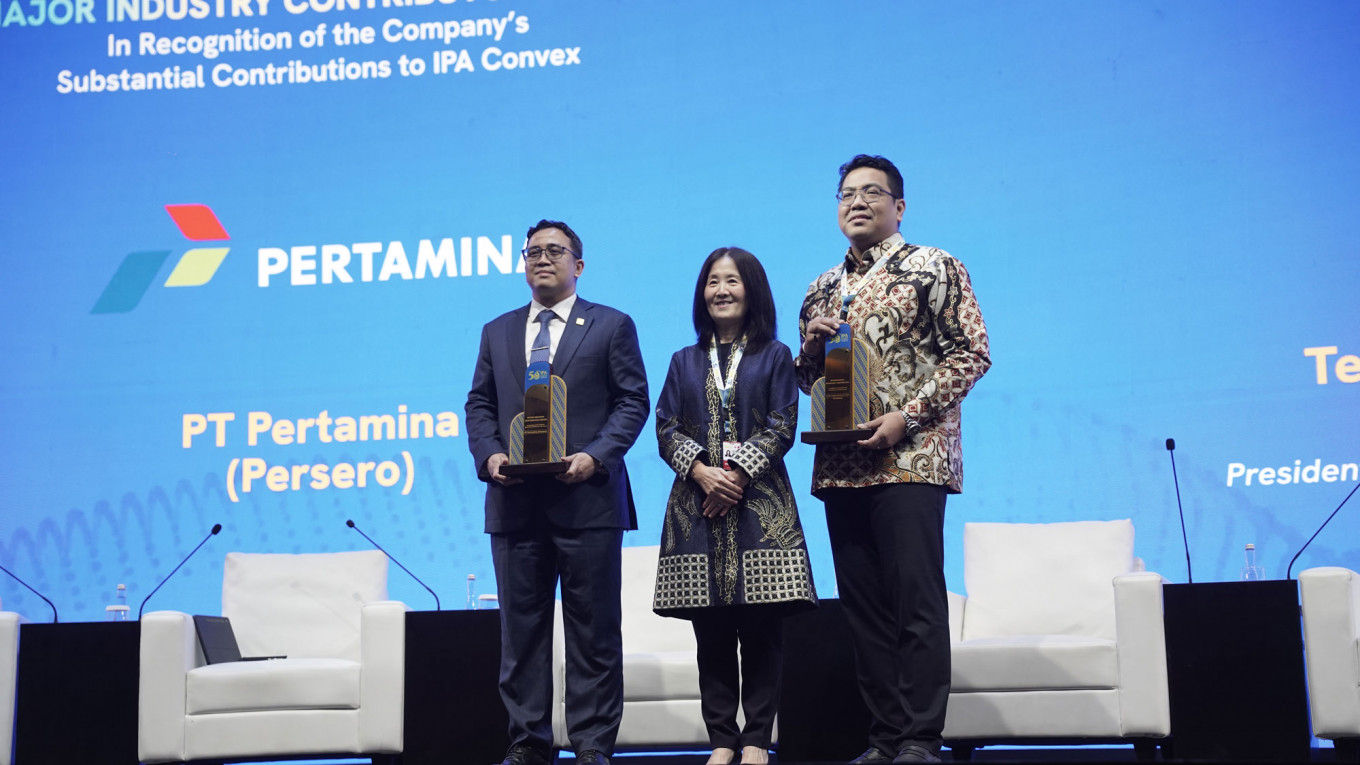 (Courtesy of IPA Convex 2026)
T
he government considers partnerships between business actors and the state to be increasingly important, especially in facing the upstream oil and gas industry’s current challenges.
Energy and Mineral Resources Minister Bahlil Lahadalia stated that lifting would not be possible without strong collaboration between oil and gas contractors (KKKS) and the government.
"We have made various efforts to reform, including various regulations to accelerate progress. I ask our colleagues at the Upstream Oil and Gas Regulatory Task Force [SKK Migas] to please let us know if there are any delays," Bahlil said on the sidelines of the inauguration of the Indonesia Petroleum Association Convention and Exhibition (IPA Convex) 2026 on Wednesday.
The government also emphasized its readiness to provide incentives, including tax incentives, to ensure the sustainability of upstream oil and gas projects. However, these incentives must be provided fairly and based on the principle of fairness.
"The state does provide tax incentives, but they are given to KKKS deemed worthy and appropriate based on feasibility studies," Bahlil said.
Meanwhile, Kathy Wu, president of the IPA, explained that to maintain this partnership, both the government and business actors must uphold three main foundations.
The first foundation is legal certainty and respect for agreed contracts. As upstream oil and gas projects are capital-intensive, high-risk and have a long cycle, investment decisions are made for years or even decades of project operation.
"When fiscal and contractual provisions are consistently respected, investor confidence will grow, capital will continue to flow and projects can progress. This ultimately creates an environment where investment can provide significant added value for Indonesia," Kathy said.
The second foundation relates to project timelines, where excessively long project cycles are one of the biggest risks in the oil and gas industry. "Therefore, all parties share the challenge of accelerating project development by minimizing obstacles and delays.”
The third foundation is in encouraging exploration activities. Indonesia is believed to have significant potential for oil and gas reserves, though Kathy noted that all of it would be wasted without exploration activities. "Indonesia still has enormous potential, with more than 50 percent of the nation's oil and gas basins yet to be optimally explored," she added.
Indonesia has a clear energy production target, and Kathy believes the IPA is ready to support this ambition. Achieving this goal requires speed, coordination and alignment across the entire system.
To that end, the IPA has affirmed its commitment to continued support and collaboration. Experience shows that strong alignment between government and industry enables projects to run more smoothly and achieve shared goals. The success of this convention, according to the IPA, should not be measured solely by the ambitious vision expressed in various speeches.
"The IPA, along with all its members, declares its readiness to be a strategic partner of the Indonesian government, ready to invest, ready to collaborate and ready to help provide safe, affordable and increasingly low-carbon energy," Kathy concluded.