TheJakartaPost
Please Update your browser
Your browser is out of date, and may not be compatible with our website. A list of the most popular web browsers can be found below.
Just click on the icons to get to the download page.


Popular Reads
Top Results
No results found. Please check your search term and try again
Can't find what you're looking for?
View all search results
Popular Reads
Top Results
No results found. Please check your search term and try again
Can't find what you're looking for?
View all search resultsTech initiatives address Indonesia’s plastic recycling problem
Change text size
Gift Premium Articles
to Anyone
Share the best of The Jakarta Post with friends, family, or colleagues. As a subscriber, you can gift 3 to 5 articles each month that anyone can read—no subscription needed!
I
n a country as large and populous as Indonesia, a bit of individual waste can go a long way, especially when multiplied by millions.
Based on a report from the World Bank’s Indonesia Marine Debris Hotspots Rapid Assessment, an estimated 20 percent of plastic waste in Indonesia ended up in rivers and coastal waters.
Experts have identified chronic problems including the absence of a proper waste collection and management system. A large part of the system is handled by the informal sector, making it difficult to control, measure and prevent from polluting the nearby environment.
Even so, Indonesia has found a likely ally in the fight against waste mismanagement: technology.
In line with the ministry’s plan to increase the nation’s waste collection capacity, the Coca-Cola Foundation Indonesia (CCFI) together with Ancora Foundation worked with waste management companies, including a startup, to create a waste management system that involves digitalization and an information system to make plastic waste collection more effective.
The program, titled Plastic Reborn 3.0, reaches out to vulnerable coastal communities in Indonesia, involving more people from the informal sector to amplify their efforts into a bigger collective action through technology adoption that eventually addresses the national crisis.

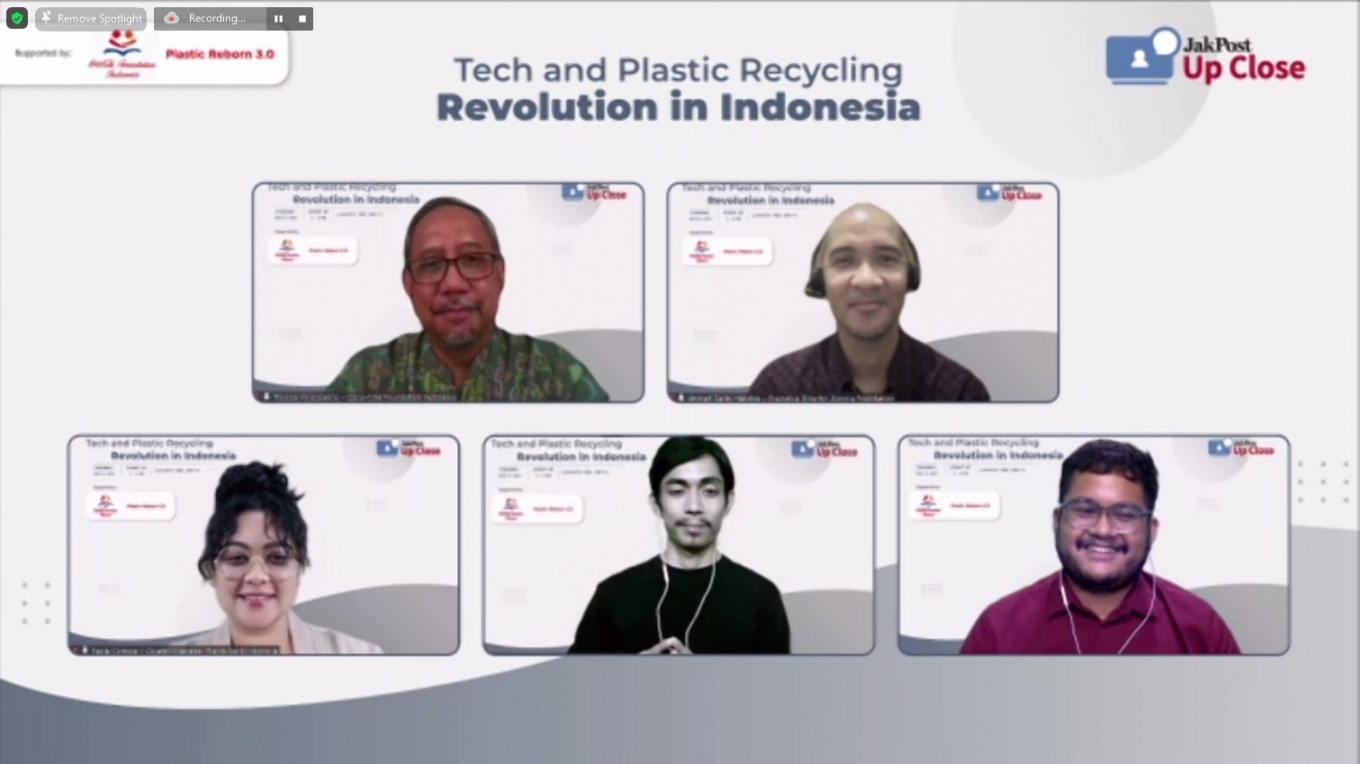
Triyono Prijosoesilo, chief executive of CCFI, explained that the initiative was part of Coca-Cola’s “World Without Waste” vision that was launched in 2018, where the company aims to help collect and recycle a bottle or can for every one sold by 2030.
“What we are saying is that we acknowledge there is a packaging problem around the world, and like all companies, we have the responsibility to help solve it. Through the World Without Waste vision, we are investing in our planet and our packaging to help make this problem a thing of the past,” he said during the 38th Jakpost Up Close webinar.
The Plastic Reborn initiative began in March 2017 as a collaborative program initiated by CCFI and the Ancora Foundation, aiming to promote a robust waste management ecosystem based on a circular economy.
Its first iteration, Plastic Reborn 1.0 focused on education and empowerment for schoolchildren, while Plastic Reborn 2.0 saw further engagement and collaboration with business stakeholders while also nurturing Indonesian talents.
Ancora Foundation executive director Ahmad Zakky Habibie noted that based on the key learnings of Plastic Reborn 1.0 and 2.0, its third phase focused on community for their vital role in the circular economy.
“Like the second iteration, we try to bet on technology and how to accelerate the collection side. [...] In this model, what we meant by community are the waste banks, some of the drop-off points which can be located in someone’s garage or a local market, as well as some of the collectors,” he said.
The focus on community, he continued, was also due to the informal sector being one of the most vulnerable, while also lacking access to education and business development opportunities.
Plastic Reborn 3.0 focused on Lombok, West Nusa Tenggara and Makassar, South Sulawesi. Lombok was chosen for its status as a rising tourist destination, while Makassar is one of Eastern Indonesia’s major industrial cities, and both will benefit from improvement of waste management infrastructures.
The project’s main objective sees the introduction of a collection app for the community, which supports waste collection by recording, tracking and monitoring the recycling data. Plastic Reborn 3.0 is funded by The Coca-Cola Foundation, where CCFI will monitor the implementation of the grant fund in Indonesia.
To date, Plastic Reborn 3.0 has also activated eight drop-off points near households and communal facilities in Lombok with the help of Plastic Bank Indonesia, while also seeing economic and social improvement as well as financial inclusion through profitable recycling.
Collectors in the Plastic Bank ecosystem receive the market rate of plastic exchange as well as a premium, allowing members to gain extra income. They also gain nonfinancial incentives that grant them access to basic necessities such as grocery vouchers, subsidized smartphones, as well as national health insurance.
Meanwhile in Makassar, approximately 100 recyclable collectors and junkyard operators have adopted the technology through its partner MallSampah, gaining increased business knowledge and optimized waste management process.
Through the MallSampah app, users can upload a picture of their recyclable waste, where the nearest collector will collect, weigh and pay for the waste. Conversely, they can visit the nearest recycling center to recycle even the smallest amount of waste.
Waste recycled through MallSampah will be converted into the MS Point digital currency, which can be exchanged for digital products such as phone and electricity credit as well as health insurance bills.
Through the Plastic Reborn 3.0 program, Ancora Foundation together with Plastic Bank and MallSampah has collected more than 14 million plastic bottles from the Lombok and Makassar region, equal to 293 tonnes.
Plastic Bank Indonesia and MallSampah have provided intensive training and mentoring to 436 scavengers and waste collectors to accelerate technology adoption in the waste management sector, improving the existing post-consumption plastic packaging waste management capabilities.
This article is joint collaboration with The Jakarta Post and Coca-Cola Foundation Indonesia (CCFI).