TheJakartaPost
Please Update your browser
Your browser is out of date, and may not be compatible with our website. A list of the most popular web browsers can be found below.
Just click on the icons to get to the download page.


Popular Reads
Top Results
No results found. Please check your search term and try again
Can't find what you're looking for?
View all search results
Popular Reads
Top Results
No results found. Please check your search term and try again
Can't find what you're looking for?
View all search resultsIn a slowing economy, SMEs must modernize
Change text size
Gift Premium Articles
to Anyone
Share the best of The Jakarta Post with friends, family, or colleagues. As a subscriber, you can gift 3 to 5 articles each month that anyone can read—no subscription needed!
 (Courtesy of Mastercard Indonesia)
Rising costs, fragile supply chains and cooling demand are forcing businesses in Asia Pacific to rethink their future strategies.
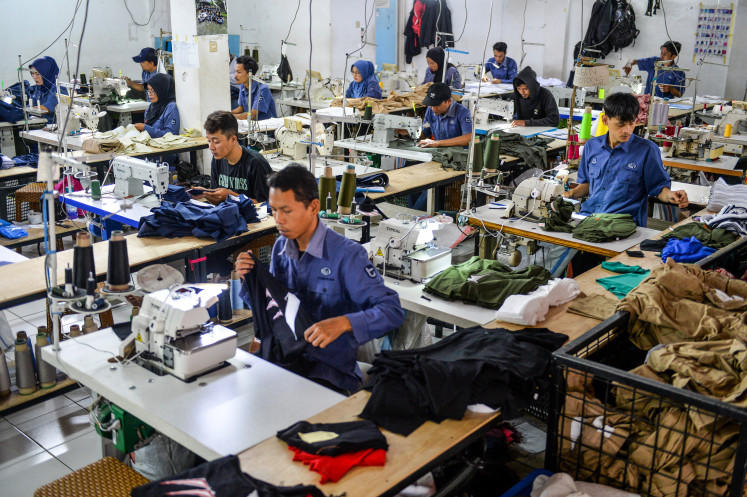
While economic slowdowns test resilience, they also expose inertia, with small and medium enterprises (SMEs) across the region still operating in cash-dominated environments that hold them back.
This dependence on cash has further spotlighted more issues, says Anouska Ladds, Mastercard’s executive vice president of commercial and new payment flows, Asia Pacific.
She outlined some issues cash-centric businesses face on the daily, which include limited understanding of financial tools, poor line of sight into finances and constant exposure to theft and operational inefficiencies.
Capitalizing on cards
She cited a study by the U.S. Bank, which showed that eight in ten small businesses fail due to ineffectively managing their cash flow.

“Even as financial institutions embrace digital and data-driven ways to assess SME credit risk and unlock tailored support in the digital economy, card adoption stands out as a simple yet powerful solution to deliver flexibility, security and control to key processes like vendor payments.”
Mastercard’s “The State of Commercial Card Acceptance 2025” white paper found that businesses that accept cards are 14 percentage points more efficient at maximizing working capital than those who do not. This, Ladds said, is especially critical in volatile economic conditions, where liquidity and responsiveness are essential for resilience.
“Beyond checkout, integrating cards into unified API-driven platforms enables SMEs to automate reconciliation processes, reduce manual errors and gain real-time visibility into cash flow,” he explained.
This is further backed by research, where a white paper by Rydoo estimates that by simply digitalizing the expense process, businesses can save as many as 30,000 hours a year and boost productivity by more than 70 percent.
When progress pays off
For SMEs navigating uncertainty, Ladds said that their first instinct may be to slow down investments in favor of stockpiling.
However, she continues, standing still poses a bigger risk.
Around the world, a robust ecosystem of digital platforms have transformed how SMEs launch, operate and scale their businesses.
In markets like the United States and Chinese mainland, marketplaces have enabled small businesses to reach global customers. Several other platforms have also provided small players with access to financial services, logistics and other capabilities once reserved for large enterprises.
In Indonesia, e-commerce platforms like Shopee, Tokopedia and Lazada have expanded MSME reach across the archipelago while simplifying digital adoption. These platforms enable merchants to accept card payments seamlessly, helping businesses move beyond cash and improve working capital efficiency.
At this stage, modernizing a business’s payments infrastructure can bring critical value during this period of flux, though it can also be a daunting undertaking with plenty of unknowns, a plethora of partners to choose from and murky regulatory complexities to overcome.
According to Ladds, however, the path forward is easy as “A-B-C”, or audit, bridge and checkout.
First, an audit of current payment and reconciliation touchpoints is needed to identify automation opportunities that reduce risk and delays. When done in combination with unified payment platforms with global reach, open APIs and built-in reconciliation tools, business operations can become more focused.
Serving as the bridge to operational excellence and sustained growth, finding the right partner means finding a trusted guide who minimizes risk and recognizes that small steps lead to big changes.
Lastly, the checkout process is the last and often most decisive touchpoint with a customer. In an increasingly digital-first era, a frictionless payment journey boosts conversions and cements loyalty, when every tap, scan or click feels effortless, customers come back.
“Card-based solutions may not be the cure-all, but they can be the catalyst for transforming working capital and operational pain points into competitive advantages. Ultimately, progress does pay off, especially for those who move first,” Ladds concluded.
Visit Mastercard Easy Savings Specials to learn more and take advantage of special savings offers for SMEs.