The Jakarta Post
Please Update your browser
Your browser is out of date, and may not be compatible with our website. A list of the most popular web browsers can be found below.
Just click on the icons to get to the download page.


Popular Reads
Top Results
No results found. Please check your search term and try again
Can't find what you're looking for?
View all search results
Popular Reads
Top Results
No results found. Please check your search term and try again
Can't find what you're looking for?
View all search resultsTrump, nine pharmaceutical companies strike deal to cut prices
Change text size
Gift Premium Articles
to Anyone
Share the best of The Jakarta Post with friends, family, or colleagues. As a subscriber, you can gift 3 to 5 articles each month that anyone can read—no subscription needed!
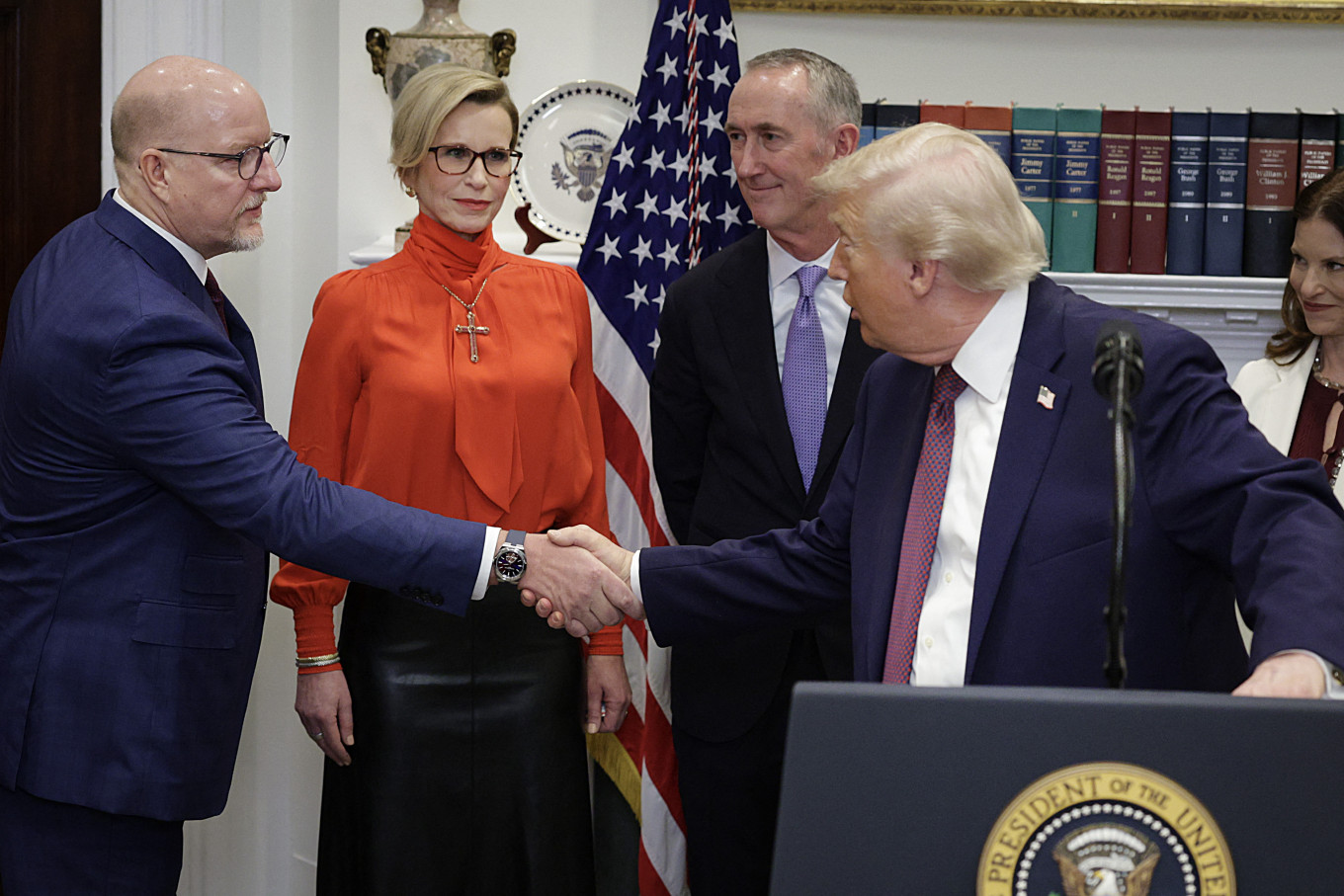 US President Donald Trump shakes hands with Merck CEO Robert Davis (left) during an event in the Roosevelt Room of the White House Dec. 19, 2025, in Washington, DC. Trump delivered remarks on lowering prescription drug prices during the event. (Getty Images via AFP/Alex Wong)
U
S President Donald Trump and nine major pharmaceutical companies on Friday announced deals that will slash the prices of their medicines for the government's Medicaid program and for cash payers, in his latest bid to align US costs with those in other wealthy nations.
Bristol Myers Squibb, Gilead Sciences, Merck and Roche's US unit Genentech have struck deals. Novartis, Amgen, Boehringer Ingelheim, Sanofi and GSK have also signed on.
"We were subsidizing the entire world. We're not doing it anymore," Trump said at a White House press conference, flanked by nine drugmaker executives.
US patients currently pay by far the most for prescription medicines, often nearly three times more than in other developed nations, and Trump has been pressuring drugmakers to lower their prices to what patients pay elsewhere.
Despite the announcements, shares of most of the drugmakers rose about 1 percent to 3 percent as the deals removed Trump's threat of tariffs for three years and investors downplayed the impact of the price cuts the White House said were up to 70 percent off list prices. Companies already give substantial aftermarket discounts on most list prices.
"These deals re-affirm that the pharma leaders have taken this opportunity to collaborate with this administration to deliver headlines and minimize any step-change in company economics from these deals," Bernstein analyst Courtney Breen said, adding that Gilead is likely the largest beneficiary given its Medicaid exposure.

Mehmet Oz, the director of the Centers for Medicare and Medicaid Service, said Regeneron, Johnson & Johnson and AbbVie would visit the White House after the holidays for the launch of the government's TrumpRx website.
All three companies confirmed they were in conversations with the administration.
Under the deals, each drugmaker will cut prices on most drugs sold to the Medicaid program for low-income people, senior administration officials said, promising "massive savings" on widely used medicines.
Analysts have noted that Medicaid, which accounts for only around 10 percent of US drug spending, already benefits from substantial price discounts, exceeding 80 percent in some cases.
Agreements included cutting cash-pay, direct-to-consumer prices of select drugs sold potentially through the TrumpRx.gov website, launching drugs in the US at prices equal to those in other wealthy nations and to increase manufacturing. In return, companies can receive a three-year exemption from any tariffs.
Most Americans with health insurance pay for drugs with set co-pays or co-insurance based on the list price. They may not be helped by TrumpRx, which will direct customers to drugmakers' websites where they will sell their product to cash-pay customers.
Merck said it will sell its diabetes drugs Januvia, Janumet and Janumet XR – set to face generic competition next year – directly to US consumers at about 70 percent off list prices. If approved, its experimental cholesterol drug enlicitide will also be offered through direct-to-consumer channels, including TrumpRx.
Enlicitide is one of two Merck drugs expected to receive a speedy review under the FDA's new, fast-track pathway, Reuters previously reported.
An executive for Bristol Myers said during the White House press conference that the company would provide its blockbuster blood-thinner Eliquis to Medicaid for free as part of its deal.
Amgen said it will add migraine drug Aimovig and arthritis treatment Amjevita to its direct-to-patient program at US$299 a month, which is 60 percent to 80 percent off list.
Sanofi said it will offer lower-cost medicines via TrumpRx and other direct-to-patient platforms, with average savings of about 70 percent on treatments for infections, heart disease and diabetes.
In July, Trump sent letters to leaders of 17 major drugmakers, urging them to offer so-called most-favored-nation prices to Medicaid and ensure new medicines launch at prices no higher than those in other wealthy countries.
Five companies had previously struck deals with the administration to rein in prices – Pfizer, Eli Lilly, AstraZeneca, Novo Nordisk and EMD Serono, the US division of Germany's Merck KGaA. Three – Regeneron, Johnson & Johnson, and AbbVie – are now left.
Investors initially feared sweeping US price controls, but the details of recent deals have largely eased those concerns.
Drugmakers on Friday committed to "most-favored-nation" pricing on all new US drug launches across commercial, government and cash-pay markets, including the US Medicare program for those aged 65 and over, officials said.
A portion of revenues from each company's foreign sales will also be remitted to the US to offset costs, officials said.
The companies pledged together to invest more than $150 billion in US for R&D and manufacturing, according to officials, although it was unclear whether that included earlier commitments. Merck said it chipped in $70 billion of that sum.
Several also agreed to donate drug ingredients to the US strategic reserve, with Bristol saying it will donate more than six tonnes of Eliquis.