The Jakarta Post
Please Update your browser
Your browser is out of date, and may not be compatible with our website. A list of the most popular web browsers can be found below.
Just click on the icons to get to the download page.


Popular Reads
Top Results
No results found. Please check your search term and try again
Can't find what you're looking for?
View all search results
Popular Reads
Top Results
No results found. Please check your search term and try again
Can't find what you're looking for?
View all search resultsConsumption is picking up, stability is yet to follow
The past three years show that Indonesia’s consumption has moved through distinct phases, shaped not only by how much people spend, but by how they choose to spend it.
Change text size
Gift Premium Articles
to Anyone
Share the best of The Jakarta Post with friends, family, or colleagues. As a subscriber, you can gift 3 to 5 articles each month that anyone can read—no subscription needed!
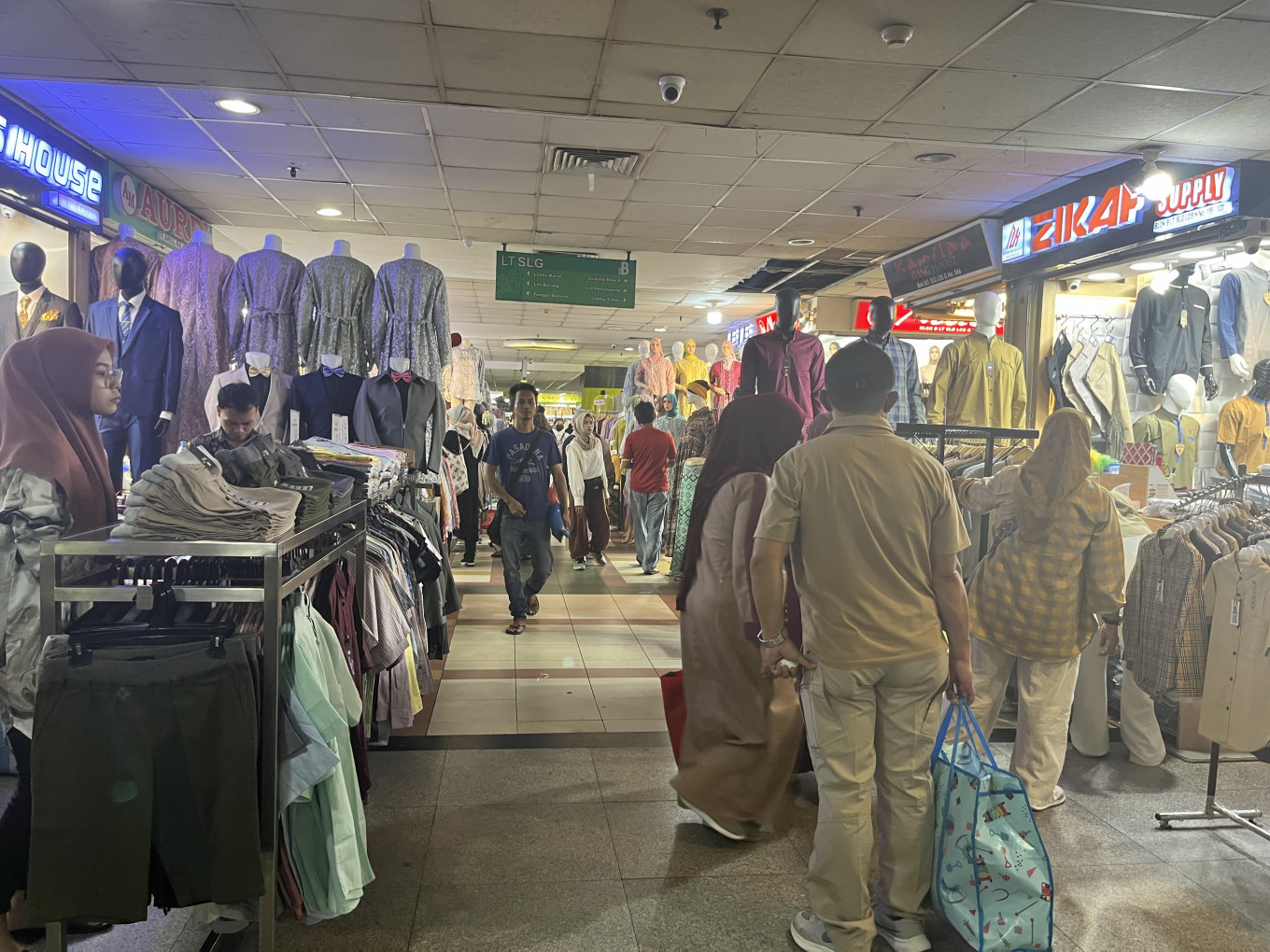 Customers walk on Oct. 10, 2023, through Jakarta's Tanah Abang Market. (JP/Yohana Belinda)
O
n many weekends toward the end of 2025, shopping areas across Jakarta felt busy again. Cafés were full, queues formed at new food stalls and transactions picked up ahead of the year-end holidays. On the surface, it looked like consumption had finally found its footing after a long period of adjustment.
The past three years, however, show that Indonesia’s consumption has moved through distinct phases, shaped not only by how much people spend, but by how they choose to spend it.
In the immediate post-pandemic period of 2022-2023, consumption was driven by pent-up demand. Using the Mandiri Spending Index (MSI) as a leading indicator, spending on durable goods consistently exceeded spending on essentials. The ratio of durable to essential consumption ranged between 1.0 and 1.5. This reflected strong optimism and a willingness to spend beyond basic needs.
Our data moved in line with sentiment data. Bank Indonesia’s Consumer Confidence Index (CCI) recorded average monthly growth of 0.3 percent during this period, suggesting households felt increasingly secure.
That momentum faded in 2024. From early 2024 through the Q3 2025, consumption entered a more cautious phase. Households shifted back to necessities, while discretionary spending softened. The durable-to-essential spending ratio fell to 0.7-0.8.
Consumer sentiment softened as well. Over the same period, BI’s CCI posted average monthly declines of 0.3 percent, alongside weaker income expectations and job outlook.

By late 2025, consumption began to stabilize. In Q4 2025, the ratio moved back to 0.9, supported by year-end festivities and faster government budget disbursements. BI ‘s CCI rose by an average of 3.9 percent month-on-month (mom) in Q4.
The recovery, however, looked different from the post-pandemic surge. Spending resumed, but in a more measured way. Households spent again, yet with clearer limits and tighter control.
As 2026 begins, the sustainability of this recovery remains uncertain. Spending in the first quarter is likely to stay positive, supported by a cluster of festivities including the year-end holidays, Lunar New Year and Ramadan.
Beyond that, support becomes thinner. In the second quarter, the calendar effect will be weaker than in 2025, with fewer public holidays and joint leave days. In the second half of the year, consumption will depend more on school holidays and the pace of government spending. Outside these periods, spending will rely increasingly on fundamentals: income stability, job security and confidence.
Who spends matters as much as how much is spent
MSI shows that consumption today is largely driven by two generations: Millennials and Gen Z. Together, they account for most transactions.
Over the past year, however, their roles have started to shift. Millennials’ share of total spending has gradually edged down, while Gen Z’s has continued to rise. By Q4, Gen Z contributed 24 percent of total spending, up from 19 percent a year earlier, while Millennials still made up just over half.
At first glance, this shift appears healthy. Younger consumers are becoming more active, helping offset moderation elsewhere. But the picture is more fragile beneath the surface. Despite their rising contribution, Gen Z’s purchasing power remains weak. Their average spending per transaction sits at roughly half of the national average in 2025. Spending is frequent, but small.
Labor market conditions help explain this pattern. In 2024, 43 percent of Gen Z workers were in informal jobs, earning on average only about 58 percent of formal-sector wages. Gen Z unemployment reached 13.6 percent, far above the national rate of 4.9 percent.
The pressure is also visible in sentiment indicators. Throughout 2025, BI’s CCI for Gen Z declined by an average of 0.3 percent mom, while the current income index fell by 0.4 percent. Weak jobs and weak current income continue to limit how much this group can spend.
Yet Gen Z sits at the center of Indonesia’s consumption pattern, not because they spend big, but because they spend often. Across major cities, small-ticket purchases have multiplied. Bubble tea kiosks, donut stalls and lifestyle micro-merchants continue to appear and survive in dense urban areas. Their presence signals steady demand. MSI shows Gen Z’s share of transaction frequency rising from 36 percent in Q4 2024 to 41 percent in Q4 2025. Consumption happens in small amounts, but with high repetition.
These purchases are not purely functional. Eating out, trying new brands or owning the latest phone often carries social value. Visibility and identity matter for this generation. The same pattern appears in electronics. Toward the end of 2025, smartphone spending among Gen Z surged, posting triple-digit yoy growth in November.
Spending appetite remains high, but expectations lag behind. Throughout 2025, BI’s income expectation index for Gen Z declined by an average of 0.1 percent mom, while expectations for job availability fell by 0.3 percent. At the same time, exposure to pay-later schemes and digital lending continued to rise. Consumption is still moving, but confidence in future income and employment has yet to follow.
Government efforts also matter. Internship and apprenticeship programs introduced toward the end of 2025 have given more young people a first foothold in the labor market. For many, this means earlier income, work exposure and a smoother transition from school to work. It is not a silver bullet, but it helps at a time when job prospects remain tight.
Consumption is clearly picking up. Younger consumers are spending again and are increasingly visible in everyday activity. The key issue now is stability. Whether this momentum can last into 2026 will depend on steady income growth, better job prospects and stronger confidence. Without that foundation, spending may continue but remain cautious and uneven.
*****
The writer is an analyst at Mandiri Institute