The Jakarta Post
Please Update your browser
Your browser is out of date, and may not be compatible with our website. A list of the most popular web browsers can be found below.
Just click on the icons to get to the download page.


Popular Reads
Top Results
No results found. Please check your search term and try again
Can't find what you're looking for?
View all search results
Popular Reads
Top Results
No results found. Please check your search term and try again
Can't find what you're looking for?
View all search resultsRecovery momentum for Indonesia’s fashion industry
Domestic players must adapt agilely and effectively to a noticeable shift in segment-specific consumer behavior amid weaker purchasing power, whether to more affordable products or reduced spending, including strategic marketing that takes a balanced approach to incorporating both online and offline channels.
Change text size
Gift Premium Articles
to Anyone
Share the best of The Jakarta Post with friends, family, or colleagues. As a subscriber, you can gift 3 to 5 articles each month that anyone can read—no subscription needed!
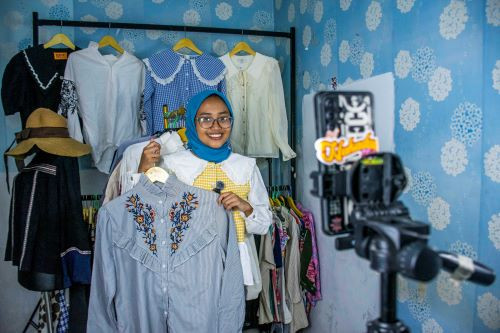 An employee of Studio Nukadua Thrift in Padalarang, West Bandung regency, West Java, promotes women’s blouses via a live stream on Oct. 23, 2024. (Antara/Abdan Syakura)
T
he fashion industry landscape in Indonesia has undergone a significant transformation as weakened purchasing power has prompted consumers to adjust their consumption behavior. Consumption patterns now differ markedly between the upper and middle classes, the latter also including the aspiring middle class.
The fashion spending index, based on the twice yearly National Socioeconomic Survey (Susenas) of Statistics Indonesia (BPS), shows that by 2024, fashion spending among the upper class remained 7.1 points below pre-pandemic levels while the middle-class segment had recovered to 2 points above the baseline.
As spending appetite moderated, purchasing power weakened, so the upper class had limited scope to shift toward cheaper alternatives as a substitute and instead curtailed discretionary spending on high-priced luxury fashion.
In contrast, middle-class consumers had greater flexibility to adjust their consumption patterns, enabling them to trade down to more affordable options such as secondhand clothing and imported apparel. As a result, fashion consumption among this segment proved more resilient.
Reflecting this shift, the import value of used clothing reached Rp 23.82 billion (US$1.4 million) in 2024 and surged further to Rp 25.47 billion by June 2025, exceeding last year’s full-year total. At the same time, Gen Z consumers increasingly sought unique items at affordable prices as part of their shopping experience, a shift that has accelerated the expansion of the thrifting trend.
This shift in consumption patterns has exerted significant pressure on the domestic fashion industry, affecting both large-scale manufacturers and small businesses. The textile and textile products industry recorded average growth of only 1.1 percent year-on-year (yoy) during 2023-2024, far below the 12 percent yoy average growth during the 2018-2019 pre-pandemic period.

According to the Mandiri Business Survey 2025, one in four small and medium enterprises in the industry recorded lower revenues than the previous year and nearly half reported revenue stagnation, pointing to widespread industry pressures.
Recovery momentum
Despite these headwinds, aggregate fashion spending has remained on a broadly positive trajectory.
The Mandiri Spending Index indicates steady growth in fashion consumption throughout 2023-2024. However, this growth has largely benefited imported and secondhand clothing products rather than domestically produced fashion.
Entering 2025, additional challenges emerged as consumer confidence weakened, leading to softer fashion spending in the second quarter of the year. Nevertheless, confidence began to recover in the second half, as reflected in the renewed upward trend in fashion consumption.
This recovery momentum presents an opportunity for domestic fashion industry players to regain consumer interest and strengthen their position in the domestic market.
Recovery is also supported by government efforts to revive the national fashion industry. Through tighter supervision of used clothing imports, particularly illegal inflows, the government aims to protect and revitalize domestic producers. While these measures could create space for local manufacturers to meet existing demand, their effectiveness will depend heavily on appropriate business strategies, especially in pricing and marketing.
Our analysis shows that the 84 percent of national fashion consumption in 2024 originated from the middle-class segment. This segment exhibits high price sensitivity due to lower per-capita spending, and domestic producers must compete on price with the lower-cost alternatives consumers now prefer.
Meanwhile, the upper class accounts for only around 3 percent of total fashion consumption. Although small relative to share, this segment represents a distinct market for premium fashion products with differentiated pricing and designs. Appropriate price segmentation is therefore essential for domestic fashion producers to remain competitive and relevant.
Beyond pricing, marketing strategy is a key element of industry transformation in response to changing consumption patterns. Our analysis shows that Gen Z contributed more than 30 percent of national fashion consumption in 2024. This highlights the importance of understanding the preferences of younger consumers, particularly their emphasis on convenience and shopping experience.
Online shopping has become increasingly attractive due to its ease and accessibility, making it a preferred channel for many consumers. At the same time, in-store shopping experiences continue to provide added value and play a role in influencing purchasing decisions. As such, maintaining a balanced approach that integrates both online and offline channels is essential for capturing the full range of market opportunities.
Government support, combined with improving consumer expectations, provides momentum for the domestic fashion industry. However, this momentum must be accompanied by adaptive business strategies.
Amid pressures on purchasing power, the market is increasingly segmented: The upper-class segment continues to buy luxury fashion, albeit at a slower pace, while the middle-class segment increasingly trades down to more affordable options. In this situation, adjustments in pricing strategies are crucial, supported by targeted marketing efforts across both offline and online platforms.
By responding effectively to these shifts, the domestic fashion industry can enhance resilience and strengthen long-term competitiveness.
*****
The writer is an analyst at the Mandiri Institute.