TheJakartaPost
Please Update your browser
Your browser is out of date, and may not be compatible with our website. A list of the most popular web browsers can be found below.
Just click on the icons to get to the download page.


Popular Reads
Top Results
No results found. Please check your search term and try again
Can't find what you're looking for?
View all search results
Popular Reads
Top Results
No results found. Please check your search term and try again
Can't find what you're looking for?
View all search resultsDollar dismal, yen muted in 2025 but euro and sterling shine
Change text size
Gift Premium Articles
to Anyone
Share the best of The Jakarta Post with friends, family, or colleagues. As a subscriber, you can gift 3 to 5 articles each month that anyone can read—no subscription needed!
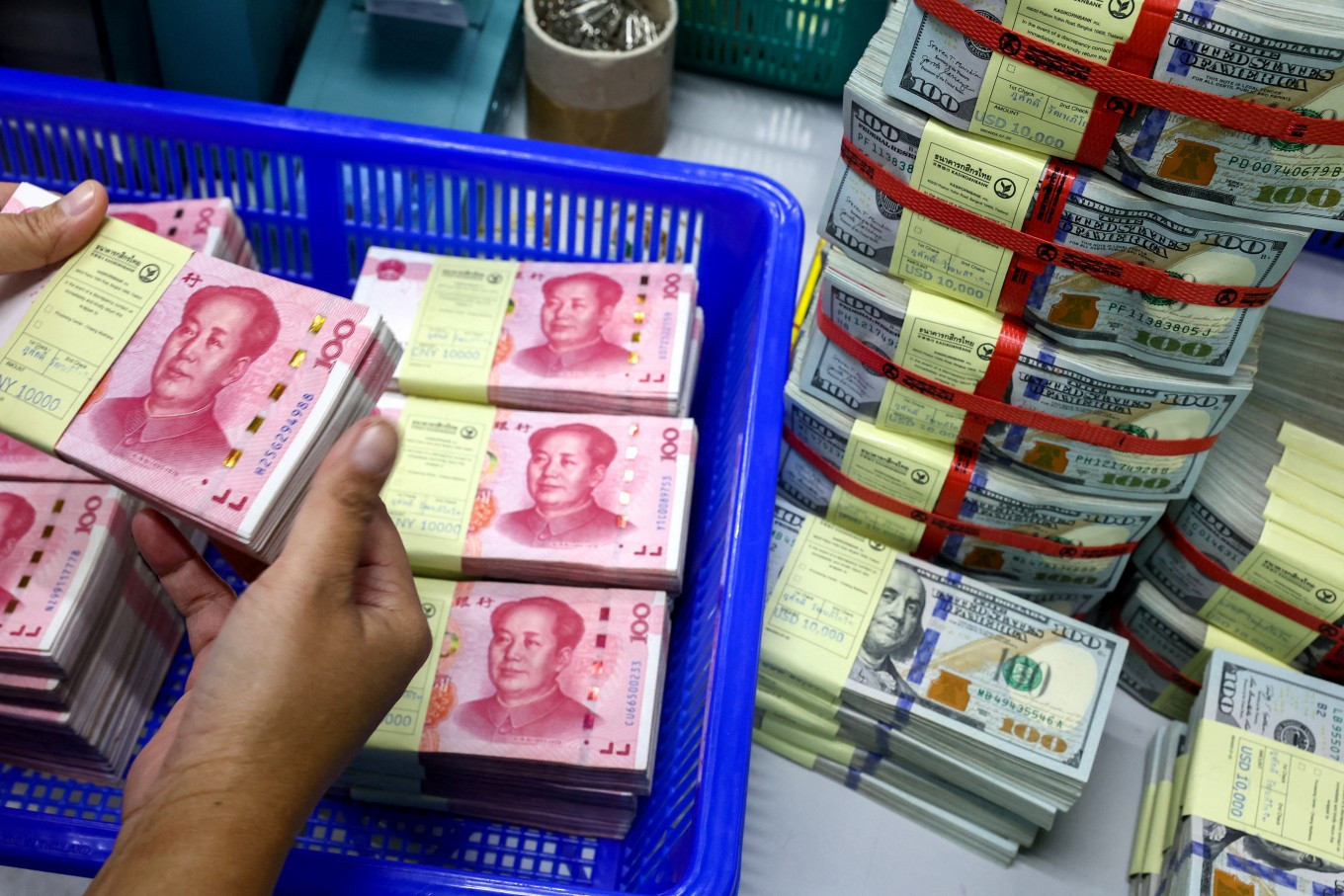 A bank employee counts China's renminbi or yuan notes next to US dollar notes on Jan. 25, 2023, at a Kasikornbank branch in Bangkok. (Reuters/Athit Perawongmetha)
T
he US dollar held steady on Wednesday but was headed for its biggest annual drop since 2017 as interest rate cuts, fiscal worries and erratic trade policies under US President Donald Trump cast a shadow on currency markets in 2025.
Many of those worries are likely to remain in 2026, suggesting the dollar’s dire performance could extend and underpin the behavior of some of its rivals, including the euro and sterling, that have made significant gains this year.
Adding to the dollar's woes, concerns about the Federal Reserve's independence under the Trump administration remain in focus. Trump said he plans to announce his pick for the next Fed chair sometime in January, replacing Jerome Powell whose term ends in May and who has faced constant bashing from the president.
That backdrop has kept the "sell-dollar" trade firmly in place with positioning remaining net-short since April, according to Commodity Futures Trading Commission data.
Japanese markets are closed for the rest of the week, and with most markets closed on Thursday for the New Year's Day holiday, volumes are likely to be razor-thin.
The euro was steady at $1.1747 and the pound last bought $1.3463 on the last trading day of the year. Both are poised for their biggest yearly gains in eight years.

The dollar index, which measures the US currency versus six other major units, was at 98.228, holding onto its overnight gains. The index has declined 9.5 percent in 2025 while the euro gained 13.5 percent and the pound surged 7.6 percent.
Prashant Newnaha, senior Asia-Pacific rates strategist at TD Securities, said the bearish dollar thesis for 2026 remains a well-subscribed view with "short dollars vs EUR and the AUD expected to perform".
The greenback got a bit of a boost in the previous session after minutes of the Fed's December meeting showed deep divisions among policymakers as they cut rates earlier this month.
Traders are pricing in two cuts for 2026, although the central bank itself has projected just one more next year.
Goldman Sachs strategists said the dollar probably will weaken next year against the backdrop of solid global growth, and rate cuts from the Fed with other central banks standing pat.
"But it is probably a much shallower move [...] greater concern around a labor market recession, deeper cuts or a sharp derating in US tech exceptionalism could see a larger move lower," they said in a note.
The dollar's weakness in 2025 has helped push many of the major currencies as well as emerging markets to strong gains for the year.
China's yuan broke through the key psychological level of seven to the dollar on Tuesday for the first time in 2-1/2 years, defying weaker central bank guidance. The currency is on course for a 4 percent increase in the year, its sharpest gain since 2020.
Fragile yen the outlier
The Japanese yen is one of the few currencies that failed to take advantage of the soft dollar in 2025, broadly flat for the year even as the Bank of Japan raised rates twice during the period, once in January and another earlier this month.
On Wednesday, the yen was steady at 156.35 per US dollar, slowly grinding away from the levels that brought intervention worries and severe jawboning from officials in Tokyo.
Investors have been disappointed with the slow and cautious pace of monetary tightening, with the significant long yen position in April completely reversing by the end of the year.
As 2026 unfolds we suspect that the conditions for a retracement back lower in dollar-yen should materialize, said MUFG strategists. "The lower US yields go, the greater the chance that the yen could see its safe-haven status revived."
"If momentum turns, expectations will slowly start to shift, leading to behavioral changes and greater appetite for buying the yen," they said, forecasting the yen to trade at 146 per US dollar by the fourth quarter of 2026.
The risk-sensitive Australian dollar last fetched $0.66965, poised for an over 8 percent surge in the year, its best year since 2020. The New Zealand dollar eased a bit to $0.57875 but was set for a 3.4 percent rise in the year, snapping a four-year losing streak.