TheJakartaPost
Please Update your browser
Your browser is out of date, and may not be compatible with our website. A list of the most popular web browsers can be found below.
Just click on the icons to get to the download page.


Popular Reads
Top Results
No results found. Please check your search term and try again
Can't find what you're looking for?
View all search results
Popular Reads
Top Results
No results found. Please check your search term and try again
Can't find what you're looking for?
View all search resultsBanking sector 2026: Gaining altitude?
Change text size
Gift Premium Articles
to Anyone
Share the best of The Jakarta Post with friends, family, or colleagues. As a subscriber, you can gift 3 to 5 articles each month that anyone can read—no subscription needed!
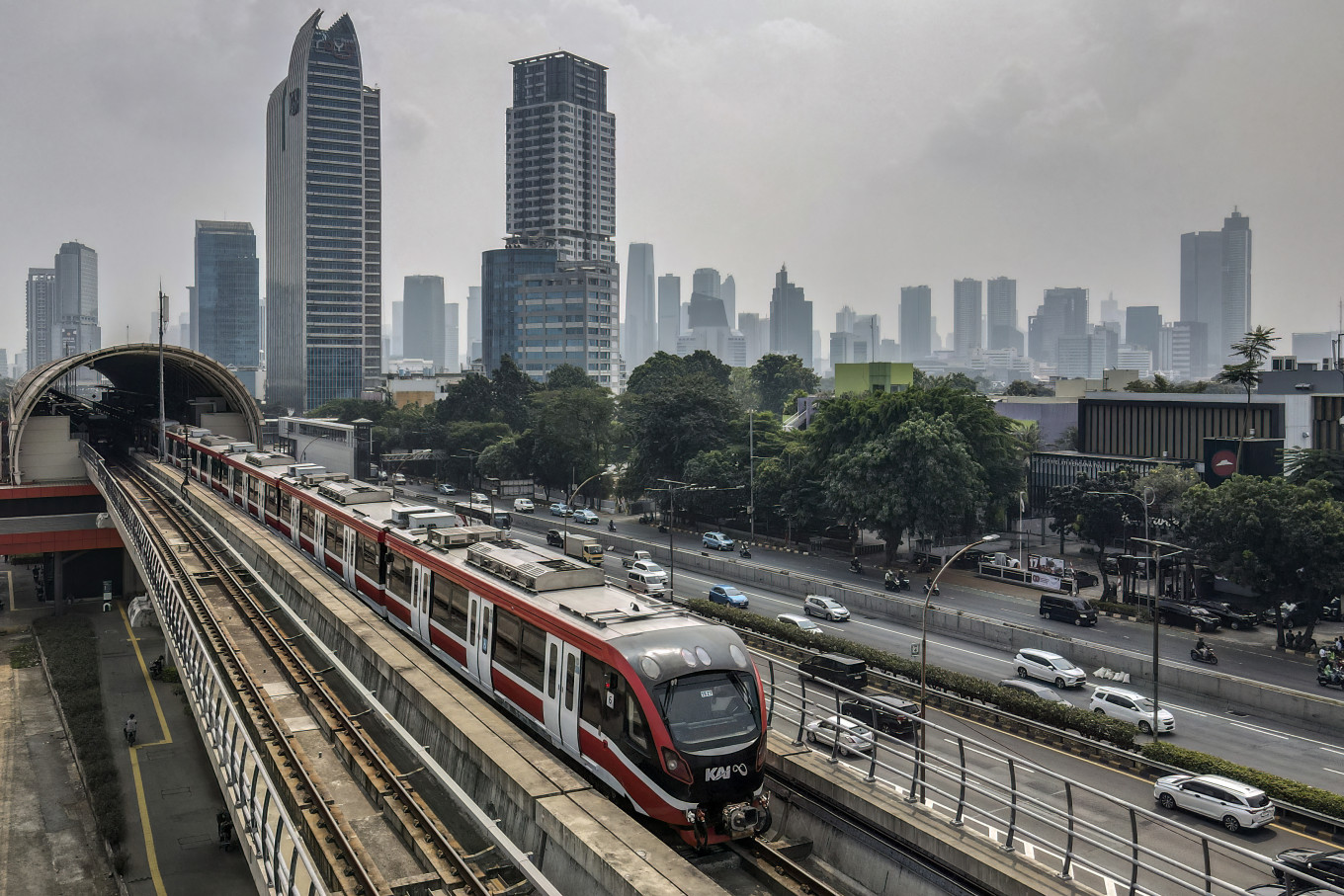 A passenger train runs on an elevated track on Aug. 5, 2025, in Jakarta's central business district. (AFP/Bay Ismoyo)
I
ndonesia’s banking sector had a tough time in 2025 due to several challenges, mostly stemming from weaker domestic demand. A struggling middle-to-low-income class has put pressure on banks from the assets and liability side.
At the beginning of 2025, the banking sector faced noticeable liquidity tightening, primarily driven by fiscal contraction. Realized government spending remained below both the target and historical trends, with budget absorption reaching only about 38.8 percent as of June 2025, compared with an average of 41.3 percent during the 2015–2019 period and 41.5 percent in 2023 and 2024.
This fiscal consolidation was immediately felt in the financial system, particularly through cash flow pressures on corporates and micro, small and medium enterprises (MSMEs) that depend on government spending and public projects, as well as limited creation of new liquidity within the banking system.
This situation intensified competition among banks in raising funds, keeping deposit rates elevated and resulting in uneven and costly liquidity conditions, thereby exerting pressure on the supply side of banking funds.
Meanwhile, despite Indonesia recording a trade surplus, the repatriation of export proceeds (DHE) into the domestic banking system remained suboptimal. As a result, the external surplus was not fully converted into excess liquidity, contributing to persistently high funding costs and keeping the supply of funds tight throughout the first half of 2025.
On the asset side, loan demand also weakened, particularly for working capital loans, which account for the largest share of total credit and are closely linked to consumption and weakening cash flows among MSMEs and households. Working capital loan growth declined sharply from 8.35 percent yoy in 2024 to 2.39 percent yoy by October 2025, while consumer loan growth slowed from 10.61 percent yoy to 7.03 percent yoy.

Income uncertainty, rising living costs and still relatively tight lending rates prompted both businesses and households to adopt a more cautious stance, prioritizing liquidity preservation and internal funding over credit-based expansion.
From the banking perspective, rising risks, particularly in the MSME and consumer segments, reinforced a more selective approach to lending. MSME nonperforming loans (NPLs) increased to around 4.46 percent, while consumer NPLs rose to 2.37 percent. In contrast, corporate asset quality remained relatively well maintained, and aggregate banking sector NPLs stayed manageable at approximately 2.24 percent.
Diverging risk profiles across segments, limited room for loan repricing and funding cost pressures led banks to tighten credit standards and pricing.
Mid-2025 developments
The situation was different in the second half, when banking funding conditions began to improve gradually, supported by stronger corporate profitability and front-loading export strategies that accelerated cash inflows.
Third-party fund growth strengthened in the second half, rising from 4.29 percent in May to 6.96 percent, driven by excess liquidity in the private sector as well as incentives from the government and Bank Indonesia. Overall banking system liquidity remained adequate, as reflected in a decline in the LDR to around 84 percent.
Nevertheless, competition for funding remained intense, keeping deposit rates relatively high and slowing the transmission of policy rate cuts to banking rates. Given the still elevated funding cost structure, banks remained cautious in lowering lending rates to safeguard margins and liquidity stability. In this context, government fund placements through the on-call deposit scheme played an important role in strengthening short-term banking liquidity and enhancing flexibility in liquidity management.
Maintaining the momentum for 2026
Entering 2026, prospects for loan growth and fund mobilization in Indonesia’s banking sector are expected to improve, supported by a more accommodative policy stance. Four key factors are projected to drive credit and funding growth in 2026, namely more timely government spending realization, government programs supporting industrial sectors, recovery of the middle class and household purchasing power and continued fiscal incentives and macroprudential policies targeting MSMEs.
More timely government spending will be a major driver of credit and funding growth in 2026. Accelerated and targeted fiscal disbursement will increase money circulation in the economy, improve corporate cash flows and support growth in demand deposits and savings. From a loan perspective, a more evenly distributed fiscal disbursement profile will provide greater demand certainty, boosting working capital and investment loans, particularly in sectors directly linked to government projects, such as construction, infrastructure, transportation and supporting industries.
The recovery of the middle class will serve as a key pillar in supporting credit and funding growth in 2026. As the primary driver of domestic consumption, strengthening the middle class requires sufficient job creation to lift real incomes. Improved purchasing power will stimulate consumer loan growth, including mortgages, auto loans and multipurpose loans. On the funding side, middle-class recovery will support more stable, low-cost retail deposit growth, as household deposits and demand deposits tend to be more sticky than corporate funds, providing a more sustainable funding base.
Challenges for Indonesia’s banking sector in 2026
The outlook is increasingly constructive, yet structural challenges have not fully subsided. Uneven economic recovery creates an intermediation environment that demands prudence, particularly with respect to loan demand, asset quality and profitability sustainability. Banks are required to navigate this recovery by balancing expansion with sound risk management.
The first major challenge continues to stem from the MSME segment. While MSMEs remain a catalyst for loan growth and a pillar of domestic economic activity, expansion is constrained by thin margins, cost volatility and limited capital capacity. High sensitivity to economic and interest rate fluctuations keeps banks cautious, resulting in MSME loan growth that is more selective and slower than in previous recovery phases.
To promote sustainable MSME loan growth, strengthening the business ecosystem is essential. The Government needs to map industrial zones and economic clusters to better integrate MSMEs into larger supply chains, while encouraging partnerships between MSMEs and large corporations. Such integration will create market certainty, improve cash flows and enhance business scale, thereby lowering MSME risk profiles and making them more attractive to banks.
Risks in consumer lending also warrant close attention. While middle-class purchasing power is recovering gradually, household debt burdens remain relatively high. This could pressure consumer loan quality, particularly in unsecured and mass-market segments.
Amid these challenges, growth opportunities remain as Indonesia’s economic structure shifts. In 2026, economic growth is expected to be increasingly supported by services sectors and higher value-added activities, which will also drive credit demand, particularly for productive lending and domestically oriented financing.
Transportation and warehousing are projected to be the main growth drivers, expanding by around 9.1 percent yoy amid logistics and supply chain recovery, which will lift demand for working capital and investment financing. Information and communication are expected to grow strongly at around 7.8 percent yoy alongside ongoing digitalization, supporting credit demand for digital infrastructure and technology investment, while financial services and insurance are projected to expand by about 6 percent yoy, reinforcing broader credit activity across sectors.
In the next tier, consumption-based sectors, such as wholesale and retail trade, are expected to grow moderately, driving demand for working capital and inventory financing. Accommodation and food services are projected to grow relatively strongly at around 8.4 percent yoy as mobility and consumption recover, increasing demand for operational financing.
In contrast, commodity-based and utility sectors, including mining, electricity and gas, as well as water supply and waste management, are expected to record more moderate growth in the 4–5 percent yoy range, resulting in a more limited contribution to credit demand due to cycle normalization and constrained capacity expansion.
Overall, 2026 represents a balancing phase for Indonesia’s banking sector, capturing growth opportunities in strengthening sectors while maintaining system resilience amid remaining risks. Banks’ ability to manage this transition will be critical to ensuring that intermediation continues to operate optimally and sustainably. We estimate bank loan growth of 9-11 percent yoy in 2026, while third-party funds are expected to grow by 10-12 percent yoy.
***
Andry Asmoro is the chief economist at Bank Mandiri.
Andhi Prasetyo Hadi is an economist at Bank Mandiri.