TheJakartaPost
Please Update your browser
Your browser is out of date, and may not be compatible with our website. A list of the most popular web browsers can be found below.
Just click on the icons to get to the download page.


Popular Reads
Top Results
No results found. Please check your search term and try again
Can't find what you're looking for?
View all search results
Popular Reads
Top Results
No results found. Please check your search term and try again
Can't find what you're looking for?
View all search resultsThousands of Irish farmers protest against EU-Mercosur trade deal
Change text size
Gift Premium Articles
to Anyone
Share the best of The Jakarta Post with friends, family, or colleagues. As a subscriber, you can gift 3 to 5 articles each month that anyone can read—no subscription needed!
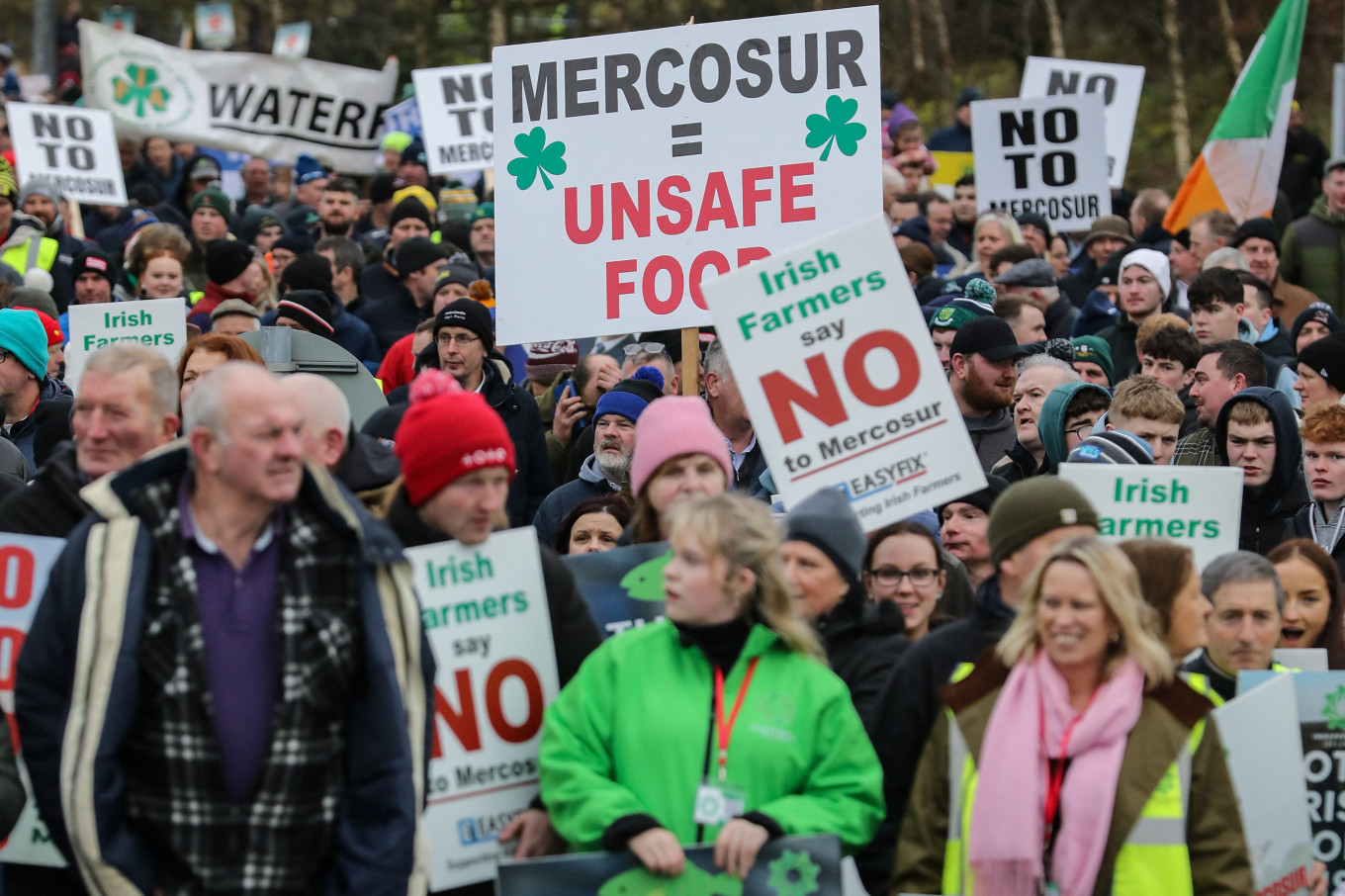 Irish farmers take part in a protest against the EU-Mercosur trade deal, in the town of Athlone on Jan. 10, 2026. Several thousand Irish farmers protested the European Union's trade deal with the South American trade bloc, a day after EU states approved the treaty despite opposition from Ireland and France. (AFP/Gareth Chaney)
T
housands of Irish farmers, many of whom traveled across the country on tractors, protested on Saturday against the European Union's Mercosur trade deal after a majority of EU states gave a provisional go-ahead for its largest ever free-trade accord.
Opponents led by France, the EU's largest agricultural producer, failed to convince enough fellow member states on Friday that the deal with South American nations would flood the market with cheap food products and undercut domestic farmers.
Under pressure from opposition parties, farming groups and members of its own coalition, the Irish government argued the deal lacks safeguards on what it says are weaker food safety standards in South America.
"It's an absolute disgrace on behalf of the farmers and people that have put Europe where it is today," said Joe Keogh, a farmer from the central village of Multyfarnham at the protest in the nearby town of Athlone.
"It's going to close down the whole countryside."
Protesters held placards reading "Don’t sacrifice family farms for German cars", "Our cows follow the rules, why don’t theirs", and "Sell out".

The demonstration, large by Irish standards, followed similar protests in Poland, France and Belgium on Friday.
While Ireland is a small exporting nation that aims to diversify away from its reliance on the US market, it has large beef and dairy industries that are major employers.
Opponents of the deal have secured some concessions and compensation for EU farmers.
The European Parliament must approve the accord before it can take effect, and like France, Ireland has pledged to fight for its rejection in what could be a tight vote.
"The Irish farmer is at great risk as it is. We're a small country, we don't have large farmers and farmers struggle to make an income from the farm as it is," said Niamh O'Brien, a farmer who traveled from the western town of Athenry.
"But also it's about the quality of the food we are eating. It has severe implications for both the farmer and for the consumer."