TheJakartaPost
Please Update your browser
Your browser is out of date, and may not be compatible with our website. A list of the most popular web browsers can be found below.
Just click on the icons to get to the download page.


Popular Reads
Top Results
No results found. Please check your search term and try again
Can't find what you're looking for?
View all search results
Popular Reads
Top Results
No results found. Please check your search term and try again
Can't find what you're looking for?
View all search resultsChina's Q4 GDP growth slows to 3-year low, full-year pace meets official target
Change text size
Gift Premium Articles
to Anyone
Share the best of The Jakarta Post with friends, family, or colleagues. As a subscriber, you can gift 3 to 5 articles each month that anyone can read—no subscription needed!
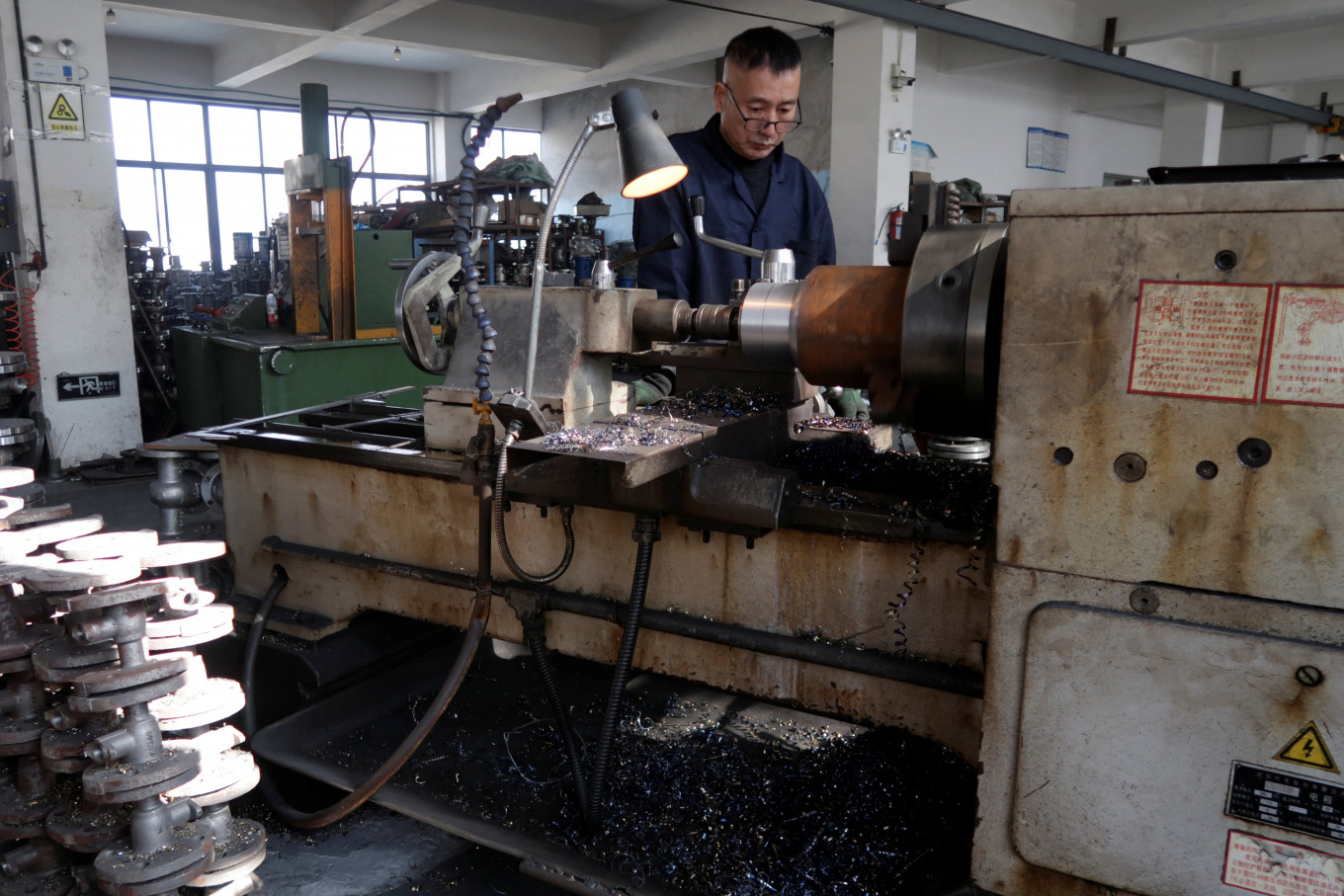 An employee works on the production line manufacturing pipe-fitting valves at a factory in Wenzhou, Zhejiang province, China, on Jan. 14, 2026. (Reuters/Josh Arslan)
C
hina's economic growth slowed to a three-year low in the fourth quarter as domestic demand softened, and while the full-year pace hit Beijing's target, trade tensions and structural imbalances pose significant risks to the outlook.
The world's second-largest economy showed remarkable resilience in 2025, helped by smaller-than-expected US tariff hikes and exporters' efforts to diversify away from the United States, allowing policymakers to keep stimulus to modest levels.
But demand at home further weakened since late last year as confidence has remained low amid a prolonged property crisis.
China's economy grew 4.5 percent in the fourth quarter from a year earlier, data from the National Bureau of Statistics (NBS) showed on Monday, slowing from the third quarter's 4.8 percent pace as consumption and investment dragged.
Analysts polled by Reuters had forecast fourth-quarter gross domestic product (GDP) would expand 4.4 percent from a year earlier. Last quarter's growth was the slowest in three years.
For the whole of 2025, the economy expanded 5.0 percent, meeting the official target of around 5 percent. Analysts had forecast 4.9 percent growth and the economy grew 5.0 percent in 2024.

Headline 2025 growth masks 'uneven momentum'
"Exports and manufacturing did the heavy lifting, while property and parts of domestic demand stayed soft - so the 'headline win' hides uneven momentum," said Charu Chanana, chief investment strategist at Saxo.
"The fourth quarter slowdown is the tell [...] suggesting China enters 2026 with fading momentum, not a fresh upswing."
China's mighty manufacturing machine provided the much-needed economic lift last year. The nation last week reported a record trade surplus of nearly US$1.2 trillion in 2025, driven by booming exports to non-US markets as producers diversified to offset tariff pressure from Washington.
But the reliance on external demand underscores vulnerabilities in China's economy, which is grappling with weak domestic spending amid a prolonged property slump and persistent deflationary strains.
On a quarterly basis, GDP grew 1.2 percent in October-December, compared with a forecast 1.0 percent increase and a 1.1 percent gain in July-September.
China's yuan hit a fresh 32-month high before the data release, and held steady after the publication, trading in a narrow range. The benchmark Shanghai Composite Index shook off brief weakness at the open and climbed as much as 0.6 percent.
Industrial output up in December, retail sales disappoint
China's economic development in 2025 was "hard-won", said Kang Yi, the NBS head on Monday, adding the economy faces problems and challenges including strong supply and weak demand.
For December alone, industrial output rose 5.2 percent from a year earlier, faster than the 4.8 percent pace in November. Retail sales grew only 0.9 percent last month, compared with the 1.3 percent growth in November and analysts' forecast of a 1.2 percent rise.
Fixed asset investment contracted 3.8 percent in 2025, the first annual drop since data became available in 1996.
Property investment slumped 17.2 percent last year.
The 2026 economic outlook is clouded by rising global trade protectionism and by US President Donald Trump's unpredictable economic policies. Trump has threatened to impose a 25 percent tariff on countries that trade with Iran.
Providing an early boost to demand, China's central bank last week cut sector-specific interest rates and kept the door open for further reductions in banks' cash reserve requirements and broader rate cuts.
At an agenda-setting economic meeting in December, Chinese leaders promised to maintain a "proactive" fiscal policy this year to support economic growth, which analysts expect Beijing to target at roughly 5 percent again.
Chinese leaders have also vowed to "significantly" lift household consumption's share of the economy over the next five years, without revealing a specific target.
China's household spending is less than 40 percent of annual economic output, some 20 percentage points below the global average. Analysts say China will need to boost household incomes, which have been slowing, and strengthen its weak social safety net to curb high precautionary savings.
The tepid demand has not been reflected in employment figures with the nationwide urban survey-based jobless rate staying at 5.1 percent in December, unchanged from November.
Falling property prices have also eroded household wealth, adding to the policy challenge.
The World Bank and IMF have long urged China to shift toward consumption-led growth and rely less on investment and exports, warning that the current model poses long-term risks.
Beijing has moved to curb excess industrial capacity and eliminate price wars, but economists say more needs to be done.