TheJakartaPost
Please Update your browser
Your browser is out of date, and may not be compatible with our website. A list of the most popular web browsers can be found below.
Just click on the icons to get to the download page.


Popular Reads
Top Results
No results found. Please check your search term and try again
Can't find what you're looking for?
View all search results
Popular Reads
Top Results
No results found. Please check your search term and try again
Can't find what you're looking for?
View all search resultsSouth Korea economy unexpectedly contracts, but AI boom brightens outlook
Change text size
Gift Premium Articles
to Anyone
Share the best of The Jakarta Post with friends, family, or colleagues. As a subscriber, you can gift 3 to 5 articles each month that anyone can read—no subscription needed!
 Set as preferred source
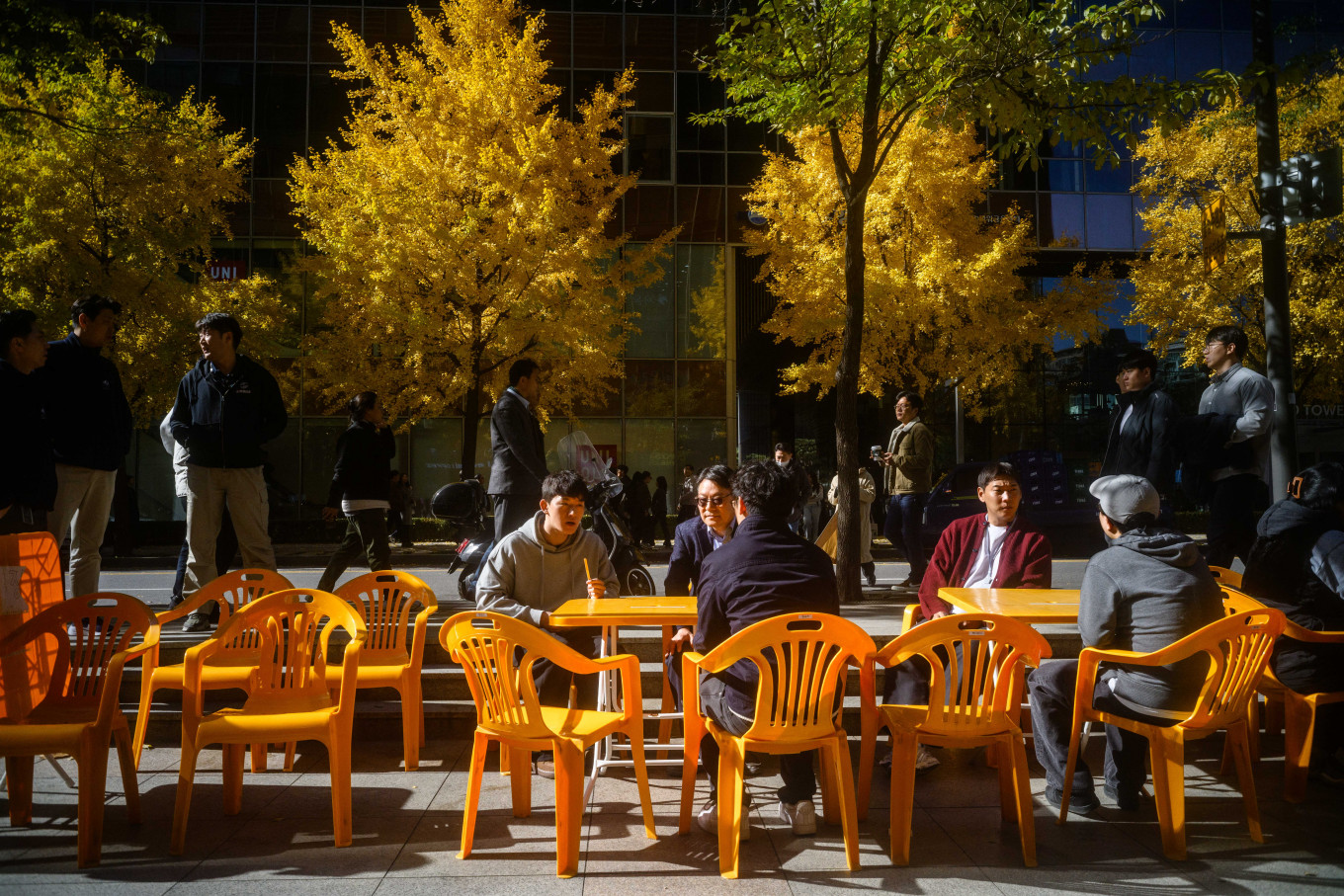 Customers sit at tables along a street as they wait for their orders from nearby cafes in Seoul on Nov. 14, 2025. (AFP/Anthony Wallace)
S
outh Korea's economy unexpectedly shrank in the final quarter of 2025, marking the biggest slump in three years on weaker investment and exports, but the global AI boom is set to improve the outlook and allow the central bank to retain its steady rates stance.
The contraction followed a sharp expansion in the third quarter when the new administration of President Lee Jae Myung rolled out stimulus policies to boost domestic demand.
"The fourth-quarter contraction has not derailed overall growth, and the policy backdrop points toward a cautious central bank," said Dave Chia, an economist at Moody's Analytics, echoing a consensus view for stronger growth this year underpinned by its roaring semiconductor sector.
Gross domestic product decreased 0.3 percent in the October-December period from the preceding three months on a seasonally adjusted basis, advance central bank estimates showed on Thursday, compared with a median 0.1 percent increase tipped in a Reuters poll of economists.
It was the steepest economic contraction since the fourth quarter of 2022, but analysts say the result was largely payback from the previous quarter's growth of 1.3 percent, which was the fastest in almost four years.
"On top of the unfavorable base effect, the pace of recovery in construction investment was weaker than expected, dragging down the growth rate a little more," said Lee Dong-won, director general of the economic statistics department at the Bank of Korea.

Still, domestic investment is seen improving this year as more government infrastructure projects are expected and companies plan to expand semiconductor factories and artificial intelligence investments, Lee said.
Tech demand to keep economy humming
South Korea's stock benchmark topped 5,000 points for the first time in morning trade on Thursday, powered by gains in chipmakers like Samsung Electronics and SK Hynix, a level targeted by President Lee in just over six months since he took office.
Construction investment, down 3.9 percent, was the biggest drag in the last quarter, while facility investment dropped 1.8 percent. Private consumption rose 0.3 percent, after expanding 1.3 percent in the previous quarter on a boost from the government's extra budget.
Exports fell 2.1 percent, hurt by autos and machinery despite a tariff deal with the US that was finalized in November, while imports declined 1.7 percent, resulting in a net negative contribution of 0.2 percentage points.
Asia's fourth-largest economy grew 1.0 percent in 2025, after expanding 2.0 percent in 2024, marking the slowest annual growth since 2020, according to the BOK, which expects the economy to grow 1.8 percent in 2026.
The government expects stronger growth of 2.0 percent this year.
The Bank of Korea last week signaled an end to its current easing cycle after keeping interest rates unchanged, prioritizing foreign exchange stability as it flagged upside risks to this year's economic growth.
"With pressure from a weaker won in focus, rate cuts in early 2026 appear unlikely; easing now could worsen currency depreciation, heighten financial stability risks, and revive inflation pressures," said Chia of Moody's Analytics.
On a year-on-year basis, GDP expanded 1.5 percent in the fourth quarter, after rising 1.8 percent in the third quarter, also missing economists' expectations for a median 1.9 percent increase.
"Growth held up last year on strong semiconductor exports and it is clear that this year will be stronger than last year, but other than the semiconductor sector, there is little momentum on the domestic demand side," said Park Sang-hyun, an economist at iM Securities.