The Jakarta Post
Please Update your browser
Your browser is out of date, and may not be compatible with our website. A list of the most popular web browsers can be found below.
Just click on the icons to get to the download page.


Popular Reads
Top Results
No results found. Please check your search term and try again
Can't find what you're looking for?
View all search results
Popular Reads
Top Results
No results found. Please check your search term and try again
Can't find what you're looking for?
View all search resultsIndonesian markets slide again after Moody's cuts outlook
The benchmark Jakarta Composite Index lost 2.5 percent while the rupiah dropped as much as 0.37 percent to 16,888 per dollar, its lowest since January 22 and down 1 percent for the year.
Change text size
Gift Premium Articles
to Anyone
Share the best of The Jakarta Post with friends, family, or colleagues. As a subscriber, you can gift 3 to 5 articles each month that anyone can read—no subscription needed!
 Set as preferred source
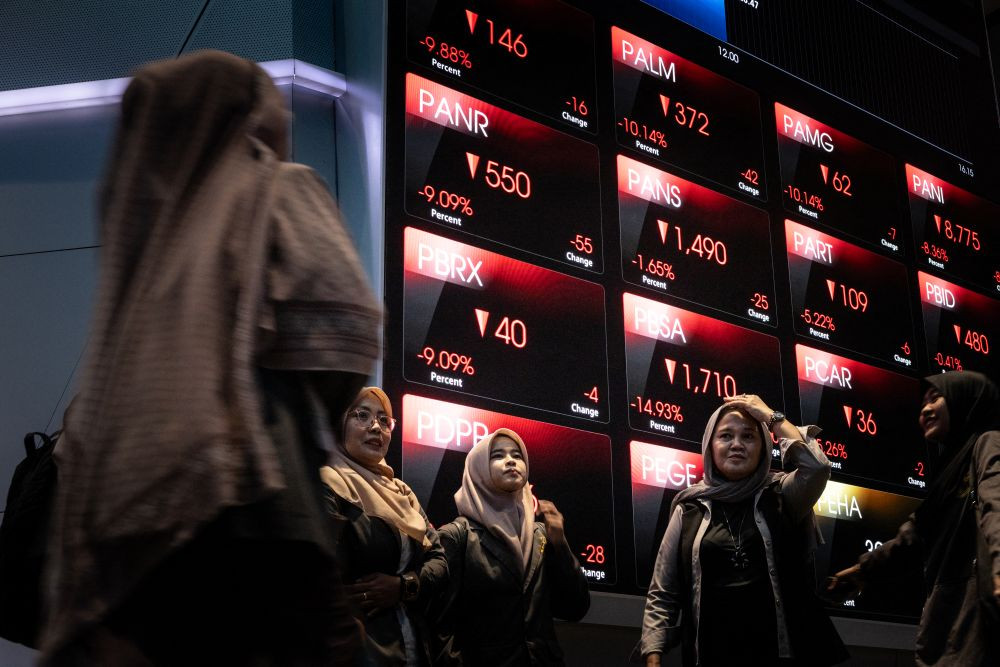 Momentous shot: A group of visitors takes a picture on Jan. 29, 2026 in front of a stock ticker display at the Indonesia Stock Exchange (IDX) in South Jakarta. (AFP/Yasuyoshi Chiba)
I
ndonesia's stocks and currency skidded on Friday after Moody's lowered the country's credit rating outlook, the latest jolt for Southeast Asia's largest economy, wiping about $120 billion off its equity market in a turbulent start to the year.
International investors have reacted nervously to President Prabowo Subianto's attempt to ramp up growth to 8 percent, as concerns over fiscal health and central bank independence cool sentiment on Indonesia.
The benchmark Jakarta Composite Index lost 2.5 percent while the rupiah dropped as much as 0.37 percent to 16,888 per dollar, its lowest since January 22 and down 1 percent for the year.
Stocks have fallen 5 percent for the week so far, after last week's decline of 6.9 percent.
Moody's move to cut the outlook to negative from stable for the $1.4-trillion G20 economy, citing reduced predictability in policymaking, came a week after MSCI flagged transparency issues that triggered the market rout.
The agency also cited concerns about policy effectiveness and signs of weakening governance, which could erode Indonesia's long-established policy credibility if they persist.

Moody's on Friday also cut its outlook for five of the country's biggest banks and seven companies, including its biggest telecoms firm Telkom Indonesia, its cellular provider unit Telkomsel, instant-noodle maker Indofood CBP Sukses Makmur and heavy equipment and mining company United Tractors, due to their sensitivity to a potential decline in the sovereign rating.
The outlook reduction also affected energy firm Pertamina, its upstream unit and miner MIND ID. Telkom, Pertamina, MIND ID and the four banks are state-owned.
Finance Minister Purbaya Yudhi Sadewa brushed off the concerns on Friday, saying Indonesian economic fundamentals were strong, with economic growth accelerating and the fiscal deficit, though swelling, under control.
"There's no strong reason to downgrade," Purbaya told reporters, adding that fiscal policy was on track to boost growth.
"On the flip side, we should slowly see prospects for an upgrade. Maybe by year-end, when our economic growth is 6 percent or more."
[RA::2025 GDP growth misses target;;/business/2026/02/05/2025-gdp-growth-misses-target.html?utm_source=(direct)&utm_medium=home_headlines]
Prabowo's year-old sovereign wealth fund Danantara Indonesia, his main vehicle to push growth, said Moody's outlook cut "a constructive reminder to strengthen our institutional foundations".
Moody's said that without sufficient policy coordination and cohesiveness, Danantara's establishment raised risks to policy credibility and potential contingent liability for the government.
In a statement, Danantara chief Rosan Roeslani said the fund was still in an institution-building phase and would follow global best practices.
"The Moody's outlook downgrade is a warning shot, which could trigger other ratings agencies to follow suit, particularly if the nature of policymaking remains subject to a heightened degree of uncertainty," OCBC economists said.
Authorities' responses to avert a rating downgrade would be watched closely over the next year or more, they added in a note.
Indonesia's dollar bonds stayed under pressure, though they recouped some small losses from Thursday. The yield on 10-year benchmark bonds was little changed at 6.317 percent, LSEG data showed.
The country's five-year credit default swap spread, or the cost of insuring against a default, climbed to a 15-month high.
"The main potential impact on Indonesian markets is a higher risk premium across asset classes," said Rully Arya Wisnubroto, a market analyst at Mirae Asset Sekuritas Indonesia.
This would put pressure on long-term government bonds, state companies' and major banks' stocks, as well as sentiment toward the rupiah and capital flows, he added.
Moody's Baa2 rating for Indonesia puts the sovereign at the second-lowest tier of investment grade.
The two other major agencies, S&P Global Ratings and Fitch Ratings, currently rate Indonesia similarly, both with a "stable" outlook. They have yet to issue reviews this year.
"Recent volatility in Indonesian stock prices have not materially affected our views on the sovereign ratings," Rain Yin, a sovereign analyst at S&P, told Reuters in an emailed response.
Yin, however, cautioned that fiscal deterioration could exert more downward pressure on S&P's rating in the absence of offsetting improvements.
Read also: Manufacturing PMI climbs on rising domestic demand
Fitch did not immediately respond to a request for comment.
Official's vows for changes and the resignations of five top officials of the financial regulator and stock exchange have failed to stabilize the market.
Foreigners have already dumped about $860 million worth of shares in net terms since last Wednesday, exchange data showed, versus $1 billion in sales for the whole of 2025.