The Jakarta Post
Please Update your browser
Your browser is out of date, and may not be compatible with our website. A list of the most popular web browsers can be found below.
Just click on the icons to get to the download page.


Popular Reads
Top Results
No results found. Please check your search term and try again
Can't find what you're looking for?
View all search results
Popular Reads
Top Results
No results found. Please check your search term and try again
Can't find what you're looking for?
View all search resultsStocks dive, silver and cryptos look for cover after rout
Change text size
Gift Premium Articles
to Anyone
Share the best of The Jakarta Post with friends, family, or colleagues. As a subscriber, you can gift 3 to 5 articles each month that anyone can read—no subscription needed!
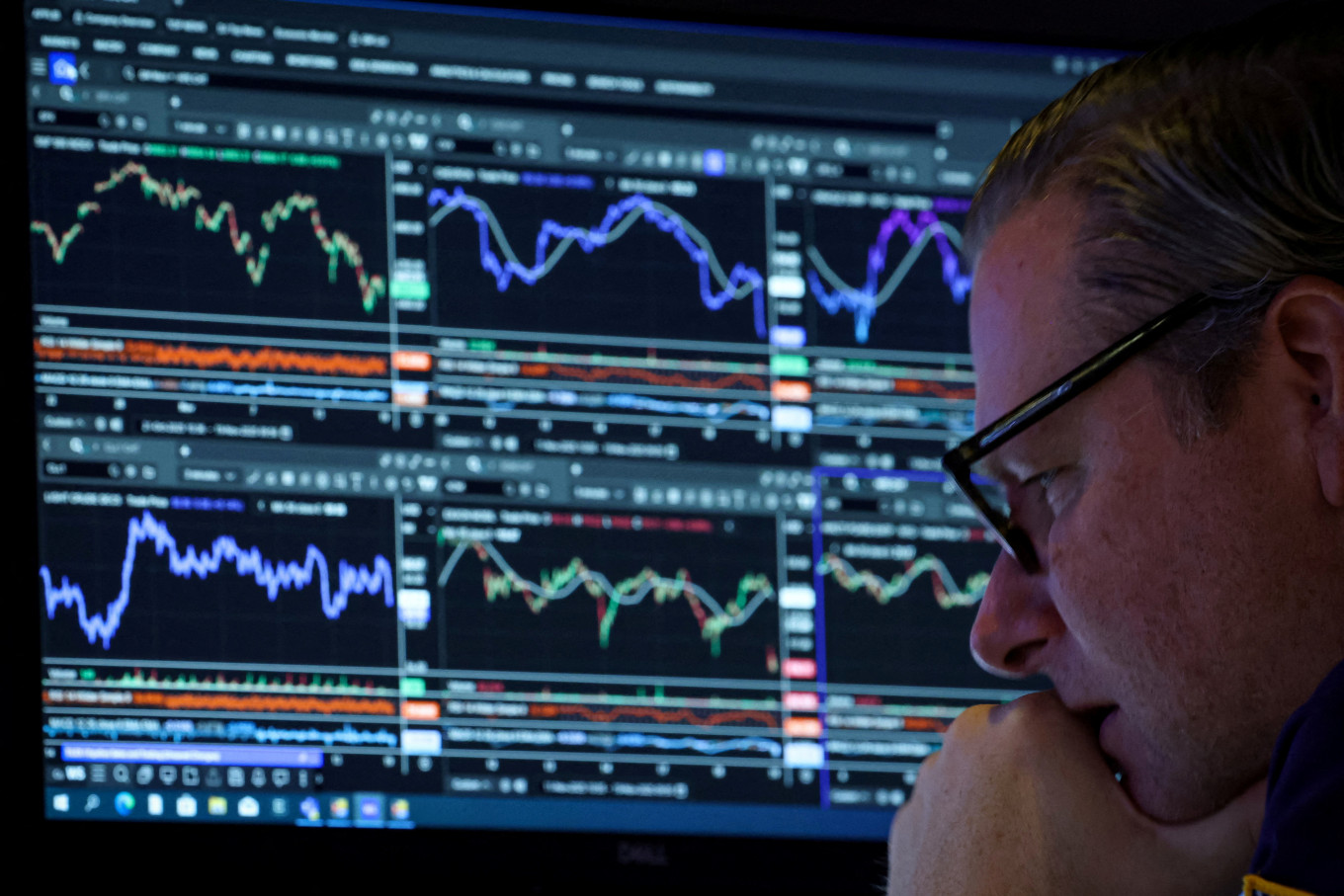 A trader works inside a booth on the floor at the New York Stock Exchange (NYSE) in New York City, US, on Nov. 19, 2025. (Reuters/Brendan McDermid)
G
lobal stocks extended losses into a third day on Friday as a selloff on Wall Street intensified, leaving investors dazed as wrenching volatility gripped precious metals and cryptocurrencies.
The MSCI All-Country World Index was down 0.1 percent, rallying off intrasession lows but still on track for its worst week since mid-November.
MSCI's broadest index of Asia-Pacific shares outside Japan tumbled 0.8 percent to head for a second straight day of losses. S&P 500 e-mini futures slid 0.3 percent and Nasdaq e-mini futures fell 0.5 percent.
"There's a massive rotation that's going on, and Nasdaq is clearly underperforming the S&P and things like boring consumer staple stocks," said Prashant Bhayani, chief investment officer for Asia at BNP Paribas Wealth Management. "The market is starting to say 'ok, yeah, AI is very interesting', but people are also saying 'What is my payback?'"
Stocks on Wall Street sold off on Thursday for a third straight day on fears that new AI models may start to eat into the profits of software firms, with the S&P 500 turning negative for the year as fears around the labor market grew.
Layoffs announced by US employers surged in January to the highest level for the month in 17 years, a survey from global outplacement firm Challenger, Gray & Christmas showed on Thursday.

Cryptocurrency markets managed to staunch a bruising selloff for now after a $2 trillion wipeout on Thursday, with bitcoin jumping 2.4 percent to $64,642.09 after earlier falling as much as 4.9 percent to a low of $60,008.52. Ether was last up 3 percent at $1,901.54, partially recouping a 5.1 percent decline.
Precious metals were also looking to regain their footing after sharp falls, with silver clawing back a 0.5 percent gain to $71.61 having plunged as much as 10 percent. Gold was up 0.9 percent at $4,815.19 after an earlier decline of 2.4 percent.
China's UBS SDIC Silver Futures fund 161226.SZ, which has recently emerged as an important marker of the rout in precious metals, was suspended for an hour at the start of trading to protect investors after falling by its maximum 10 percent for several days. The fund promptly fell by the same magnitude when it reopened on Friday.
"You've seen a lot of these big crowded positions being unwound very, very aggressively and that's led to massive flows," said Chris Weston, head of research at Pepperstone Group in Melbourne.
"We're getting to a stage where we could see, later this year, casualties," he added.
"Certain businesses - not the Mag7 - but for some of the smaller businesses, the capital markets may not be so kind," he said, referring to the so-called Magnificent Seven mega-cap technology stocks.
The S&P 500 software and services index dropped 4.6 percent, having shed about $1 trillion in market value since January 28, in a selloff dubbed "software-mageddon."
Amazon shares tumbled 11.5 percent in after-hours trading on Thursday after it projected a surge of more than 50 percent in capital expenditures this year.
Asian stocks were volatile, with some investors seemingly looking for cheaper entry points amid the broad losses. An initial 5 percent dive for South Korea's Kospi, which triggered a brief trading halt, was pared to 2.3 percent by midday.
Japanese stocks rose, with the Nikkei 225 up 0.3 percent, while China's Shanghai Composite eked out a 0.1 percent increase.
Indonesian stocks opened 2 percent lower after Moody's lowered its outlook on the country's credit rating, citing reduced predictability in policymaking days after MSCI flagged transparency issues that triggered a market rout of more than $80 billion.
On the US monetary policy front, the market is starting to bet on an increased likelihood of a rate cut by the Federal Reserve at its next meeting, though most still expect it to remain on hold.
Fed funds futures are pricing a 22.7 percent probability of a 25-basis-point cut at the two-day meeting that ends on March 18, compared with a 9.4 percent chance a day earlier, according to the CME Group's FedWatch tool.
The US dollar index, which measures the greenback's strength against a basket of six currencies, was flat at 97.92. The yield on the US 10-year Treasury bond fell 2.8 basis points to 4.18 percent.
The yen rallied 0.2 percent to 156.75 against the dollar and Japanese government bonds attracted buyers across the curve ahead of Sunday's election.
In energy markets, Brent crude edged up 0.2 percent to $67.71.