The Jakarta Post
Please Update your browser
Your browser is out of date, and may not be compatible with our website. A list of the most popular web browsers can be found below.
Just click on the icons to get to the download page.


Popular Reads
Top Results
No results found. Please check your search term and try again
Can't find what you're looking for?
View all search results
Popular Reads
Top Results
No results found. Please check your search term and try again
Can't find what you're looking for?
View all search resultsJapan's economy limps back to scant growth in Q4, raises test for Takaichi
Change text size
Gift Premium Articles
to Anyone
Share the best of The Jakarta Post with friends, family, or colleagues. As a subscriber, you can gift 3 to 5 articles each month that anyone can read—no subscription needed!
 Set as preferred source
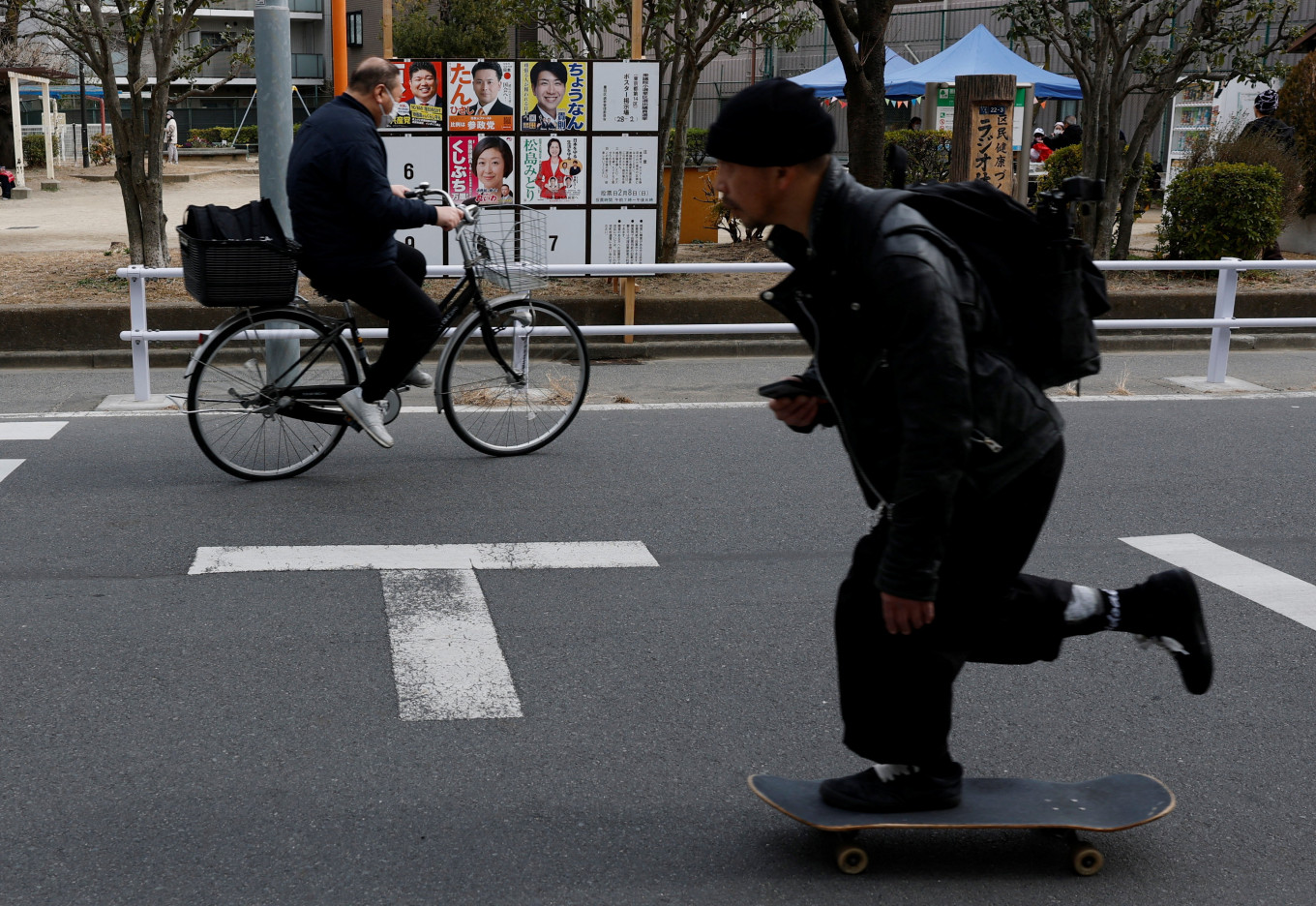 A man on a skateboard crosses a street as a cyclist rides past election campaign posters for the Feb. 8 snap election, displayed on a board in Tokyo on Feb. 6, 2026. (Reuters/Kim Kyung-Hoon)
J
apan's economy limped back to meager growth in the fourth quarter, significantly missing market expectations in a key test for Prime Minister Sanae Takaichi's government as cost-of-living pressures drag on confidence and domestic demand.
Fresh off a sweeping election victory, Takaichi's administration is preparing to ramp up investment through targeted public spending in sectors seen as vital to economic security.
Monday's data bring sharp focus to the challenge at hand for policymakers at a time when the Bank of Japan has reiterated its pledge to keep raising interest rates and normalize monetary settings from years of ultra-low borrowing costs.
"It shows that the economy's recovery momentum is not very strong," Meiji Yasuda Research Institute economist Kazutaka Maeda said. "Consumption, capital expenditure and exports - areas we hoped would drive the economy - just haven't been as strong as we expected."
Gross domestic product in the world's fourth-largest economy increased an annualized 0.2 percent in the October-December quarter, government data showed, well short of a median market estimate of a 1.6 percent gain in a Reuters poll. It barely scraped back to growth from a larger revised 2.6 percent contraction in the previous quarter.
The reading translates into a quarterly rise of 0.1 percent, also weaker than the median estimate of a 0.4 percent uptick.

Economists project Japan will continue to expand at a gradual pace in coming months, though the fourth quarter's weak outcome suggests the economy might struggle to fire on all cylinders.
"Whether the economy can achieve sustainable growth really depends on whether real wages can firmly return to positive growth," Shinichiro Kobayashi, principal economist at Mitsubishi UFJ Research and Consulting, said. "In that sense, the key will be the outcome of this year's wage negotiations in the coming months."
A survey this month by the Japan Center for Economic Research showed 38 economists forecast an average annualized growth of 1.04 percent in the first quarter and 1.12 percent in the second quarter this year.
Kobayashi said the GDP report is unlikely to affect the Bank of Japan's monetary policy decisions. "Rather than this rate hike causing the economy to stall, the BOJ's focus is likely to be on how to contain inflation," he said.
Private consumption, which accounts for more than half of economic output, rose 0.1 percent in October-December, matching market estimates.
It cooled from the 0.4 percent rise in the previous quarter, indicating that persistently high food costs remain a drag on household spending.
Capital spending, a key driver of private demand-led growth, also rose at a slow pace of 0.2 percent in the fourth quarter, versus a rise of 0.8 percent in the Reuters poll.
Net external demand, or exports minus imports, contributed nothing to growth, versus a 0.3 point drag in the July-September period.
Exports posted a milder drop after the United States formalized a baseline 15 percent tariff on nearly all Japanese imports, down from 27.5 percent on autos and initially threatened 25 percent on most other goods.
"The impact of tariffs appears to have peaked in July-September, but judging from the latest results, there is at least some possibility that firms will continue to take a somewhat cautious stance going forward," Meiji Yasuda's Maeda said.