The Jakarta Post
Please Update your browser
Your browser is out of date, and may not be compatible with our website. A list of the most popular web browsers can be found below.
Just click on the icons to get to the download page.


Popular Reads
Top Results
No results found. Please check your search term and try again
Can't find what you're looking for?
View all search results
Popular Reads
Top Results
No results found. Please check your search term and try again
Can't find what you're looking for?
View all search resultsTrump to travel to China next month with US trade policy in focus
Trump's talks with Chinese President Xi Jinping on an extended visit to Beijing had been expected to revolve around extending a trade truce that kept both countries from further hiking tariffs.
Change text size
Gift Premium Articles
to Anyone
Share the best of The Jakarta Post with friends, family, or colleagues. As a subscriber, you can gift 3 to 5 articles each month that anyone can read—no subscription needed!
 Set as preferred source
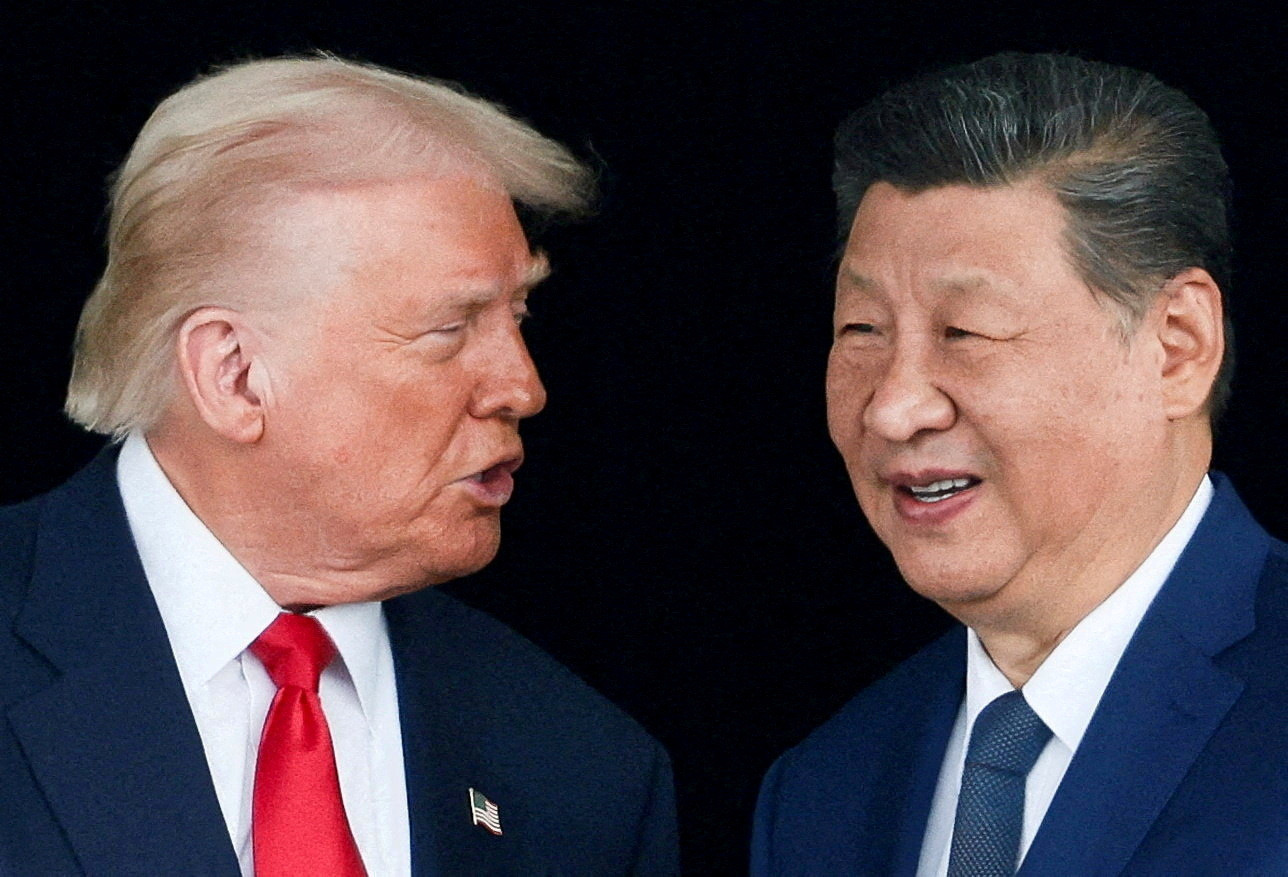 United States President Donald Trump and Chinese President Xi Jinping talk as they leave after a bilateral meeting on the sidelines of the Asia-Pacific Economic Cooperation (APEC) summit in Busan, South Korea, on Oct. 30, 2025. (Reuters/Evelyn Hockstein)
U
nited States President Donald Trump will travel to China from March 31 to April 2 for a highly anticipated meeting between the leaders of the world's two biggest economies, a trip announced as the Supreme Court overturned Trump's sweeping tariffs against imported goods.
A White House official confirmed the trip on Friday, just before the highest US court dealt Trump a stinging defeat by striking down many of the tariffs he has used in a global trade war, including some against rival China.
Trump's talks with Chinese President Xi Jinping on an extended visit to Beijing had been expected to revolve around extending a trade truce that kept both countries from further hiking tariffs.
But the Supreme Court's reversal created new questions for tense US-China relations that had recently stabilized after Trump trimmed tariffs on China in exchange for measures from Beijing, including cracking down on the illicit fentanyl trade and pausing export restrictions on critical minerals.
Twenty-percent tariffs on China's US-bound exports were imposed under the International Emergency Economic Powers Act (IEEPA) which the Supreme Court ruled Trump had overstepped. Those tariffs were tied to national emergencies related to fentanyl distribution and trade imbalances.
Other duties on Chinese goods, including those implemented under legislated trade authorities, known as Section 301 and Section 232, remain in place.

It was not immediately clear how many of the tariffs Trump would restore, but he said at a press conference that he would impose a new 10 percent global tariff for 150 days.
Trump's last trip to China in 2017 was the most recent by a US president.
"That's going to be a wild one," Trump told foreign leaders visiting Washington on Thursday about the upcoming China visit. "We have to put on the biggest display you've ever had in the history of China."
The Chinese embassy in Washington did not respond to a request for comment. Beijing has not confirmed the trip.
National emergency
The Trump administration has said the global tariffs were necessary because of national emergencies related to trade imbalances that have weakened US manufacturing.
Trump had already been "playing defense" in the trade war, given the effectiveness of Beijing's threat to cut off rare earths, said Scott Kennedy, a China economics expert at the Center for Strategic and International Studies in Washington. The tariff defeat likely "cements his weakness in their eyes," he said.
"They [Chinese officials] like the direction of travel of the bilateral relationship in which the US is diminished and they want to keep things from re-escalating," Kennedy said.
The visit would be the leaders' first in-person talks since an October meeting in South Korea, where they agreed on the trade truce.
While the October meeting largely sidestepped the sensitive issue of Taiwan, Xi raised US arms sales to the island when the two leaders spoke this month.
Washington announced its largest-ever arms sale approval with Taiwan in December, including $11.1 billion in weapons that could ostensibly be used to defend against a Chinese attack. Taiwan expects more such sales.
China views Taiwan as its own territory, a position Taipei rejects. The US, bound by law to provide Taiwan with the means to defend itself, has formal diplomatic ties with China, but it maintains unofficial ties with Taiwan and is the island's most important arms supplier.
Xi also said during the February call that he would consider further increasing soybean purchases, according to Trump. Struggling US farmers are a major political constituency for Trump, and China is the top soybean consumer.
Although Trump has justified several hawkish policy steps from Canada to Greenland and Venezuela as necessary to thwart China, he has eased policy toward Beijing in the past several months in areas from tariffs to advanced computer chips and drones.
The global trade war Trump initiated after he began his second term as president in January 2025 has alienated other trading partners, including allies.
Critics had argued that imposing steep tariffs on countries across the board actually insulated Beijing from the tariff barrage and reduced incentives to move supply chains out of China.
Friday's ruling could indirectly increase pressure on Beijing if the effective tariff rates on other countries, particularly in Southeast Asia, fall more than on China, said Martin Chorzempa, a senior fellow at the Peterson Institute of International Economics.
"Unlike with many other countries, there is a well-established, much more legally durable mechanism for most of the tariffs on China that make them less affected than those on other countries," Chorzempa said.